Outreach Services SEND Local Offer
Outreach services have been developed to support the inclusion of pupils with a range of needs in all Torbay schools, including special schools and provisions.

Highlight to listen
Outreach services have been developed to support the inclusion of pupils with a range of needs in all Torbay schools, including special schools and provisions.


Mayfield School also offer training courses and professional development services.
This Guidance has been produced by Torbay LA. This guide is designed to provide information, responsibilities and guidance for SENDCOs and support SENDCOs in understanding the EHC Team’s shared vision, structure, and daily operations from September 2025 onwards.

All educational establishments (nurseries and pre-schools, schools and colleges) must have arrangements in place to identify SEND.

The SEND Code of Practice 2015 states,
All schools should have a clear approach to identifying learners with SEN. The benefits of early identification are widely recognised – identifying need at the earliest point and then making effective provision improves long-term outcomes for the child or young person. (SEND CoP 6.14)
Parents know their children best, and it is important that all professionals listen and understand when parents/carers express concerns about their child’s development. They should also listen to and address any concerns raised by children and young people themselves. (SEND CoP 5.5 & 6.20)
Slow progress and low attainment do not necessarily mean that a child has SEN and should not automatically lead to a pupil being recorded as having SEN. However, they may be an indicator of a range of learning difficulties or disabilities. Equally, it should not be assumed that attainment in line with chronological age means that there is no learning difficulty or disability present. Some learning difficulties and disabilities occur across the range of cognitive ability and, left unaddressed may lead to frustration, which may manifest itself as disaffection, emotional or behavioural difficulties. (SEND CoP 6.23)
This process should include:
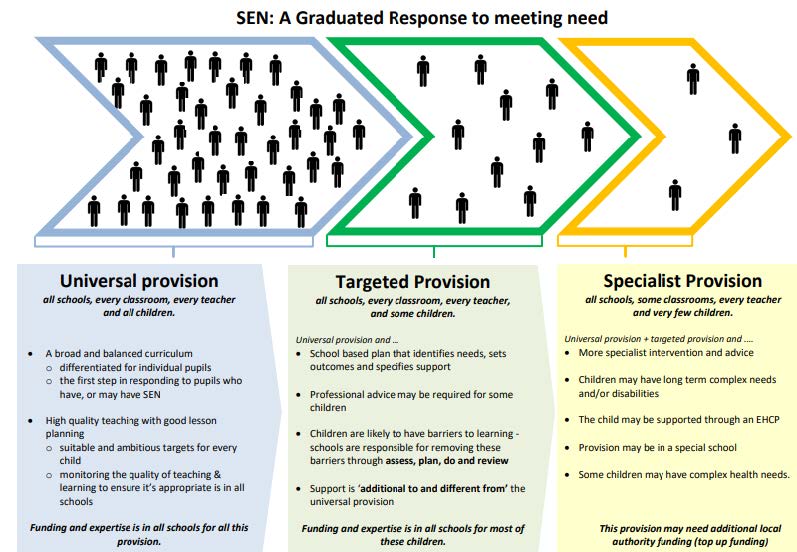
The Graduated Response, or Graduated Approach, is the process which must be carried out when there are concerns about a possible special educational need.
Torbay’s Graduated Response toolkits have been developed to ensure all partners work together to get the “right support in the right place at the right time” by the right people for every child or young person with special educational needs and disabilities.
Find out more about the following age specific Torbay Graduated Response toolkits:
A SEND Support and Provision Toolkit for young people aged 19 – 25 is currently in the process of being developed and will be coming soon.
Health professionals have a duty to tell the local authority if they believe a child under school age has, or is likely to have, special educational needs or a disability (SEND).
Usually, this notification is made by any Health professional, who must in the first instance:
As part of the Section 23, Health professionals will share information about the named child. The local authority will respond to the notification, and act upon the shared information.
“A child or young person has special educational needs if they have a learning difficulty or disability which calls for special educational provision to be made for them.”
SEND Code of Practice 2015, Introduction xiii
Special educational needs and disabilities (SEND) can affect a child or young person’s ability to learn. They can affect their:
This duty is Section 23 of the Children and Families Act 2014 Children and Families Act 2014. Section 23 Duty of health bodies to bring certain children to local authority’s attention.
(1) This section applies where, in the course of exercising functions in relation to a child who is under compulsory school age, a clinical commissioning group, NHS trust or NHS foundation trust form the opinion that the child has (or probably has) special educational needs or a disability.
(2) The group or trust must —
(a) inform the child’s parent of their opinion and of their duty under subsection (3), and
(b) give the child’s parent an opportunity to discuss their opinion with an officer of the group or trust.
(3) The group or trust must then bring their opinion to the attention of the appropriate local authority in England.
(4) If the group or trust think a particular voluntary organisation is likely to be able to give the parent advice or assistance in connection with any special educational needs or disability the child may have, they must inform the parent of that.
Children & Families Act 2014, Section 23
The progress of all groups of children has been a prominent issue for all schools since the introduction of the 2012 Ofsted inspection framework. Parents also want to see evidence of progress.
The issue of showing progress is particularly challenging for children with special educational needs and disabilities (SEND) as they tend to make progress in very individual ways, and sometimes in very small increments. The challenge is therefore how to demonstrate both how and why progress is taking place.
Measuring progress for students with special educational needs and disabilities requires a personalised holistic and flexible approach. Traditional academic benchmarks may not always be appropriate, so alternative methods should be used to track their development effectively.
How might this be achieved?
Individualised Education Plans should measure progress towards short term outcomes, and these should be reviewed on at least a termly basis. If a student is receiving SEN support or has an EHCP then they should have an IEP to measure progress against short term targets.
EHCP outcomes in most cases will be longer term outcomes that should be achievable by the end of a key stage or phase of education. Usually there will be an IEP or implementation plan that breaks down the longer-term outcomes into shorter achievable targets.
It is reasonable to expect that schools and settings should undertake baseline assessments at the start of any interventions, as this will enable staff to measure the impact of an individualised or group-based intervention.
Many schools use ongoing formative assessments, particularly in literacy and numeracy, to track progress and to provide feedback on areas of strength and need. For example, a school may track reading age and spelling age scores from year to year to measure progress.
Schools and settings may also use observations, samples of independent work and problem-solving tasks as less formal assessments measuring progress over time.
For children and young people who present with SEMH needs then schools may use questionnaires and checklists to measure development of skills. In setting assessments such as the Boxall Profile may be used to baseline and reassess each term. For specific SEMH interventions such as ELSA both teachers and parents may be asked to fill in ‘Emotional Literacy Checklists’ or ‘Strengths and Difficulties Questionnaire’(SDQ) before the intervention has taken place. Following the intervention, it is good practice to reassess using the same measure to track progress.
The school or setting may seek advice from outside agencies such as Speech & Language Therapy, Educational Psychology, Hearing or Vision Impairment service, Occupational Therapy or allied colleague from relevant health departments. The assessments, advice and recommendations given should be incorporated into the student’s IEP or to amend EHCP targets.
For post 16 students there may be a focus on functional skills assessments to support independent living skills, self- care and safety awareness.
For some children and young people with special educational needs and disabilities it can be a challenge to measure the progress they make against targets set out in the National Curriculum and so more bespoke tools and frameworks can be beneficial.
These areas allow teachers to assess pupils’ engagement in developing new skills, knowledge and concepts in the school’s curriculum by demonstrating how pupils are achieving specific outcomes. They represent what is necessary for pupils to fully engage in their learning and reach their full potential.
For some children and young people with special educational needs and disabilities it can be a challenge to measure the progress they make against targets set out in the National Curriculum and so more bespoke tools and frameworks can be beneficial.
Working in partnership with parents is key to successful support for children and young people with special educational needs and disabilities. Relationships and interactions with parents should be build on mutual respect, trust and strong communication. It is vital that we keep the child or young person at the centre of the conversation so that the promotion of the learning and welfare remains paramount.
How might this be achieved?
This video has been created by local Children and Young People.
Torbay Council has worked with young people to put together this short video to explain all about our Graduated Response toolkits and how they can help young people who may need additional support.
You’ll see characters drawn by students at South Devon College and voiceovers recorded by students from the Spires College, Paignton Academy, South Devon College, Mayfield School and Mayfield Chestnut. Altogether, 26 young people were involved with the production of the video.
If you are not already accessing this from the “SEND Support and Provision – Graduated Response” home page please see SEND Support and Provision – Graduated Response – Family Hub (torbayfamilyhub.org.uk) for more information.
There is also a series of 3 videos to help children, young people and their families understand more about Education, Health and Care plans (EHCPs).
View and/or download the Introduction to Graduated Response
This is how everyone should work together make sure children get the “right support in the right place at the right time” by the right people. SEND Support and Provision – Graduated Response - Family Hub (torbayfamilyhub.org.uk)
This is how everyone should work together make sure children get the “right support in the right place at the right time” by the right people. SEND Support and Provision – Graduated Response – Family Hub (torbayfamilyhub.org.uk)
There is also a specific additional page for the Torbay Early Years Graduated Approach Toolkit (TEYGAT).
View and/or download the Introduction to Graduated Response
What is a Locality Model?
A Locality Model is not a new concept and many Local Areas have adopted the principles in their own locality to support solving the challenges they face SEND in their Local Area.
In the last two years 9, other Local Areas have piloted Locality principles in their Local Areas. Their pilots had a common cause, collective moral purpose and integrated ways of working which we hope to replicate.
Torbay Locality Model.
Last year, we asked for your thoughts on plans for a locality model in Torbay. A locality model is when decisions about a child’s education are made at a more local level.
Speech, language and communication needs will be the focus of our locality trial this year.
Next year, after the trial has finished, we hope to have a plan for future working.
Our aims
In this pilot we aim to:
What will it mean for my child?
It could mean your child gets the help they need without a diagnosis or an EHCP.
It also means we’ll make local decisions about how children and young people’s needs can be met. We’ll also share good practice across different services and providers.
We’ll try and be more consistent in the provision we offer across schools and make more effective use of the money available.
We’ll be pooling our expertise and resources so that SEND support and services can be accessed more easily.
The trial will concentrate on a small area of SEND across a selection of Torbay schools.
Over the next few months, we’ll be co-designing this trial alongside our health, social care, Family Hubs and school partners.
We also want to work with young people and parents and carers. If you’d like to get involved, email admin@familyvoicetorbay.onmicrosoft.com.
As this pilot develops we will add information to this webpage so everyone can hear about how our pilot project is progressing.
Schools Involved:
We are pleased to announce that the primary schools who have volunteered to be involved in our Locality Pilot are:
Preston Primary School
Eden Park Primary School
Cockington Primary School
Galmpton Primary School
Collaton St Mary Primary School
Torre Academy
Brixham C of E Primary School
Sacred Heart Primary School
St Margaret Clitherow
Our Lady of the Angel
Priory School
St Marychurch Primary School
All Saints Babbacombe Primary School
Upton St James Primary School
Oldway School
Shiphay Learning Academy
Roselands Primary School
Warberry Primary School
Ilsham Primary School
Ellacombe Primary School
St Michael’s Primary School
Barton Hill Academy
Furzeham Primary School
Kings Ash Academy
Curledge Street Academy
St Margaret’s Academy
Sherwell Valley School
Watcombe Primary School
Homelands Primary School
Capital Grants given to our Primary schools in the Locality Pilot to support delivery of Speech Language and Communication Needs:
I’m pleased to announce that a total of £778,768 has been allocated to 22 providers through a successful bid process!
The funding will support a range of inclusive provisions, including sensory and intervention spaces, speech, language and communication support, nurture provision, and outdoor sensory areas. Many schools are having this work completed in the summer holidays ready for the new academic year. We hope to bring you some pictures and stories of the difference it has made once the new term starts.
One School leader commented:
“I wanted to also share how delighted we were that all of our Capital Funding bids were approved. The impact that this will have in supporting some of our most vulnerable pupils is incredible, and Heads have been sharing with me just how grateful and exited they are.
We truly see this as making a difference as we develop the physical environments and this will provide us as a Trust with a route map of what this can look like, which will no doubt impact our wider development across all of our schools, thank you!”
A full list of the primary schools receiving this special capital grant are below.
| PROVIDER | PROJECT |
| Barton Primary Academy | Speech, language and communication provision Funding to improve outdoor learning space |
| Brixham C of E Primary | Creation of Language Lab |
| Collaton St Mary Primary | Pastoral and sensory intervention space designed to support students with SEMH and speech, language, and communication needs (SLCN) in our mainstream setting. |
| Eden Park Primary & Nursery School | 2 x Sensory rooms for KS1 & KS2 |
| Ellacombe Academy | Toilet and changing space in current nurture room Sensory Room Development of outdoor provision to include more gross motor play options and support additional SEND classroom from September 2025. |
| Galmpton C of E Primary | Creation of a dedicated Communication, Language and Literacy room designed to provide individual and group language/intervention and support sessions to EYFS/KS1 pupils |
| Ilsham Academy | Development of sensory spaces around the school accessible for all children Creation of outdoor covered sensory space to support regulation and SEND support as a breakout area |
| Oldway Primary | Creation of a multi-sensory, speech and language, and nurture provision |
| Our Lady of the Angels Catholic Primary | Creation of a dedicated space for Speech, Language, and Communication interventions Establishing a Sensory Calm Area for pupils with communication needs in Key Stage One Outdoor Area for Children with communication needs |
| Preston Primary | Speech, Language, Communication Needs area Sensory Regulation Spaces (For ERP and safe sensory spaces for children in mainstream) |
| Roselands Primary | Creation of a multi-sensory learning environment |
| Sacred Heart RC Primary | Creation of two breakout rooms within the Torbay Locality Model Pilot, specifically designed for pupils with Special Educational Needs and Disabilities (SEND) to support Communication and Language Needs (SLCN) and Social, Emotional, and Mental Health (SEMH) needs |
| Sherwell Valley Primary | Acoustic Treatments to Support Speech, Language and Communication Development to support a diverse range of pupils, including those with Speech, Language, and Communication (SLC) needs, as well as Communication and Interaction (C&I) needs. |
| Shiphay Learning Academy | Creation of outdoor space for Enhanced Provision to include sensory learning and equipment |
| St Marychurch Primary | Development of outside play equipment to support children with SEMH who need to regulate and our children with Communication and Interaction need to manage the mainstream classroom and develop their social and problem-solving skills. |
| St Michael’s C of E Academy | Break out spaces to support high needs children and interventions Development of Outdoor area – send provision – sensory traversing walls Sensory equipment to support both Nursery and SEND children |
| Torre Academy | Community Language Café and Support for Speech, Language, and Communication Needs Developing the physical space of our nurture provision Development of Sensory room to enable children to self-regulate Develop Forest School |
| Warberry C of E Academy | Developing the physical space of our nurture provision Development of Sensory room to enable children to self-regulate Forest School |
| Watcombe Primary | Improve our existing enhanced provisions: Multi-Purpose All-Weather Activity Area Accessibility improvements Creation of sensory room |
Locality Pilot – Summer update!
Over the past six months we have held more than 50 coproduction events, talked to over 100 educational colleagues, more than 20 colleagues from health and care and worked with more than 50 children, young people and their parents and carers to create the pilot project which will test the concept of working in a different way through a Locality or place-based approach.
We had an amazing evaluation day on the 4th July, where parents and carers came together with colleagues from across the local partnership to devise our next steps.

We know from national press that this localised and collaborative way of working is a concept which is being forged across many agencies and we are proud that Torbay stakeholders have come together to embrace and trial a different way of collectively solving some challenging problems. We know that our pilot is just the start of this and we hope the package we have put together to support your school will begin to make a difference. We are keen to consider your feedback throughout the pilot process and evaluate what the next steps for this way of working could be when the pilot comes to its official end in December 2025.
Every school involved in the pilot has been sent a letter indicating which priority areas of focus from the Balanced System should be a focus for them next term.
You can see a summary of the school ‘clusters’ or groups which have the same priorities and the schools which are champions in these areas.
Below is a menu of the possible support which will be available for the schools in the pilot from September. Each school will be given their tailor-made list of support and further details after the summer break.
| Family Support | Workforce | Identification | Environment | Intervention |
| Champion Schools – schools who have identified they have a strength in this area: | ||||
| Champions: | Champions: Cockington | Champions: Galmpton Barton | Champions: Torre | Champions: All Saints Homelands Acorns Pre-School |
| Schools where audit identified this should be a focus area for the Autumn term: | ||||
| Preston Eden Park Cockington Galmpton Torre Brixham CofE Priory St Marychurch All Saints Kings Ash Acorn Nursery Watcombe Curledge St Upton St James Oldway Shiphay Roselands Ellacombe St Michael’s Barton Sherwell Valley Homelands Southernwood Nursery Sacred Heart | Eden Park Acorn Collaton St Mary Torre Brixham CofE Priory Shiphay Roselands Warberry Ellacombe Barton Kings Ash Curledge St Watcombe Homelands Ilsham Sacred Heart | Upton St James Oldway St Michael’s | Cockington Galmpton All Saints Warberry St Margaret’s Ilsham Preston | Collaton St Mary St Marychurch St Margaret’s Sherwell Valley Southernwood Nursery |
Below is a menu of the possible support which will be available for the schools in the pilot from September. Each school will be given their tailor-made list of support and further details after the summer break.
| Family Support | Workforce | ||
| Social Care and The Family Hub teams will host locality coffee mornings to build relationships with parents/carers and colleagues. EaL Support will be available to all schools (assessment, training and engagement) for the Autumn term. The learning Academy and SFVT will develop and publish bitesize parent resources on SLCN on the Family Hubs webpages. Linked Therapists can support school with parent events (coffee mornings/ parents evenings etc…) with parents and carers. The learning Academy will offer Language that Cares training for parents and schools. | Educational Psychology Service delivers ‘on demand’ training for class teachers on adaptive teaching methods for SLCN. Linked Therapists will support the workforce through training and development strategies which are bespoke to the school’s needs. The Linked Therapists and Educational psychology Service will be working together to deliver support to the workforce. Champion schools offer good practice session for leaders. Educational Psychology service hold monthly online ‘surgeries’ to support SENDCos. Educational Psychology Service and Learning Academy creates a shared bank of resources. Educational Psychology Service create an online training checklist on SEMH vs SLCN to assist class teachers and support staff. The Head of Quality First Teaching develops the SLCN Graduated Response toolkit resources. The Advisory Teacher team delivers dual coding training. | ||
| Identification | Environment | Intervention | |
| The Linked Therapist supports training at all levels in identification/assessment; Blanks, LEG, etc… The Linked Therapist supports triage meetings with each school. Linked Therapists will offer further support on the Balanced System evaluations. Champion schools showcase and share good practice. | Capital Grant for environmental changes. Linked Therapist supports with further environmental changes; core boards, signage etc… Champion schools showcase and share good practice. | The Linked Therapist supports schools with reviewing/training and modelling effective interventions for SLCN. Champion schools showcase and share good practice. | |
SEND Coffee Morning for Parents & Carers. Details to be found here:
If you would like to be involved in the Parent/Carer Focus group on this pilot, please contact our Parent Carer Forum: Contact — Family Voice Torbay
This toolkit has been developed to acknowledge that at Post 16 education some tools are applied differently and the setting in which young people learn is also different.

Although we anticipate that many of the tools in the five main toolkits for Torbay will still be relevant for all children and young people this toolkit particularly describes the ordinarily available provision which all our young people should experience Post 16.
This toolkit has been combined into one easy-checklist guide for Post 16 parents and practitioners, with acknowledgement that they will still also use the main toolkits.
Are you, or someone in your family, neurodiverse?
We believe you and those who know them well are best placed to describe and understand their needs and differences.
Families and young people in Torbay and South Devon have been working with us to create tools to do this.
We would love to have your feedback if you want to give them a try.
(The First Steps Team, Torbay and South Devon)
The Educational Psychology (EP) Service have developed this guide to support schools and other educational settings, working with parents and carers to support young people with EBSA. This guidance has beenplanned to support early intervention for young people who may be experiencing EBSA return toschool after long absences.
The Educational Psychology (EP) Service have developed this guide to support schools and other educational settings, working with parents and carers to support young people with EBSA. This guidance has been
planned to support early intervention for young people who may be experiencing EBSA return to
school after long absences.
These include the following documents included below:
Video of webinar held on November 30, 2023

Accompanying materials from webinar held on November 30, 2023
For further information on Torbay’s SEND support and provision – please go to SEND Support and Provision – Graduated Response – Family Hub.
For further information about SEND Family Voice Torbay – please go to SEND Family Voice Torbay or Contact — Family Voice Torbay.
Hearing impairment, deafness, or hearing loss refers to the total or partial inability to hear sounds.
Symptoms may be mild, moderate, severe, or profound. A patient with a mild hearing impairment may have problems understanding speech, especially if there is a lot of noise around, while those with moderate deafness may need a hearing aid.
Some people are severely deaf and rely on lip-reading to communicate with others. People who are profoundly deaf can hear nothing at all and can find themselves totally reliant on lip-reading or sign language.
There are Two main physical Types of Hearing Loss:
It is also possible to have a combination of both these types of hearing loss.

The following resources have been created and provided by the Torbay Hearing Support Service:
Sensorineural hearing loss is when a problem occurs in either the cochlea (which transforms sound into signals that get sent to the brain) or the hearing nerve pathways from the inner ear to the brain. Things like illness, noise exposure, genetics, and head trauma can all deteriorate these parts’ ability to function. Unfortunately, it is not reversible.
People with sensorineural hearing loss have difficulty with sound volume and clarity, especially when it comes to understanding speech. Sounds may seem muffled, and people may seem to mumble.
Although sensorineural hearing loss cannot be cured it can be effectively treated with hearing aids, which amplify and process the sounds around you so you can both hear and understand. However, if someone has severe to profound hearing loss that can’t be helped through hearing aids, they may be a candidate for cochlear implants, which provide direct electrical stimulation to the auditory nerve.
It is also possible to have a combination of both these types of hearing loss.
For further information on the development of hearing and hearing loss in children under the age of 5 you may find Physical & Sensory needs (SEND Early Years Resources) useful.
Auditory Processing Disorders do not impact on the pysical ability to hear. Auditory Processing Disorders occur when the brain has problems processing the information contained in sound, such as understanding speech and working out where sounds are coming from. It is important to note that Children with auditory processing disorders may also experience difficulties in hearing and understanding conversations over background noise or have trouble locating certain sounds and can experience difficulty learning in a classroom environment. Auditory processing can be related to lots of other communication and interaction difficulties. For suggestions to help with auditory processing please see:
The following resources have been created and provided by the Torbay Hearing Support Service:
The educational implications of hearing loss vary according to;
A hearing loss may impact on a child’s ability to:
How can you help at home
You may also find Hearing Impairment Resources – Family Hub (torbayfamilyhub.org.uk) useful.
Many children suffer from conductive hearing loss.

Many children suffer from conductive hearing loss.
This is often caused by a ‘glue-like’ fluid which collects in the middle ear (behind the eardrum) when a child has a heavy cold or catarrh.
Sounds may not be conducted to the inner ear and this problem is called a conductive hearing loss.
This hearing loss can fluctuate, changing from day to day. However, it can cause a habit of not listening very well and this might lead to frustrations and difficulties both for the child and parent/teacher.
Listening with a conductive hearing loss is like listening to the television with the sound turned too low, or trying to hold a conversation in a noisy room, or listening under water.
You may also find Hearing Impairment Resources – Family Hub (torbayfamilyhub.org.uk) useful.
A pupil may:
A pupil may:
You may also find Hearing Impairment Resources – Family Hub (torbayfamilyhub.org.uk) useful.

Pupils with hearing difficulties often rely on clues from lip reading and need to look at whoeveris speaking as well as listening in order to understand. It is impossible therefore, for them tolook at other things at the same time. These pupils are likely, for example, to find it difficult towatch a speaker and pay attention to text at the same time.
Pupils with hearing difficulties often rely on clues from lip reading and need to look at whoever
is speaking as well as listening in order to understand. It is impossible therefore, for them to
look at other things at the same time. These pupils are likely, for example, to find it difficult to
watch a speaker and pay attention to text at the same time.
The following points will help:
You may also find Hearing Impairment Resources – Family Hub (torbayfamilyhub.org.uk) useful.
All materials presented in a written form should be differentiated to take account of a pupil’s language level.
Think about the purpose of the teaching materials you are using. Is the key point to get some facts or concepts over or is the language being used itself the ‘content’ of what has to be learnt? Where appropriate, make sure that the language used on worksheets does not get in the way of the pupil understanding the key concept or learning objective for the session.
Many deaf pupils will benefit from a clear list of key words and concepts covered in the lesson and used in written follow-up materials. Some will be helped by written follow-up materials which allow them to express their understanding in a more visual/pictorial way than would be appropriate for other children.
Modify the text of books that form part of the topics or curriculum. There are many such books already available in a simplified form, ranging from Shakespeare to the modern classics. Ask for advice from the Torbay Hearing Support Service.
You may also find Hearing Impairment Resources – Family Hub (torbayfamilyhub.org.uk) useful.
Information on asthma friendly schools and parent resources to support children with asthma.
Website: Children & Young Person’s Asthma
Learning for Life covers late primary, secondary, and beyond school, focusing on the Relationships and Sexual Education curriculum. The resources are created in line with what the Down's Syndrome community needs; teaching on personal health, emotions, relationships, and appropriate behaviour.

Learning for Life covers late primary, secondary, and beyond school, focusing on the Relationships and Sexual Education curriculum. The resources are created in line with what the Down’s Syndrome community needs; teaching on personal health, emotions, relationships, and appropriate behaviour.
Current resources explore Growing Up and Keeping Safe, Emotions, Puberty and Caring Friendships. These resources are created with specialist teachers and speech and language therapists, for young people with Down’s Syndrome and other SEN. To break down barriers in SEN education, all Learning for Life recourses are completely FREE and exclusively online.
Teach Me Too provides resources for early years and KS1. It covers Literacy, Maths, the Wider Curriculum, Exploring Language and Language through Play.

These resources are created with specialist speech and language therapists for children with Down’s Syndrome/SEN, to be used at home, in school or at support groups.
Teach Me Too is dedicated to utilising innovation and technology to break down barriers to education and learning for every person with Down’s Syndrome, regardless of wealth, background or postcode. As a result, all the recourses can be access completely FREE and are exclusively online.
The Local Authority receive money from central government each year to fund schools. This is called the Dedicated Schools Grant (DSG). The DSG is split into three parts or 'blocks':

The Local Authority receive money from central government each year to fund schools. This is called the Dedicated Schools Grant (DSG). The DSG is split into three parts or ‘blocks’:
Following local area funding decisions in collaboration with the local schools forum, the Education and Skills Funding Agency and Local Authority provide this funding at the same level to all mainstream maintained schools, academies and free schools within thier local area.
This money comes from the Schools block of the Designated Schools Grant (DGS).

Schools, academies and Free schools all get money for each pupil, based on actual pupil numbers. This is called the Age Weighted Pupil Unit (AWPU) and it is part of schools’ delegated funding. This is the amount of money that is allocated to schools for every pupil on roll. This varies according to age, so primary schools get a different rate to secondary schools.
The national average AWPU funding per pupil is about £4,000, but Local Authorities (LAs) are permitted to choose different rates.
In Torbay the AWPU per pupil set for 2024-2025 is:
This funding goes directly to schools, academies and free schools and is used to run the school and to provide support for all pupils (including those with Special Educational Needs and/or Disabilities – SEND) so that they can achieve good quality learning outcomes through Quality First Teaching (QFT).
Some of this money is for general SEND provision for example the cost of providing the Special Educational Needs and Disability Coordinator (SENDCO) and some other resources.
This money comes from the Schools block of the Designated Schools Grant (DGS).
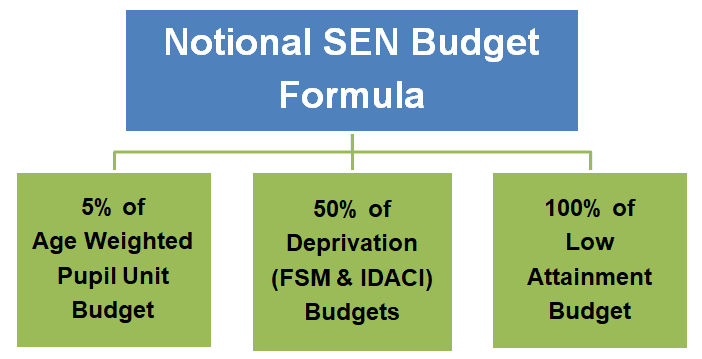
Schools, academies and free schools all have an amount identified within their overall budget, called the notional SEN budget. This is an additional amount of money to the element 1 (AWPU) which is used for SEND provision that is ‘additional to and different from’ the provision made for all pupils. This money is provided directly to schools and academies alongside their AWPU money. It is referred to as ‘notional’ because it is a suggested amount and is not ring-fenced.
The formula used in Torbay is 5% of the Age Weighted Pupil Unit (AWPU) + 50% of deprivation (Free School Meals (FSM) and Income Deprivation Affecting Children Index (IDACI)) budget +100% of the Low Attainment budget = Notional SEN Budget

Pupils with SEND have very varied needs therefore the amount of funding needed to meet these needs will be different for each pupil. The government has recommended schools use the notional SEN budget to pay for up to £6,000 worth of special educational provision to meet a child’s SEND, but the majority pupils at SEND support can have their needs met for much less than this.
Schools should use their SEND funding to pay for things like:
To find out how your child’s school use their SEND money, have a look at your child’s schools SEN Information report.
A school must use its ‘best endeavours’ [do all it possibly can] to meet the needs of pupils at SEND support using element 1 and 2 funding. School provision must be based on an ‘assess, plan, do, review’ cycle implemented in partnership with the pupil and their family. Sometimes the provision may target a pupil, but often shared provision is more preferable and meets the pupil’s needs best. For example, group work is very important when developing language and social skills.
More information about the provision that schools are expected to make for pupils at SEND support can be found in the SEND Code of Practice 0-25 p 99 – 107.
Some pupils with SEND will also be eligible for additional funding from:
This is provided from the high needs block element of the Designated Schools Grant (DGS), and is aimed mainly, though not exclusively, at pupils with Education, Health and Care plans (EHCPs).
The government expects schools, academies and free schools to have spent at least £10,000 out of their core and notional budget before this funding can be accessed.
Top-up funding is individual pupil related funding from the Local Authority from national funding called the ‘high needs block’ for children and young people with an Education Health and Care plan (EHCP) where the provision described is above the level of provision expected to be covered by Element 2 (Notional SEN Budget).
This funding is awarded on an individual basis and the amount depends on the pupil’s level and complexity of need in line with funding matrix descriptors.
An EHCP describes a pupil’s needs, agreed outcomes and required provision and the top-up funding is directly linked to these and reviewed alongside the Annual Review of the child’s EHCP.
The rest of the high needs block is used by us to fund other types of SEND support and provision. The total funding in the high needs block is spent on many different types of support. This includes:
The High Needs funding from the last 4 years has allowed us to invest in provisions and enhance inclusive opportunities for children and young people across a range of settings.
The focus was on projects that incorporated Torbay’s local area Graduated Response Framework to enable the continued improvement of existing provision for pupils and students with high needs.
A total of 8 providers were successful and allocated funding to progress their projects as detailed below:
Oldway Primary School
Lift access to Year 4 & 6 Classrooms
School Feedback – Jill Christian, Operations Manager
Sending you some pictures of our fantastic 3 floor lift at Oldway Primary. Thank you for all your help towards part funding this. It makes a huge difference for our children in wheelchairs.

Paignton Academy
Sensory Gardens at Borough Road and Waterleat Road sites, with accessible ramp at Waterleat Road.
School Feedback – Simon Dossett, LEAD SENDCo and Head of SEND
The ramp is complete and the plants that have gone in are starting to take hold! Nurture groups are ready with sunflower seeds and other smelling and vibrant plants for spring planting. It has been a great addition, and children have been accessing the area and recognising the potential.
The contractor is returning shortly to plant trees in the lower half of the garden, benches, and a living wall on the new trellis so it will change again shortly.
Over at BRC the garden is tied up with the wider build going on. Scaffolding is down, windows are going in, and the garden area is now being levelled ready for completion during Easter which is fab.

Shiphay Learning Academy
Creation of sensory space in Year 4 and outdoor courtyard/sensory garden in Year 3
School Feedback – Kathryn Waterson, SENDCo
A huge thank you to the High Needs Funding Bid Capital Team from Shiphay Learning Academy! Last Summer Term, we requested support with creating an extension onto a classroom to provide a calm sensory space from the class. Our contracted builders worked hard over the summer holidays to complete the work. An untidy and unused cupboard was transformed into a calmer sensory space for 4 EHCP children. Shiphay also requested funding to create a wonderful small garden space for our high need’s children. Unfortunately, the courtyard has yet to be improved due to more building work needed to ensure it is a safe zone for children. We did not anticipate the scale of clearing the courtyard. However, we still used the funding to buy the outdoor resources we requested – we received a green house, planters and a water/sand tray. These have been utilized around the school to support our pupils with EHCPs while we begin the huge task of clearing the courtyard – watch this space! We used the planter to celebrate World Down Syndrome Month and grew sunflowers across the school. Our sunflowers were presented at the front of the building, and you can spot our little star on the World Down Syndrome Day Posters! The greenhouse has been beneficial to 3 pupils with EHCPs in reception. These pupils are currently working within the engagement model and have been growing a wide range of vegetables such as carrots, cucumbers and peas! All have been used in their sensory activities and the children have enjoyed including them within their cooking sessions! The sand and water trays have been used for children who are currently accessing the Attention Autism program (a provision stated on their EHCPs) so they can get as messy as needed! We have invested in a wide range of Widgit resources for communication and a range of toys to enhance our smaller sensory spaces further. We are extremely grateful for the High Needs Funding Bid!


South Devon College
Sensory room refurbishment
College Feedback – Sarah Al-Humaidi, Projects Coordinator
The sensory room is currently used by at least 20 students. Frequent users include a student with Downs Syndrome who loves the interactive wall panel. The sensory room also provides a student with narcolepsy with a pleasant environment to sleep. We have a couple of wheelchair users who use the space. Many students use it to calm and regulate or if they are feeling unwell. The upper and lower LED and UV lights evoke a sense of calm to the body aiding those with autism or sensory processing disorders. The many interactive features enable students to personalize their experience in the room such as playing their own music or choosing lights and projector settings.
The refurbishment of the sensory room has enriched the Colleges provision for SEND learners. Ofsted inspectors commended the facility during a recent evaluation of South Devon College. We have a large cohort starting in September and have a couple of students that have regular seizures who will be supported by use the sensory room.

St Marychurch Primary School
Extension/refurbishment of current nurture provision

Barton Academy
Development of the Outdoor Learning Environment
School Feedback – Stephen Eccles SENDCo
The work has had a massive impact on the high needs children that access the learning environment and we’re already seeing the children engaging together in more positive social interactions in the outdoor space!

Sacred Heart
Outdoor nurture provision
School Feedback – Nichola Day, Headteacher
The area has been a great success and is having a firm impact on the breaktimes of many of our SEND pupils and as an outdoor learning space throughout the day.
Sherwell Valley Primary School
Creation of 2 sensory spaces
Local authorities must ensure there are sufficient good school places for all pupils, including those with Special Educational Needs (SEN) and disabilities.
In April 2021, the Government committed £280 million of capital funding nationally (2021-2022) to support local authorities to create new places and improve existing provision for pupils with special educational needs and disabilities (SEND) or who require alternative provision (AP) via the High Needs Provision Capital Allocations (HNPCA). This is in addition to the total of £365 million of SEND Special Provision capital funding nationally (2018-2020) to help local authorities create new school places and improve existing facilities for children and young people with SEN and disabilities, in consultation with parents and providers.
The High Needs Provision Capital Allocations (HNPCA) (2021-2022) for Torbay is £530,150. The funding is intended to address the need for places for academic year 2022/23 but it is not time-bound, and is up to the local authority to determine how to best use this funding, in line with national guidence, to meet local priorities.
The Local Authority has been allocated an additional £2,670,554 for 2022 – 2024 and work is currently underway to identify the need and scope of potential projects. It has been agreed, as in previous years that a portion of the funding be utilised to give schools the opportunity to think creatively as to what could be done to support the children and young people to access provisions locally and help us to relieve some of the pressures on the High Needs Block, by meeting needs without recourse to Out of Area placements.
The SEND Special Provision allocation for Torbay (2018-2020) was a total of £848,837, which was split into 3 equal payments for each of the years 2018/19, 2019/20 and 2020/21. (£500,000 initially allocated plus £116,279 allocated in May 2018 and £232,558 allocated in December 2018).
This funding was:
Children and young people in Torbay may attend mainstream early years settings, schools or colleges or specialist provision such as mainstream schools with enhanced resource provision or special schools. In a diverse provider landscape the local area must exercise a range of roles and remain committed to the inclusion of children and young people.
In addition to mainstream provision the LA has developed a number of enhanced resource provisions that are delivered by mainstream providers. These include the following:-
The number of children presenting with additional needs is increasing both locally and nationally. Torbay has taken action to commission additional placements with existing schools, colleges and special schools within the local area. The current capacity of providers to expand the offer further is limited; this is compounded by the demographical demand to create more provision at all phases.
The SEND reforms have required Post 16 provision to be developed further. Additional needs which require enhanced provisions are around students with Autistic Spectrum Disorders (ASD) and Emotional, Social and Mental Health difficulties (SEMH).
The SEND Strategy provides the framework within which services can develop in an affordable and sustainable manner in the interests of Torbay children.
Participation is a key theme within the SEND Strategy, which also identifies Co-Production as a Priority area. We will ensure that parents, children and young people are involved in discussions and decisions about every aspect of planning, including making provision to meet local needs.
The conditions and timeline of this funding were:
| Date | Action | Progress |
| Spring 2018 | Local authorities must consult with parents and providers | Consultation took place between 1 December 2017 and 31 January 2018. Consultation Report |
| By Wednesday 14 March 2018 | Local authorities must publish the short plan on their local offer page | Torbay’s original Special Provision Plan (2018-2021) published 14/3/18 |
| Summer 2018 | If plans meet requirements, local authorities will receive the first tranche of funding. | First tranche of funding received. |
| Spring 2019 | Local authorities must consult further with parents and providers | Consultation took place between 2 – 30 May 2019. Consultation report |
| 31 May 2019 | Local authorities must update and republish their plan to show what they have spent on so far, and any changes/updates to their plan or consultation. This should cover as much detail as is known on how they will spend the additional funding. | Torbay’s revised and updated Special Provision Plan (2018-2021) published 31/5/19 |
| Summer 2019 | If plans meet requirements, local authorities will receive the second tranche of funding. | Second tranche of funding received. |
| March 2020 | Local authorities should update and republish their plans again. | Torbay’s revised and updated Special Provision Plan (2018-2021) published 31/3/2020 |
| Summer 2020 | Local authorities will receive the third tranche of funding. | Third tranch of funding received |
| March 2021 | Local authorities should update and republish their plan a final time, to show how all money was eventually spent. | Torbay’s revised and updated Special Provision Plan (2018-2021) published 31/3/2021 |
Expressions of interest were sought from schools prior to allocations being awarded for these accessibility funds.
For 2023 a total of £100,000 was available for schools to bid for, with a focus on projects that incorporate Torbay’s new local area Graduated Response Framework to enable the continued improvement of existing provision for pupils and students with high needs.
Below are summary details of the projects that were successful in improving inclusion within mainstream via the Accessibility Funding in 2018-19. Where supplied by schools, there are also comments from the successful schools with images of the work completed.
Creation of sensory area within the Reception Unit – safe, calming and sensory stimulating room within the Reception Unit to allow SEN children to develop and engage in sensory experiences without feeling frightened or overwhelmed. Resourced with lights, projections, cushions, tactile toys, calming music, soft play equipment and safety items e.g. plug covers etc.

“The money we received to go towards setting up the sensory room had provided the children of Torre Academy C of E with a fully equipped indoor sensory room with strobes, sensory mats, soft areas and plenty of resources to meet the needs of several children. In our outdoor area, we were able to develop it with a range of outdoor equipment to enhance their learning. The impact this has on our SEN children is evident for all that visit to see. Our children with sensory needs often self-regulate using this room and it has become a fantastic safe space to allow them to meet sensory seeking needs”
The provision of blinds to improve access to the learning environment for those with visual impairment.
Creation of a sensory room for children to access, to include specialist sensory walls, flooring, lighting, projectors, bubble tubes, seating, bean bags, sounds and textures. All children benefit from having a secure and safe space to relax and engage emotional thinking to help promote learning, but naturally, for children with additional needs and disabilities it can play a crucial part in their development and progress.

“The children absolutely love the new sensory room, we have found that all of them are benefitting from the holistic, calming atmosphere it is providing, it is particularly helpful for our 1:1 children too. Thank you so much for the funding, we couldn’t have achieved this without it!”
Conversion of a functional room into a calm, sensory room with soft chairs, weighted blankets, lowered ceiling, soft lighting with carpet and calming wall coverings. Provision of a safe and calming room will accelerate the process of helping young persons to re-engage with school life and their learning It is hoped that the room will play a significant role in helping to reduce school and/or lesson absence due to anxiety and that the room will enable the school to work towards significantly improved life chances for their most vulnerable students.

“The old storage/nurses room now has a much lower ceiling, making it feel a much cosier room. The colour on the wall and the dimmable lighting has helped create a soothing space and removing the large sink and shelves give much more sitting space. The new smaller sink placed in the toilet makes the toilet still useable. In the mornings before school and during breaks and lunches up to 3 students at any one time use the room. Most of these are EHCP students but other highly anxious autistic students also use the room on a daily basis. The room is also used frequently during the day for students to spend time regulating themselves, or during their dropped lessons to complete work. We keep some lego, puzzles and calming items in the room so that it much more of the student’s room, rather than a multi-use meeting room and they feel very much that it is their space. They have named it the ‘chill out room’ and created a sign for the door. At present the walls are bare to create a calm space with no distractions, but we will liaise with the key students to discuss if they would like anything else in there. It has been a much needed addition to enable us to cater for our higher needs students who require 1:1 TAs at all times, particularly for 2 of our new yr 7 EHCP students and a highly anxious yr 9 student who has recently been diagnosed with autism.”
Creation of a level path with suitable surface, wide enough for an electric wheelchair. The outcome would be increased inclusivity in PE and sports for wheelchair users.

“The camber on this entrance meant that our child who uses a wheelchair felt very unsafe accessing the playing field. The child now gets down there in safety and, weather permitting, plays on the field and joins in with sporting events with the other children”.
Alterations required to accommodate two students moving from the Waterleat Road Site to the Borough Road Site. To include altered access on site for powered wheelchairs. Improve physical access to classrooms and specialist equipment.
Works to extend current pastoral room to create a large, more open and dedicated area for all social, emotional and mental health interventions. The space will be redecorated and equipped with calming resources and comfortable seating.
The conversion of an internal filing space in the Sixth form student study area into a calm sensory room with soft chairs, weighted blankets, soft lighting with carpet and calming wall coverings.
The room is next to the Sixth form office and allows for easy access by pastoral staff to the students who will be using the room. Installation of good quality recessed speakers and a wifi audio unit to enable acoustic isolation of the room from outside distractions. CFGS experience significant success with pastoral and SEND services post 16, but are very short of the appropriate space necessary to support their most vulnerable students. The premium on space is often felt at free association times and it is these times that can be the most challenging for students who have particular needs around anxiety and social interaction.

Creation of a forest school area to allow specific children to develop and manage their SEMH in a different environment beyond the classroom.
Building a wooden bridge to gain access
Site a storage shed for equipment
Purchase equipment
Development of nurture provision. This provision will provide an additional learning, calming and sensory space for children who are struggling to access the curriculum in a classroom environment. It will provide a calming, free environment that will allow adults to meet children’s sensory, emotional and social needs as well as allowing them to access the curriculum in a style that is more appropriate to their needs.

Quote from Hannah Dillon – Special Educational Needs and Disability Coordinator (SENDCo) – “This year we have had a higher number of children with more complex needs join the school. Our new nurture provision has provided many more inclusive opportunities for these children that allows them to access additional resources, a calming space to learn, explore and share experiences with others. It has also been a wonderful resource for children within the school that would benefit from sensory activities, messy play and quiet time to explore and understand their emotions. The new provision has been a fantastic addition to the school and we are very thankful for the capital bid funding we received”.
Below are summary details of the projects that were successful in improving inclusion within mainstream via the Accessibility Funding in 2019-20.
Conversion of existing SEND meeting room into a calm sensory room with resources.
Creation of enhanced provision unit.
Provision of a dedicated, purpose built cabin for use with ASD students including those awaiting diagnosis and those who are transitioning back into school life. Providing a calm and private environment away from the hustle and bustle of everyday school life and provide a sanctuary for those students who can experience social isolation at break times.

Student feedback – “It came at the perfect time for me. I was getting quite introverted and can now start talking to people.” (Year 9 student)
Quote from Zoe Beard – Special Educational Needs and Disability Coordinator (SENDCo) – “Students and staff at Torquay Girls’ Grammar School are thrilled with their new ASD ‘Garden Room’. It was built as a transitional space for those returning to school after a period of absence and could potentially be used for tutoring happening elsewhere to encourage ASD students back into school. In addition, it is being used as a space for ASD students both with a diagnosis and those on the waiting list, which is currently 2+ years. The school recognised the need for these students to have dedicated space to use. Many of these students are vulnerable and most are at a loss during break times to know where to go or what to do. The ‘Garden Room’ has provided them with a safe space. It is only just up and running but in due course will be filled with games, puzzles, books, arts and crafts and other items for students to interact with. It is also manned during the majority of lessons so students can use this as a quiet zone if they feel they cannot stay in a mainstream classroom. It will also be utilised for meetings with health or care professionals and parents of ASD students. The calming experience should prove popular and with only a limited number of students being able to use the space – a real lifeline for those who are able to use it”.
Creation of outdoor sensory safe space away from the busy nature of the playground. Provision to increase inclusivity for those children who struggle at break times, enhance Thrive provision and allow the children to access the curriculum in a meaningful way.

“Our Sensory Garden was opened to the children a few weeks ago. They have really appreciated the space. Children who really struggle during the un-timetabled parts of the day such as break times and lunchtime now have the opportunity to use our lunch club which now opens up to this beautiful space meaning they do not have to enter the large playground at all if they do not feel able to. It also means that those children do not have to be inside the whole time but can be outdoors which is even better for their mental health and well-being.”
Development of Speech and Language Therapy room.
Quote from Marie-Claire Christie – Speech & Language Therapy Teaching Assistant – “With the increase of children with speech and language needs, our temporary SALT room has made a world of difference to our setting. We now have a quiet, space which aids the communication potential for the children at St. Margaret’s Academy. Children are seen individually or in small groups and the setting is used for formal assessment procedures, for certain interventions that are difficult to manage in a classroom setting. Most of these students need an environment that is quieter and contains less distraction than their normal classroom. Our temporary SALT room now offers an attractive, accessible environment which promotes a sense of belonging. However, although the room is accessible on 1st floor level to children with SEN and disabilities, staff and visitors and outside agencies, it is very small and we feel that the children would benefit from a larger working/meeting area with additional storage for a wide range of teaching resources. We are extremely pleased to have secured this space on a temporary basis and the benefits are already apparent”.
Creation of Sensory Room. The designated sensory space will allow pupils to access the movement and sensory breaks necessary to enable them to engage in learning when in the classroom.

Quote from Charlotte Griffin – Assistant SEND Co-ordinator – “Eden Park have turned a large cupboard into a sensory room using the SEND accessibility funding. It is being enjoyed by children aged 2-11, who need sensory breaks in the day, to enable them to focus better in class. Children can use the large dark tent equipped with light- up toys to relax in a calm environment. Some children find a trip through the squeeze machine or a jump on the small trampoline helps them to feel better in themselves. Other children like to watch the bubble lamp change colours or like to listen to relaxing CD’s. The room is usually used for just one or two children at a time with adult supervision, but it has also worked well for a small group of children lying or sitting still and listening to a children’s meditation CD. Children and staff report that it has helped children to sustain their concentration in class and remain calm and happy throughout the day”.
Creation of safe, defined areas for 3 x EHCP children in KS1 and KS2.
Redesign and install gradual slope to reception entrance, level corner of field, resurface playground part astro/part tarmac for wheelchair user. This new ramp outside the reception class and pathway alongside the school field will allow children with disabilities and wheelchair users to be able to access the bottom playground and dinner hall.

Quote from Allison Grant – School Business Manager – “Our school received funding from Torbay Council via the SEN and Disability Grant. This paid for a new ramp outside our reception class and pathway alongside our school field to allow children with disabilities and wheelchair users to be able to access the bottom playground and dinner hall. One pupil in reception has benefited massively from the new ramp which allows her to access the main reception playground independently. She has a great time playing with her friends and can get in and out of the classroom freely. Previously she had to go around the building and through other classrooms and this sometimes meant she missed some of her playtime. The access ramp along the side of the field has also made a great difference and this is used every day by pupils with disabilities, to get to the dinner hall. Before this was installed, pupils had to walk through the whole school to get there using two stair-lifts and this took up a considerable amount of pupils’ lunch break and staff time. We are really pleased with the work that has been done. It is great quality and has made a real positive difference to our pupils’ mobility and independence”.
Creation of nurture base. Bean bags and games, benching, body socks for sensory areas, equipment for sensory area.

Quote from Allison Grant – School Business Manager – “We also received funding to develop a nurture room for children to feel safe and secure to develop their individual needs. The funding paid for sofas, cushions, beanbags, weighted blankets, lamps and a selection of developmental toys so the children can play games and work collaboratively”.
Creation of large nurture unit. Two areas to be refurbished to develop a small classroom area for up to 20 pupils with small designated outdoor play space. The newly created unit will allow children to receive the care and education specifically tailored to their individual needs in an environment with a significantly higher staff per child ratio than is possible in their own classroom. The school funded over half the Capital needed to complete the project.

Develop outdoor sensory area/garden.
Creation of nurture unit.
Conversion of existing rooms to create 2 enhanced pastoral rooms and a sensory/thrive area.
Creation of nurture base for pupils with high SEMH needs. Development of a nurture base from an existing office space, priority use given to EHCP and nurture group students in Y7 and Y8.

Quote from Sam Banks – Lead Practitioner for MFL and Differentiation/SEND – The Nurture Classroom is where our Y7 Nurture Group students have all their lessons that do not require specialist rooming (English, Maths, History, Geography and R.E.). This has given them vastly greater consistency and continuity in their experience as they transition from Primary to Secondary, as they spend a majority of their learning time in the same classroom with the same seating plan, expectations and resources. We used the money to clear and renovate a redundant classroom, fitting it out with state-of-the-art I.T. equipment and furniture chosen to give the feel of a Primary classroom. This provision has also allowed us to make other innovative additions to their curriculum, such as using their teachers’ changeover time between certain lessons to do a dynamic MFL input that gives them their entitlement to the experience of a foreign language. As well as settling in more successfully to life at STCM than has been the case for previous high-needs students, we have been really impressed with the quality of work this group is producing and the fantastic progress they have made so far this year has been really encouraging”.

Enhancement of our Nurture style provision, particularly the breakout room; creating a safe, calming and sensory regulating room within the Nurture provision to allow children who are dysregulated to have a space that they can go to without feeling frightened or overwhelmed. Resourced with lights, blinds/window covers, projections, cushions/soft mats, tactile toys, calming music, soft play equipment and safety items e.g. plug covers etc.
Redevelopment and enhancement of our currently underused environmental area into a dedicated area for specific children to develop and manage their SEMH needs in a different environment beyond the classroom.
Development of enhanced provision for students on the Autistic Spectrum.
Below are summary details of the projects that were successful in improving inclusion within mainstream via the Accessibility Funding in 2020-21.
Creation of sensory room with calming bubble wall and sensory equipment.
Creation of sensory room and garden.
Creation of sensory room with resources.
Creation of sensory garden
Creation of sensory room.
Creation of communication ‘chat shack’.
Creation of purpose built communication pods outside year 5/6 classrooms.
Development of sensory garden/outdoor space.
Creation of SEN room – sensory provision & speech and language support.
Creation of nurture/sensory room with resources.
Enhancement of SEND facilities.
Creation of outdoor (undercover) sensory area.
Classroom partition to allow flexibility to manage the classroom environment for children with EHCP.
Creation of 2 sensory areas.

‘We very much appreciate receiving this funding – it has made a big impact on SEND children settling into our school and are very grateful to have such an amazing space at White Rock for our children’
Statement from our SENCO Cathy MacPherson,
We are delighted to have received funding to develop a Sensory Room at White Rock Primary School. We have been using it since the beginning of the academic year primarily with four autistic children who have very little language and came into our Reception Classes with EHCPs. We have used the room to settle children when they come into school in the morning and to provide sensory breaks throughout the school day.
We took advice from our EP when buying resources for the room and he provided training for staff working with children accessing the room.
Unfortunately at this time only one other child has been able to access the room on a daily basis due to Covid restrictions. In the future we will ensure the room is used by a wide range of children within the school as we know they will benefit greatly from the environment.
Creation of dedicated sensory and intervention space.
Provision of outdoor gym equipment and alternative PE equipment to support an inclusive and differentiated PE curriculum.
Creation of area for visually impaired students.
Creation of sensory room.
Below are summary details of the projects that were successful. Where supplied by schools, there are also comments from the successful schools with images of the work completed.
Re-purposed space to create new sensory room to meet needs of pupils with Social, Emotional and Mental Health (SEMH) needs.
Re-purposed space to create new changing/feeding/therapy room to meet pupils’ physical needs.

Creating a new nurture provision to support inclusive practice for pupils with Social, Emotional and Mental Health (SEMH) needs.
New lift to meet pupils’ physical needs.
New provision of a cabin within Forest school outdoor area for small group interventions throughout the day.

Our lovely unit is now in place and works are very nearly finished. I have attached a few photos to show you what a wonderful learning space this has created – Karen Colmer.
Re-purposed space to create a nurture provision to improve existing provision for pupils with high needs.

Re-purpose space to create new wellbeing/sensory rooms on both school sites to support sensory and SEMH needs – to provide calming space to help alleviate anxiety and escalate intervention and therapeutic work as needed.


Disabled toilet at the Waterleat Road site to meet physical needs.
Re-purpose space to create new wellbeing/sensory rooms to support sensory and SEMH needs.

The children have benefited greatly from having a designated sensory area where they can go, or be taken to, to help to reduce their anxieties and regulate emotions. We have a number of pupils with Autism who access these spaces as part of their daily timetable. Other children, especially those in the Foundation Stage and in the Nurture provision have enjoyed using this space when they are feeling emotionally upset or dysregulated.
Re-purpose space to create new wellbeing/sensory rooms to support sensory and SEMH needs.

The funding has been used to install two sensory rooms at CSA. One is based on the Early Years site and one is based on the main site for years 1-6 to access. This has provided much needed intervention spaces for children to use to get the sensory feedback/ input they need during the school day.
Re-purpose space to create new wellbeing/sensory rooms to support sensory and SEMH needs.
Upgrade lifts on site to meet pupils’ physical needs.
Upgrade 6 external doors to have automatic openers to meet physical needs.
Re-purpose space to create a new sensory area to support sensory and SEMH needs.

The project was to turn a room available in school into a Respite Space, a room that we can use with some o the most high needs children who find full time in a mainstream classroom sometimes a challenge. The money allocated was used to create a wonderful space that is light and inviting, but also purposeful and safe. It included the fitting of doors that allow the children to be kept safe, cupboards that can be locked, improved IT capability, a sink area for cleaning up creative projects and the construction of a purpose build changing area for handling intimate care discretely. Some money was also used to create a hugely successful outside space and a gazebo so that the children using the space are kept dry during inclement weather. All round, we are now able to have a much more useful space, safe and clean and attached to a pre-existing sensory room that supports these children more comprehensively than was previously being managed, but providing a base for the children when not in their allocated classroom.
Re-purpose space to create a nurture area.

This provision has become invaluable within the Learning Opportunities department for our learners. It is a warm, supportive and calming area for all of our learners, especially those with SEMH needs, to talk, practice Mindful Craft and Art, share problems and achievements and seek guidance and sign posting to many matters. The impact this provision has had, has been quantifiable as our learners have all responded so positively to being able to access this extra and consistent support that helps them to strive and achieve.
What some of our learners have to say about having this provision available to them –
Re-purpose space to create a new nurture room to support sensory and SEMH needs.