Graduated Response (video for Children & Young People) SEND Local Offer
This video has been created by local Children and Young People.

Highlight to listen
This video has been created by local Children and Young People.

Torbay Council has worked with young people to put together this short video to explain all about our Graduated Response toolkits and how they can help young people who may need additional support.
You’ll see characters drawn by students at South Devon College and voiceovers recorded by students from the Spires College, Paignton Academy, South Devon College, Mayfield School and Mayfield Chestnut. Altogether, 26 young people were involved with the production of the video.
If you are not already accessing this from the “SEND Support and Provision – Graduated Response” home page please see SEND Support and Provision – Graduated Response – Family Hub (torbayfamilyhub.org.uk) for more information.
There is also a series of 3 videos to help children, young people and their families understand more about Education, Health and Care plans (EHCPs).
View and/or download the Introduction to Graduated Response

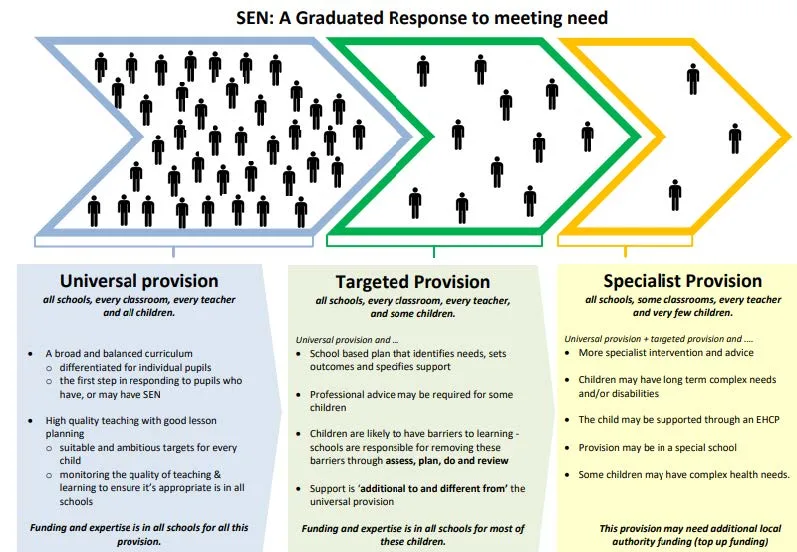
The Graduated Response, or Graduated Approach, is the process which must be carried out when there are concerns about a possible special educational need.
The Equality Act (2010) and The SEND Code of Practice (2015) places strong emphasis on reasonable adjustments and early intervention.
It states that to enable the child and young person to participate, learn and make progress, we should:
Torbay’s Graduated Response will ensure all partners work together to get the “right support, in the right place, at the right time” by the right people, for every child or young person with special educational needs and disabilities.
Our commitment is to:
What is Universal Provision?
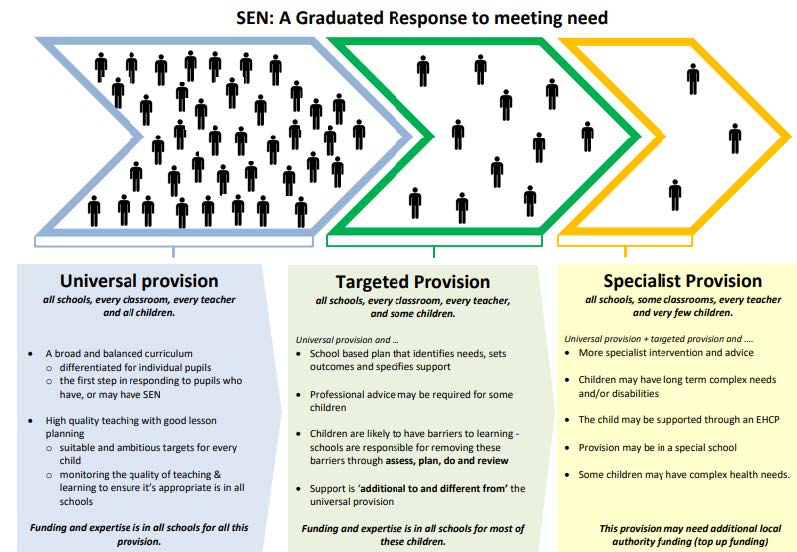
Universal Provision means the support and provision which is ordinarily available to every child or young person in every educational setting in Torbay.
Some children and young people need more support – this is called targeted and specialist provision. This support is needs led which means that the child or young person gets the right support, in the right place, and at the right time. The support may be needed right away or at a point in the future, for short or for extended periods of time.
View and/or download the Introduction to Graduated Response
For children and young people in Torbay to thrive, we know that every setting should have in place:

We believe our children and young people can thrive when quality first teaching is accessible to all.

View and/or download the Introduction to Graduated Response
The SEND Code of Practice 2015 is a statutory document and is very clear in setting out the responsibilities of educational settings in identifying and meeting the needs of all children and young people.

The Children and Families Act 2014, The Equality Act 2010 and the SEND regulations 2014 underpin the principles within The Code of Practice 2015.
These key principles are:
Every school is required to not only identify the SEND of the children and young people, but also address it. Section 6 of the Code of Practice (2015) clearly sets out the statutory duties of mainstream schools (including, maintained schools and academies that are not special schools, maintained nursery schools, 16-19 years academies, alternative provision academies and Pupil Referral Units). You can find how your child or young person’s school supports SEND by viewing the SEND Information Report on the school’s website.
No, you do not need a diagnosis to access support.
Support and Inclusion is needs led and not determined by any formal diagnosis. This means your child or young person can be supported through the Graduated Response toolkits as soon as a need is identified.
These needs may be identified by anyone working or knowing your child or young person. For example; a parent / carer, a teacher, a health visitor or a support worker.
Once identified, needs will be supported using the Assess, Plan, Do, Review cycle in the section below.
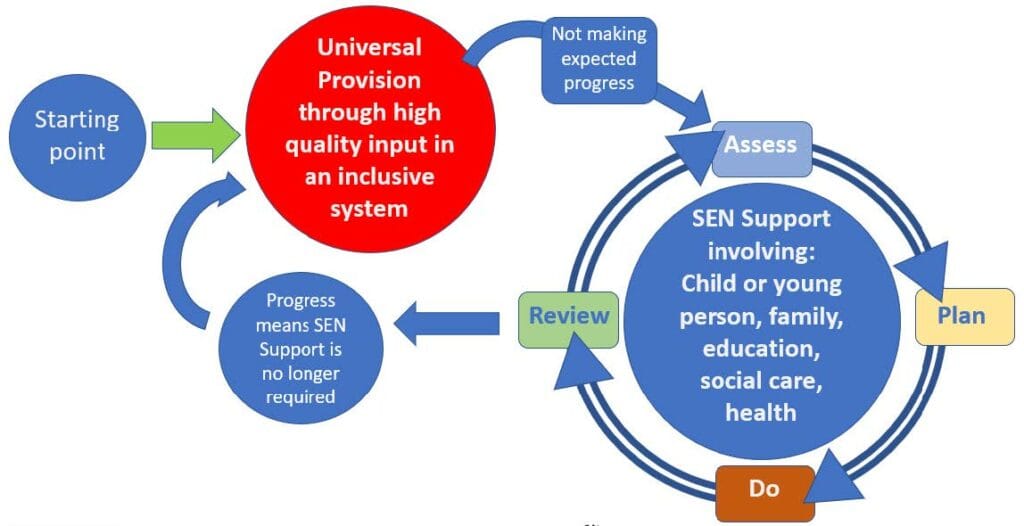
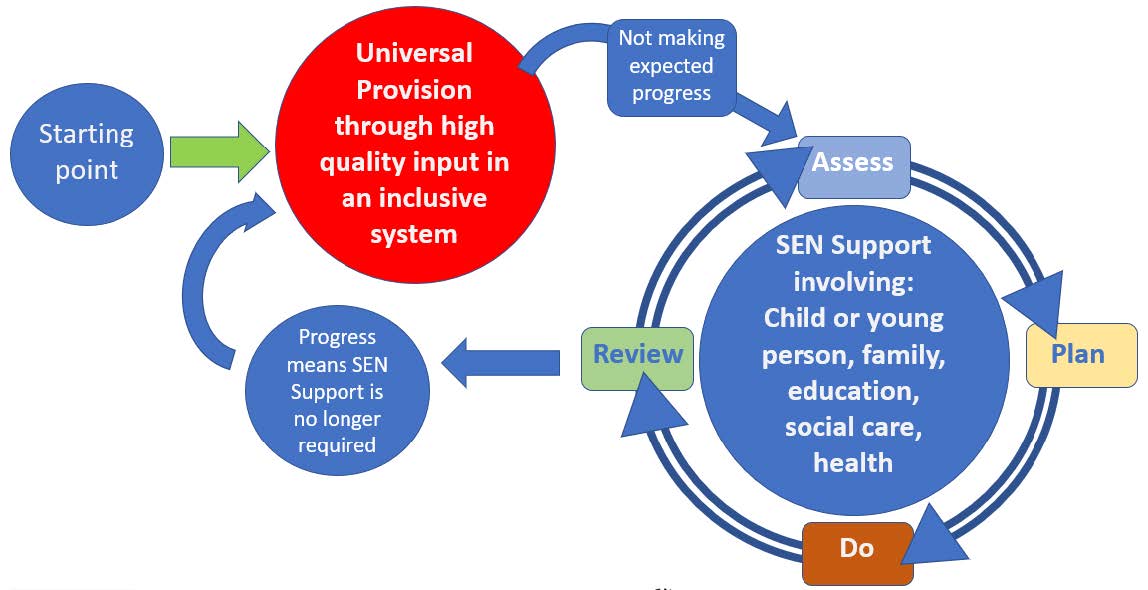
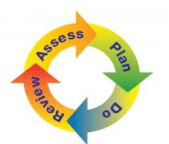
The Assess, Plan, Do, Review cycle is how the Graduated Response is put in place. It can be repeated as many times as needed to help the child or young person progress.
If a child or young person is not making the expected progress, the first step is to collect the right information and find the right people to be able to plan support. This will include the views of the child or young person and their family, information from their teachers and the views from any other service or organisation involved in the life of the child or young person. This is the Assess stage of the cycle.
The second step is the Plan stage of the cycle where the child or young person and their family agree, with their teachers and the special educational needs co-ordinator (SENDCo), on the new interventions and support that will be put in place. They will also agree the expected outcomes. The agreement will be recorded on the school’s systems and explained to the involved teaching staff.
The Plan stage of the cycle is when the plan is put into practice with the child or young person’s class teacher or subject teachers being responsible for checking that the plan is working on a daily basis.
The impact of the plan is reviewed by the child or young person and their family, teachers and the SENDCo. This is the Review stage of the cycle.
At this stage, progress may have been made which means the child or young person no longer requires special educational needs support. In this case the child or young person will continue to receive Universal Provision.
This cycle is reviewed continuously which means some children and young people no longer require support and some may continue with different or additional support and provision.

The five Graduated Response toolkits are:

For children under 5 years old an Early Years toolkit has been developed. View and / or download the Early Years toolkit here torbay-early-years-graduated-approach.pdf
For young people a 16 – 18 toolkit has been developed. View and / or download the 16 – 18 toolkit here 16 – 18 Graduated Response Toolkit
Many children and young people will have needs that do not fit in just one toolkit. Therefore, it may be necessary to refer to more than one toolkit to support the child or young person.
The Torbay Belonging Strategy has been created to support children and young people to maintain their school places by recognising and meeting need.

What is a Locality Model?

A Locality Model is not a new concept and many Local Areas have adopted the principles in their own locality to support solving the challenges they face SEND in their Local Area.
In the last two years 9, other Local Areas have piloted Locality principles in their Local Areas. Their pilots had a common cause, collective moral purpose and integrated ways of working which we hope to replicate.
Torbay Locality Model.
Last year, we asked for your thoughts on plans for a locality model in Torbay. A locality model is when decisions about a child’s education are made at a more local level.
Speech, language and communication needs will be the focus of our locality trial this year.
Next year, after the trial has finished, we hope to have a plan for future working.
Our aims
In this pilot we aim to:
What will it mean for my child?
It could mean your child gets the help they need without a diagnosis or an EHCP.
It also means we’ll make local decisions about how children and young people’s needs can be met. We’ll also share good practice across different services and providers.
We’ll try and be more consistent in the provision we offer across schools and make more effective use of the money available.
We’ll be pooling our expertise and resources so that SEND support and services can be accessed more easily.
The trial will concentrate on a small area of SEND across a selection of Torbay schools.
Over the next few months, we’ll be co-designing this trial alongside our health, social care, Family Hubs and school partners.
We also want to work with young people and parents and carers. If you’d like to get involved, email admin@familyvoicetorbay.onmicrosoft.com.
As this pilot develops we will add information to this webpage so everyone can hear about how our pilot project is progressing.
Schools Involved:
We are pleased to announce that the primary schools who have volunteered to be involved in our Locality Pilot are:
Preston Primary School
Eden Park Primary School
Cockington Primary School
Galmpton Primary School
Collaton St Mary Primary School
Torre Academy
Brixham C of E Primary School
Sacred Heart Primary School
St Margaret Clitherow
Our Lady of the Angel
Priory School
St Marychurch Primary School
All Saints Babbacombe Primary School
Upton St James Primary School
Oldway School
Shiphay Learning Academy
Roselands Primary School
Warberry Primary School
Ilsham Primary School
Ellacombe Primary School
St Michael’s Primary School
Barton Hill Academy
Furzeham Primary School
Kings Ash Academy
Curledge Street Academy
St Margaret’s Academy
Sherwell Valley School
Watcombe Primary School
Homelands Primary School
Capital Grants given to our Primary schools in the Locality Pilot to support delivery of Speech Language and Communication Needs:
I’m pleased to announce that a total of £778,768 has been allocated to 22 providers through a successful bid process!
The funding will support a range of inclusive provisions, including sensory and intervention spaces, speech, language and communication support, nurture provision, and outdoor sensory areas. Many schools are having this work completed in the summer holidays ready for the new academic year. We hope to bring you some pictures and stories of the difference it has made once the new term starts.
One School leader commented:
“I wanted to also share how delighted we were that all of our Capital Funding bids were approved. The impact that this will have in supporting some of our most vulnerable pupils is incredible, and Heads have been sharing with me just how grateful and exited they are.
We truly see this as making a difference as we develop the physical environments and this will provide us as a Trust with a route map of what this can look like, which will no doubt impact our wider development across all of our schools, thank you!”
A full list of the primary schools receiving this special capital grant are below.
| PROVIDER | PROJECT |
| Barton Primary Academy | Speech, language and communication provision Funding to improve outdoor learning space |
| Brixham C of E Primary | Creation of Language Lab |
| Collaton St Mary Primary | Pastoral and sensory intervention space designed to support students with SEMH and speech, language, and communication needs (SLCN) in our mainstream setting. |
| Eden Park Primary & Nursery School | 2 x Sensory rooms for KS1 & KS2 |
| Ellacombe Academy | Toilet and changing space in current nurture room Sensory Room Development of outdoor provision to include more gross motor play options and support additional SEND classroom from September 2025. |
| Galmpton C of E Primary | Creation of a dedicated Communication, Language and Literacy room designed to provide individual and group language/intervention and support sessions to EYFS/KS1 pupils |
| Ilsham Academy | Development of sensory spaces around the school accessible for all children Creation of outdoor covered sensory space to support regulation and SEND support as a breakout area |
| Oldway Primary | Creation of a multi-sensory, speech and language, and nurture provision |
| Our Lady of the Angels Catholic Primary | Creation of a dedicated space for Speech, Language, and Communication interventions Establishing a Sensory Calm Area for pupils with communication needs in Key Stage One Outdoor Area for Children with communication needs |
| Preston Primary | Speech, Language, Communication Needs area Sensory Regulation Spaces (For ERP and safe sensory spaces for children in mainstream) |
| Roselands Primary | Creation of a multi-sensory learning environment |
| Sacred Heart RC Primary | Creation of two breakout rooms within the Torbay Locality Model Pilot, specifically designed for pupils with Special Educational Needs and Disabilities (SEND) to support Communication and Language Needs (SLCN) and Social, Emotional, and Mental Health (SEMH) needs |
| Sherwell Valley Primary | Acoustic Treatments to Support Speech, Language and Communication Development to support a diverse range of pupils, including those with Speech, Language, and Communication (SLC) needs, as well as Communication and Interaction (C&I) needs. |
| Shiphay Learning Academy | Creation of outdoor space for Enhanced Provision to include sensory learning and equipment |
| St Marychurch Primary | Development of outside play equipment to support children with SEMH who need to regulate and our children with Communication and Interaction need to manage the mainstream classroom and develop their social and problem-solving skills. |
| St Michael’s C of E Academy | Break out spaces to support high needs children and interventions Development of Outdoor area – send provision – sensory traversing walls Sensory equipment to support both Nursery and SEND children |
| Torre Academy | Community Language Café and Support for Speech, Language, and Communication Needs Developing the physical space of our nurture provision Development of Sensory room to enable children to self-regulate Develop Forest School |
| Warberry C of E Academy | Developing the physical space of our nurture provision Development of Sensory room to enable children to self-regulate Forest School |
| Watcombe Primary | Improve our existing enhanced provisions: Multi-Purpose All-Weather Activity Area Accessibility improvements Creation of sensory room |
Locality Pilot – Summer update!
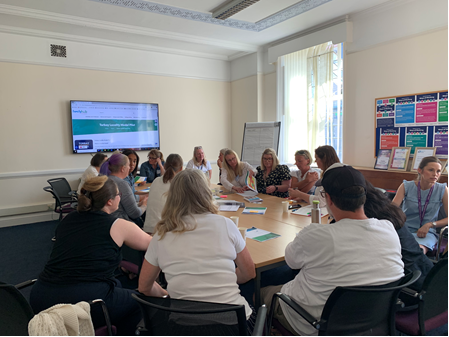
Over the past six months we have held more than 50 coproduction events, talked to over 100 educational colleagues, more than 20 colleagues from health and care and worked with more than 50 children, young people and their parents and carers to create the pilot project which will test the concept of working in a different way through a Locality or place-based approach.
We had an amazing evaluation day on the 4th July, where parents and carers came together with colleagues from across the local partnership to devise our next steps.

We know from national press that this localised and collaborative way of working is a concept which is being forged across many agencies and we are proud that Torbay stakeholders have come together to embrace and trial a different way of collectively solving some challenging problems. We know that our pilot is just the start of this and we hope the package we have put together to support your school will begin to make a difference. We are keen to consider your feedback throughout the pilot process and evaluate what the next steps for this way of working could be when the pilot comes to its official end in December 2025.
Every school involved in the pilot has been sent a letter indicating which priority areas of focus from the Balanced System should be a focus for them next term.
You can see a summary of the school ‘clusters’ or groups which have the same priorities and the schools which are champions in these areas.
Below is a menu of the possible support which will be available for the schools in the pilot from September. Each school will be given their tailor-made list of support and further details after the summer break.
| Family Support | Workforce | Identification | Environment | Intervention |
| Champion Schools – schools who have identified they have a strength in this area: | ||||
| Champions: | Champions: Cockington | Champions: Galmpton Barton | Champions: Torre | Champions: All Saints Homelands Acorns Pre-School |
| Schools where audit identified this should be a focus area for the Autumn term: | ||||
| Preston Eden Park Cockington Galmpton Torre Brixham CofE Priory St Marychurch All Saints Kings Ash Acorn Nursery Watcombe Curledge St Upton St James Oldway Shiphay Roselands Ellacombe St Michael’s Barton Sherwell Valley Homelands Southernwood Nursery Sacred Heart | Eden Park Acorn Collaton St Mary Torre Brixham CofE Priory Shiphay Roselands Warberry Ellacombe Barton Kings Ash Curledge St Watcombe Homelands Ilsham Sacred Heart | Upton St James Oldway St Michael’s | Cockington Galmpton All Saints Warberry St Margaret’s Ilsham Preston | Collaton St Mary St Marychurch St Margaret’s Sherwell Valley Southernwood Nursery |
Below is a menu of the possible support which will be available for the schools in the pilot from September. Each school will be given their tailor-made list of support and further details after the summer break.
| Family Support | Workforce | ||
| Social Care and The Family Hub teams will host locality coffee mornings to build relationships with parents/carers and colleagues. EaL Support will be available to all schools (assessment, training and engagement) for the Autumn term. The learning Academy and SFVT will develop and publish bitesize parent resources on SLCN on the Family Hubs webpages. Linked Therapists can support school with parent events (coffee mornings/ parents evenings etc…) with parents and carers. The learning Academy will offer Language that Cares training for parents and schools. | Educational Psychology Service delivers ‘on demand’ training for class teachers on adaptive teaching methods for SLCN. Linked Therapists will support the workforce through training and development strategies which are bespoke to the school’s needs. The Linked Therapists and Educational psychology Service will be working together to deliver support to the workforce. Champion schools offer good practice session for leaders. Educational Psychology service hold monthly online ‘surgeries’ to support SENDCos. Educational Psychology Service and Learning Academy creates a shared bank of resources. Educational Psychology Service create an online training checklist on SEMH vs SLCN to assist class teachers and support staff. The Head of Quality First Teaching develops the SLCN Graduated Response toolkit resources. The Advisory Teacher team delivers dual coding training. | ||
| Identification | Environment | Intervention | |
| The Linked Therapist supports training at all levels in identification/assessment; Blanks, LEG, etc… The Linked Therapist supports triage meetings with each school. Linked Therapists will offer further support on the Balanced System evaluations. Champion schools showcase and share good practice. | Capital Grant for environmental changes. Linked Therapist supports with further environmental changes; core boards, signage etc… Champion schools showcase and share good practice. | The Linked Therapist supports schools with reviewing/training and modelling effective interventions for SLCN. Champion schools showcase and share good practice. | |
SEND Coffee Morning for Parents & Carers. Details to be found here:
If you would like to be involved in the Parent/Carer Focus group on this pilot, please contact our Parent Carer Forum: Contact — Family Voice Torbay
Please find information about funding for children and young people with additional needs here.

You might feel that even with the support or provision provided, your child or young person’s needs are not being met. In the first instance, arrange to contact the SENDCo (Special Educational Needs & Disability Coordinator) at your child or young person’s educational setting. You can find out their contact details by visiting the website for the educational setting.
For guidance on resolving disagreements about SEND provision see: Resolving disagreements about Special Educational Needs or Disability (SEND) provision
For free impartial support contact: HOMEPAGE – Sendiass Torbay
To find out more about how our SEND local area partners (e.g health, education and social care) work with parents and carers, contact SEND Family Voice Torbay (SFVT), our Parent Carer forum.
Cognition and learning difficulties cover a wide range of needs and abilities. Cognition and learning difficulties may affect all areas of the curriculum, as with pupils with Moderate Learning Difficulties (MLD) or Severe Learning Difficulties (SLD). However, cognition and learning difficulties may only impact on specific areas such as reading, writing, spelling and/or numeracy.
View and/or download the full Cognition and Learning Needs Toolkit
Every school, health setting, social worker and community support worker will:
View and/or download the full Cognition and Learning Needs Toolkit
Here are some ways that teachers and other school staff can help students learn and succeed in the classroom:
View and/or download the full Cognition and Learning Needs Toolkit
Resources:
Resources:
Specific Toolkits for SENDCos:
View and/or download the full Cognition and Learning Needs Toolkit
Steve Butnik’s article Understanding, Diagnosing, and Coping with Slow Processing Speed offers an overview of ideas but also focuses on the fact that sometimes slow learning is a result of something undiagnosed. That said, if you are simply teaching the child in front of you, it shouldn’t really matter what their diagnosis is, you just need to adapt teaching to meet their needs.
Type of Problem: Activation
Examples of Interventions for Activation:
Investigate the cause. For example, see if the student:
Type of problem: Emotional factors (i.e, “It’s too much …”)
Examples of Interventions for Emotional factors:
Type of Problem: Cognitive factors (i.e., “I don’t even know where to begin.”)
Examples of Intervention for Cognitive factors:
Type of Problem: Focus / attention
Examples of Intervention for Focus / Attention:
Type of Problem: Working memory
Examples of Intervention for Working memory:
Type of Problem: Handwriting
Examples of Interventions for Handwriting:
Nicola Jones-Ford wrote an interesting article which outlines different ways to identify students as well as some strategies to support them. This, however, refers to slow processing rather than just learning at a slower pace.
Hawthorne School District, California, have created a very simple document outlining who slower paced learners are as well as some easy strategies to follow. These approached would by no means inhibit others in the classroom from making progress, so may be very useful. Microsoft Word – STRATEGIES FOR SLOW LEARNERS.docx
View and/or download the full Cognition and Learning Needs Toolkit
Cognition and Learning Toolkit for Specific Learning Difficulties
Area of Need: Specific learning difficulties
For most specific learning difficulties, there are likely to be:
Provision for children or young people with Specific learning difficulties
Area of Need: Dyslexia
Provision for children or young people with Dyslexia
Area of Need: Dyscalculia
Dyscalculia is a difficulty in understanding numbers.
Provision for children or young people with Dyscalculia
View and/or download the full Cognition and Learning Needs Toolkit
Cognition and Learning Toolkit for MLD learners
Area of Need: Moderate Learning Difficulties (MLD)
Provision for children or young people with Moderate Learning Difficulties (MLD)
View and/or download the full Cognition and Learning Needs Toolkit
Cognition and Learning Toolkit for Complex Learning Difficulties (Including FSAD. and prematurity)
Area of Need: Foetal Alcohol Spectrum Disorders (FASD)
Foetal Alcohol Spectrum Disorders (FASD) can lead to memory problems, impulsivity, disorganisation, difficulty with abstract concepts, slow information processing, developmental delays, and an inability to understand the consequences of their actions.
Provision for children or young people who experience difficulties arising from Foetal Alcohol Spectrum Disorders (FASD)
Area of Need: Premature birth
Premature birth can lead to difficulties in various areas, such as learning, behaviour, memory, planning, and language. Supporting preterm birth learners requires appropriate resources, staff training, specialist knowledge, and guidance for families. Preterm birth can also increase the risk of cerebral palsy, behaviour, emotional and social difficulties, ADHD, delayed physical development, hyperactivity, anxiety, depression, health problems, and difficulties with daily living skills.
Provision for children or young people who experience difficulties arising from Premature birth
Area of Need: Information Processing
Provision for children or young people who experience difficulties with Information Processing
Area of Need: Response inhibition
Provision for children or young people who experience difficulties with Response inhibition
Area of Need: Working memory
Provision for children or young people who experience difficulties with Working memory
See the guide by Gathercole & Alloway for further details:
WM-classroom-guide.pdf
Area of Need: Emotional control
The ability to manage emotions to achieve goals, complete tasks, control, and direct behaviour
Provision for children or young people who experience difficulties with Emotional control
Area of Need: Cognitive flexibility
Provision for children or young people who experience difficulties with Cognitive flexibility
Area of Need: Sustained attention
Provision for children or young people who experience difficulties with Sustained attention
Area of Need: Task initiation
Provision for children or young people who experience difficulties with Task initiation
Area of Need: Planning and prioritising
Provision for children or young people who experience difficulties with Planning and prioritising
Area of Need: Organisation
Provision for children or young people who experience difficulties with Organisation
Area of Need: Time management
Provision for children or young people who experience difficulties with Time management
Area of Need: Goal-directed persistence
Provision for children or young people who experience difficulties with Goal-directed persistence
Area of Need: Metacognition
Provision for children or young people who experience difficulties with Metacognition
View and/or download the full Cognition and Learning Needs Toolkit
View and/or download the full 16 - 18 Graduated Response Toolkit
View and/or download the full 16 – 18 Graduated Response Toolkit
View and/or download the full Cognition and Learning Needs Toolkit
Sensory impairments can be defined as an impairment that affects a child or young person’s ability to access auditory or visual information. Visual and hearing impairments can sometimes be corrected by hearing aids or glasses. When this is not possible, there can be an impact on the child or young person’s learning and development.
Sensory impairments can be present at birth or develop over time. A child or young person can have a multi-sensory impairment (MSI) which is a combined visual and hearing impairment and will affect communication and mobility and the child or young person will require specific support.
Physical impairments usually originate from neurological or metabolic causes and can require specific intervention. This can include mobility aids, postural management, or support with self-care skills such as dressing or toileting. Physical impairments are medically diagnosed, and can affect all aspects of daily living, learning and social needs.
View and/or download the full Sensory and Physical Needs Toolkit
All children benefit from Universal Support, which means high-quality, inclusive teaching and simple classroom adjustments to help everyone learn. If a child needs more help than this, they may receive SEND Support, which is extra, tailored support such as individual plans, targeted interventions, and advice from specialists. SEND Support ensures children with additional needs can make progress and thrive.
General advice for all the needs in this category:
Universal support for Sensory and/or Physical Needs
Every school, health setting, social worker and community support worker will:
SEND Support strategies and interventions
Physical Needs (PN)
Hearing Impairment (HI)
Visual Impairment (VI)
Habilitation training programmes and advice including:
Sensory Sensitivities
Sensory integration is based on the concept of how the brain organises and interprets sensory information. Sensory-based interventions are activities that occur in the child/ young person’s natural environment and aim to have an effect on self-regulation, attention or behavioural organisation.
Utilise the Sensory Differences Workshop – Children and Family Health Devon website amongst others to consider sensory differences for each of the senses below:
Children and young people can have needs in more than one area of the Code of Practice SEND_Code_of_Practice_January_2015.pdf and therefore it is important to consider the other toolkits:
It is understood that some children and young people will have restrictive eating behaviours associated with their sensory needs, therefore advice can be sought from the Neurodiversity toolkit.
View and/or download the full Sensory and Physical Needs Toolkit
Assessment tools for Sensory and/or Physical Needs
Transitions for Sensory and/or Physical Needs
View and/or download the full Sensory and Physical Needs Toolkit
If your child has sensory and/or physical needs, there are a range of services and resources to help. Here, we look at who can support you, what advice is available, and how to access specialist help such as advisory teachers, therapy services, and outreach. You’ll also find links to practical tools and guidance for home and school.
Specialist Advisory Teachers
Therapies and Health Services
Outreach Support
Additional Resources
View and/or download the full Sensory and Physical Needs Toolkit
Speech, language and communication needs describe difficulties with:
Everyone with speech, language and communication needs are different and may have difficulty with one, some, or all of the different aspects of speech, language or communication at different times of their lives. Find out more about the common features of speech, language and communication needs.
Some difficulties are short-term but others will be more permanent and remain throughout childhood and adult life.
It is important to understand that Speech, Language and Communication Needs are known to be a significant risk factor for poor life chances and outcomes which is why it is vital that language and communication are understood as EVERYONE’S RESPONSIBILITY. This video provides details of the impact language disorder, including DLD, can have on a child/young person and adult: SLCN and life chances
Difficulties may include:
Speech:
Language:
Expressive language:
Receptive language:
Communication:
View and/or download the full Speech, Language and Communication Needs Toolkit

Every education setting, health setting, social worker and community support worker will:
For information and resources to support the implementation of these please see appendix 1.
View and/or download the full Speech, Language and Communication Needs Toolkit
Appendix 1:
Appendix 1:
It is also important to note that many children and young people may have needs across more than one category and certain conditions may not fall neatly into one area of need. When reviewing and managing special educational provision all four broad areas of need must be considered to ensure you can provide holistic support for the child/young person.
With a multidisciplinary approach many children and young people’s needs can be met at universal and targeted support so they can make progress therefore, not all children/young people with SLCN will require a referral to Speech and Language Therapy for a specialist assessment. To help inform this process a series of factsheets are available to help professionals/parents/carers plan the decision-making process for making referrals, what to consider about the child or young person, and how to build a speech, language and communication profile.
View and/or download the full Speech, Language and Communication Needs Toolkit
All adults to:
All adults to:
View and/or download the full Speech, Language and Communication Needs Toolkit
Prepare the child/young person for experiences and learning opportunities.Help the child/young person to understand and name their needs and emotions
Prepare the child/young person for experiences and learning opportunities.
Help the child/young person to understand and name their needs and emotions
Consider and make reasonable adjustments to the environment including sensory needs
Give careful consideration to all transitions
Support friendships, interactions, social-emotional wellbeing and self-advocacy
Listen to and engage with the child/young person
Use language that is appropriate to the child/young person’s level of understanding
Provide time for the child/young person to process information and respond
Value the child/young person’s response
View and/or download the full Speech, Language and Communication Needs Toolkit
A Communication Friendly Environment enables learners (pupils) to develop their social, emotional and academic potential by reducing or removing barriers to communication. The following resources can help to review whether the environment is communication friendly and what reasonable adjustments may be necessary.
Organisation skills for 5-11 year olds – Children and Family Health Devon
Organisation skills for 11-18 year olds – Children and Family Health Devon
View and/or download the full Speech, Language and Communication Needs Toolkit
Parents/carers and professionals:
Public Health Nursing:
Early Years Practitioners:
Practitioners within education settings:
Youth Justice professionals:
View and/or download the full Speech, Language and Communication Needs Toolkit
This guide was co-created for the Torbay SEND Locality Project with input from SEND Family Voice Torbay, Children & Family Health Devon, and Torbay Council – including the Educational Psychology Service, Early Years, and Children’s Services Learning Academy.

This guide was co-created for the Torbay SEND Locality Project with input from SEND Family Voice Torbay, Children & Family Health Devon, and Torbay Council – including the Educational Psychology Service, Early Years, and Children’s Services Learning Academy.
Social, Emotional and Mental Health needs, as stated in the Code of Practice, Chapter 6 SEND_Code_of_Practice_January_2015.pdf, are a type of special educational need in which children and young people have difficulties in managing their emotions and behaviour. They may often show inappropriate responses and feelings to situations.
This means that they may have trouble in building and maintaining relationships with peers and adults; they may also struggle to engage with learning and to cope in the classroom without additional strategies and interventions. Children with SEMH will often feel anxious, scared and misunderstood.
Typical characteristics of children with SEMH can include:
SEMH does not have to be a lifelong condition. With appropriate support children and young people can move forward and live successful lives.
Key principles for supporting SEMH:
Strategic leadership will support SEMH needs by:
View and/or download the Social, Emotional & Mental Health Needs Toolkit
Every school, health setting, social worker and community support worker will:
View and/or download the Social, Emotional & Mental Health Needs Toolkit
The needs of some children / young people may require…
Positive Support Plan
View and/or download the Social, Emotional & Mental Health Needs Toolkit
There is a wide range of assessment tools and devices. The list below is not exhaustive but is indicative. Settings should use a consistent set of tools.
View and/or download the Social, Emotional & Mental Health Needs Toolkit
All human beings can be described as neurodiverse. We vary in the way our brains work. We take in information in different ways. We process it in different ways and therefore, we behave in different ways.
When we talk about neurodivergence, this covers a wide range of neurological differences which may either enhance or be a barrier to learning. These differences can affect a number of developmental areas and be observed as characteristic that are indicative of Autism, ADHD, Dyslexia, Dyspraxia, Dyscalculia, Classic Tic Disorders, Developmental Coordination Disorder, Intellectual Disability and Developmental Language Disorder (DLD).
These differences can affect a number of developmental areas. The young person may or may not choose to self-describe in this way.
Having a common understanding of neurodiversity among education, health and social care staff working with children and young people is important, as well as acknowledging how it is integral across all areas of the Graduated Response.
Therefore, this section on neurodiversity should not be read on its own. Education, health and social care staff working with neurodivergence should read the Graduated Response for cognition and learning; speech, language and communication needs; social, emotional and mental health; and sensory and physical needs.
It is important that all professionals refer to the other need toolkits of the Graduated Response for detailed strategies and interventions related to key areas of need.
Parents and carers should be seen as the experts in their own Child or Young person’s needs.
View and/or download the Neurodiversity Needs Toolkit
Every school, health setting, social worker and community support worker will:
View and/or download the Neurodiversity Needs Toolkit
Executive function can include many developmental areas. Three core areas include:
View and/or download the Neurodiversity Needs Toolkit
Please note that the following list of need is not exhaustive:
View and/or download the Neurodiversity Needs Toolkit
Please note that the following list of need is not exhaustive:
FASD – Foetal alcohol spectrum disorders
View and/or download the Neurodiversity Needs Toolkit
Please note that the following list of need is not exhaustive:
View and/or download the Neurodiversity Needs Toolkit
Please note that the following list of need is not exhaustive:
Intellectual Disability
View and/or download the Neurodiversity Needs Toolkit
Please note that the following list of need is not exhaustive:
Developmental Language Disorder (DLD)
View and/or download the Neurodiversity Needs Toolkit
It is important that all professionals refer to the sections of the graduated response for assessment tools related to key areas of need:
Professionals need to take the ‘team around child’ approach, capturing the voice and experiences of child and family.
View and/or download the Neurodiversity Needs Toolkit
‘First Steps’ Multi-Disciplinary Drop-in – For education settings held online every month (Child Health and Children and Family Health Devon). This is available for education staff and any professional working with a child or young person (e.g., Early Help team) with a focus on the wider environment as well as individual children.
Child and Family Health Devon – Telephone advice line (0330 024 5321) for referrers and families wanting information about Child and Adolescent Mental Health Services (CAMHS), therapies (Occupational Therapy, Physiotherapy and Speech and Language Therapy) and Community Nursing services for children.
Devon Partnership NHS Trust (DPT) – For adult autism and ADHD and learning disability services (for those 18+). Access to evidence-based competency frameworks and training resources specific to areas of SEND and/or types of need. Learning disability | DPT
0 to 19 Torbay Small Steps (formerly FIPCAN) – A group run by the Portage Team to give parents information and play opportunities with children with additional needs or a disability. A weekly booking, however, you can book in advance of up to four weeks. Free for under-fives: Torbay Portage Service – Family Hub
Consider referral to Early Help/Family Hubs: Torbay Early Help Hubs
Refer to Education Psychology Educational Psychology & Specialist Teaching Service (TEPATS) – Family Hub service through planning meeting with link educational psychologist
Children and Family Health Devon-provided parent programmes offered for families with a diagnosed child as well as education staff:
0 to 19 Torbay have a free online course: ‘Understanding your child with additional needs’. This can be accessed via In Our Place Free access code ‘Tamar’.
0 to 19 Torbay Sleep Workshop for low level sleep issues both for under 11’s and over 11’s
Bisnet/ CEDA – parenting courses and support for young people who have been newly diagnosed.
Access to Mayfield Outreach service which can be accessed through the differential approach (i.e., there is no need to have a plan) Outreach Services – Family Hub
Access to Chestnut – including SEMH accessed through Mayfield Mayfield Chestnut – Family Hub
Access to Educational Psychology – Educational Psychology & Specialist Teaching Service (TEPATS) – Family Hub
Torbay and South Devon Foundation NHS Trust Community Paediatrics – The First steps Handbook is given to all families on the waiting list.
Torbay Council – Portage service Torbay Portage Service –
Torbay Council – Attention Builders for Early Years – delivered by the Torbay Council Early Years team alongside speech and language therapists. This can be delivered as a whole class approach rather than child specific. Supporting the prerequisites to verbal communication – Early Years – Communication and Interaction – Family Hub
View and/or download the Neurodiversity Needs Toolkit
View and/or download and print these toolkits.
Torbay Early Years Graduated Approach Toolkit (TEYGAT) aims to provide a one-stop-shop, for all early years providers to promote inclusive practice and support the additional needs of early years children at a targeted level. For some children universal provision may not meet all of their needs. The importance of early identification and intervention with appropriate multi agency support is key to addressing young children’s needs.

The Torbay Early Years Graduated Approach Toolkit highlights the importance of a quality adaptive approach, which addresses the needs of all children. In these cases, the graduated approach of assess, plan, do, and review cycle, will be put into action. The TEYGAT can support the identification of strategies and resources documented through an Individual Learning and Development Plan (ILDP). This plan will be developed jointly with the child’s family to promote consistent support at both home and at the setting.
This toolkit has been developed to acknowledge that at Post 16 education some tools are applied differently and the setting in which young people learn is also different.

Although we anticipate that many of the tools in the five main toolkits for Torbay will still be relevant for all children and young people this toolkit particularly describes the ordinarily available provision which all our young people should experience Post 16.
This toolkit has been combined into one easy-checklist guide for Post 16 parents and practitioners, with acknowledgement that they will still also use the main toolkits.
Are you, or someone in your family, neurodiverse?

We believe you and those who know them well are best placed to describe and understand their needs and differences.
Families and young people in Torbay and South Devon have been working with us to create tools to do this.
We would love to have your feedback if you want to give them a try.
(The First Steps Team, Torbay and South Devon)
Information on asthma friendly schools and parent resources to support children with asthma.
Website: Children & Young Person’s Asthma
Resources providing information for Children and Young People (CYP) and their families.
Click on the 'Visit Site' button below - this flyer lists all current SEND and graduated response training available to Torbay practitioners. You can also view a calendar of practitioner training available by clicking on the link to our Practitioner Training Calendar, here.
Click on the ‘Visit Site’ button below – this flyer lists all current SEND and graduated response training available to Torbay practitioners. You can also view a calendar of practitioner training available by clicking on the link to our Practitioner Training Calendar, here.
You can search for any specific terms or Graduated Response categories (Neurodiversity, SEMH, Physical & Sensory, Cognition & Learning, SLCN) on the page by holding down ‘Control+F’.
For any queries about the information listed regarding SEND and graduated response practitioner training, please email: Learning&DevelopmentHub@torbay.gov.uk.