Graduated Response (video for Children & Young People) SEND Local Offer
This video has been created by local Children and Young People.

Highlight to listen
This video has been created by local Children and Young People.


Torbay Council has worked with young people to put together this short video to explain all about our Graduated Response toolkits and how they can help young people who may need additional support.
You’ll see characters drawn by students at South Devon College and voiceovers recorded by students from the Spires College, Paignton Academy, South Devon College, Mayfield School and Mayfield Chestnut. Altogether, 26 young people were involved with the production of the video.
If you are not already accessing this from the “SEND Support and Provision – Graduated Response” home page please see SEND Support and Provision – Graduated Response – Family Hub (torbayfamilyhub.org.uk) for more information.
There is also a series of 3 videos to help children, young people and their families understand more about Education, Health and Care plans (EHCPs).
View and/or download the Introduction to Graduated Response
SEND is an acronym for Special Educational Needs and/or Disability/ies.

Children and young people learn at different speeds and in different ways. Often children or young people may need extra support with some learning tasks. Teachers take account of this in the way they organise their lessons and teach. This does not always mean that they have SEND. Children making slower progress or having particular difficulties in one area may be given extra help or different lessons to help them succeed. You should not assume that, because your child is making slower progress than you expected or the teachers are providing different support, help or activities in class, that your child has SEND.
Children or young people only have SEND if they:
A learning difficulty or disability might cause difficulties with:
Children or young people do not have learning difficulties or a disability simply because their home language is not English. But some of these children or young people may also have SEND.
All educational setting (Nurseries, Schools and Colleges) have a legal responsibility to:
This is described in detail within the SEND Code of Practice.
Most children and young people with SEND have their needs met in mainstream education (Nurseries, Schools and Colleges). This works through high-quality teaching differentiated for individual pupils or under SEND Support.
Every educational setting (Nursery, School or College) has to:
Please see SEND Support in Mainstream Schools to find out more about SEND Support.
Only a very small number of children and young people with more complex SEND will need be supported via an Education, Health & Care Plan (EHCP).
An EHCP will only be issued for a child or young person following them having had an Education, Health and Care (EHC) needs assessment. To find out more please see EHC needs assessments.
Section 20 of the Children and Families Act 2014 explains that a child or young person aged from 0 to 25 years old is said to have special educational needs and/or disabilities (SEND) if they have:
A child under compulsory school age (aged 5 – 16) has special educational needs if he or she is likely to fall within the definition above when they reach compulsory school age or would do so if special educational provision was not made for them.
Post-16 institutions often use the term learning difficulties and disabilities (LDD). The term SEND is used across the 0-25 age range and includes LDD
Health professionals have a duty to tell the local authority if they believe a child under school age has, or is likely to have, special educational needs or a disability (SEND).
Usually, this notification is made by any Health professional, who must in the first instance:
As part of the Section 23, Health professionals will share information about the named child. The local authority will respond to the notification, and act upon the shared information.
“A child or young person has special educational needs if they have a learning difficulty or disability which calls for special educational provision to be made for them.”
SEND Code of Practice 2015, Introduction xiii
Special educational needs and disabilities (SEND) can affect a child or young person’s ability to learn. They can affect their:
This duty is Section 23 of the Children and Families Act 2014 Children and Families Act 2014. Section 23 Duty of health bodies to bring certain children to local authority’s attention.
(1) This section applies where, in the course of exercising functions in relation to a child who is under compulsory school age, a clinical commissioning group, NHS trust or NHS foundation trust form the opinion that the child has (or probably has) special educational needs or a disability.
(2) The group or trust must —
(a) inform the child’s parent of their opinion and of their duty under subsection (3), and
(b) give the child’s parent an opportunity to discuss their opinion with an officer of the group or trust.
(3) The group or trust must then bring their opinion to the attention of the appropriate local authority in England.
(4) If the group or trust think a particular voluntary organisation is likely to be able to give the parent advice or assistance in connection with any special educational needs or disability the child may have, they must inform the parent of that.
Children & Families Act 2014, Section 23
The SEND Code of Practice categorises SEND into 4 areas of need:


Helping you understand the meaning of acronyms and terms frequently used in relation to Special Educational Needs and/or Disabilities (SEND) in Torbay.

All educational establishments (nurseries and pre-schools, schools and colleges) must have arrangements in place to identify SEND.

The SEND Code of Practice 2015 states,
All schools should have a clear approach to identifying learners with SEN. The benefits of early identification are widely recognised – identifying need at the earliest point and then making effective provision improves long-term outcomes for the child or young person. (SEND CoP 6.14)
Parents know their children best, and it is important that all professionals listen and understand when parents/carers express concerns about their child’s development. They should also listen to and address any concerns raised by children and young people themselves. (SEND CoP 5.5 & 6.20)
Slow progress and low attainment do not necessarily mean that a child has SEN and should not automatically lead to a pupil being recorded as having SEN. However, they may be an indicator of a range of learning difficulties or disabilities. Equally, it should not be assumed that attainment in line with chronological age means that there is no learning difficulty or disability present. Some learning difficulties and disabilities occur across the range of cognitive ability and, left unaddressed may lead to frustration, which may manifest itself as disaffection, emotional or behavioural difficulties. (SEND CoP 6.23)
This process should include:
The Graduated Response, or Graduated Approach, is the process which must be carried out when there are concerns about a possible special educational need.
Torbay’s Graduated Response toolkits have been developed to ensure all partners work together to get the “right support in the right place at the right time” by the right people for every child or young person with special educational needs and disabilities.
Find out more about the following age specific Torbay Graduated Response toolkits:
A SEND Support and Provision Toolkit for young people aged 19 – 25 is currently in the process of being developed and will be coming soon.
The Torbay SEND team have created this document to help with frequently asked questions.
Our goal is to streamline communication and provide you with quicker advice and support.
SEND Support is the term used for extra and different support to meet the needs of children and young people with identified Special Educational Needs and/or Disability (SEND).

All educational setting (Nurseries, Schools and Colleges) have a legal responsibility to:
This is described in detail within the SEND Code of Practice.
The purpose of SEND support is to help children and young people meet their learning objectives so that they can achieve their desired outcomes.
SEND support is tailored to each child or young person’s individual needs and can include:
Most children and young people with SEND have their needs met in mainstream education (Nurseries, Schools and Colleges). This works through high-quality teaching differentiated for individual pupils or under SEND Support.
The SEND Code of Practice says:
All children and young people are entitled to an education that enables them to make progress so that they: achieve their best become confident individuals living fulfilling lives, and make a successful transition into adulthood, whether into employment, further or higher education or training
(SEND Code of Practice section 6.1)
If your child is receiving SEND Support you should be informed and involved.
The SEND Code of Practice says mainstream schools must:

(SEND Code of Practice section 6.2)
- use their best endeavours to make sure that a child with SEN gets the support they need – this means doing everything they can to meet children and young people’s SEN
- ensure that children and young people with SEN engage in the activities of the school alongside pupils who do not have SEN
- designate a teacher to be responsible for co-ordinating SEN provision – the SEN co-ordinator, or SENCO.
- inform parents when they are making special educational provision for a child
- publish an SEN information report and their arrangements for the admission of disabled children, the steps being taken to prevent disabled children from being treated less favourably than others, the facilities provided to enable access to the school for disabled children and their accessibility plan showing how they plan to improve access progressively over time
Each school should publish the following documents and links on thier own school’s website:
The majority of children with special educational needs will have their needs met in mainstream school at SEND support within the SEND Support and Provision – Graduated Response without the need for an EHCP.

The Local Authority (LA) will also always seek to place SEND pupils who have an EHCP in mainstream schools providing that:
The Council has a Strategic Policy for Inclusion which works to promote inclusion, reduce disadvantage and support potential learners into learning experiences. Torbay’s key principles of inclusion includes reducing the number of pupils with SEND in special schools and ensuring that the number in mainstream school rises.
For further information:
Every school must publish an SEN information report about the SEND provision the school makes. You should be able to find your child or young person’s schools SEN information report on the schools website. You can also ask your child or young person’s teacher or the school’s Special Educational Needs and Disability Coordinator (SENDCO) for information on the SEND provision made by the school.

The information published should be set out in clear, straightforward language, updated annually and any changes to the information occurring during the year must be updated as soon as possible.
The information required is set out in Schedule 1 of the Special Educational Needs and Disability Regulations 2014 and must include:
(SEND Code of Practice section 6.79)
- the kind of SEN the school provides for.
- policies for identifying children and young people with SEN and assessing their needs, including the name and contact details of the SENCO (Special Educational Needs Coordinator).
- arrangements for consulting parents of children with SEN and involving them in their child’s education.
- arrangements for consulting young people with SEN and involving them in their education. This should include the opportunities available to work with parents and young people as part of this assessment and review
- arrangements for supporting children and young people moving between phases of education and in preparing for adulthood…
- the approach to teaching children and young people with SEN
- how adaptations are made to the to the curriculum and the learning environment of children and young people with SEN
- the expertise and training of school staff and how specialist expertise will be available.
- evaluating the effectiveness of the provision made for children and young people with SEN
- how children and young people with SEN are enabled to engage in activities available with children and young people in the school who do not have SEN
- support for improving emotional and social development, including listening to the views of children with SEN and measures to prevent bullying.
- how the school involves other bodies, including health and social care bodies, local authority support services and voluntary sector organisations, in meeting children and young people’s SEN and supporting their families.
- arrangements for handling complaints from parents of children with SEN about the provision made at the school
The SEND Code of Practice says:

Class and subject teachers, supported by the senior leadership team, should make regular assessments of progress for all pupils. These should seek to identify pupils making less than expected progress given their age and individual circumstances.
(SEND Code of Practice section 6.17)
The school should then decide if your child or young person needs SEND support. The school should talk to you and your child about this. If a young person is 16 or older the school should involve them directly.
Sometimes you may be the first to notice that your child or young person has or may have Special Educational Needs and/or Disabilities (SEND). If you think your child or young person may need SEND support you should talk to your child’s teacher or to the Special Educational Needs and Disability Co-Ordinator (SENDCO).
If you are not happy about the support your child has you can ask to talk to the SENDCO or headteacher.
The SEND Code of Practice says:
Where a pupil is identified as having SEN, schools should take action to remove barriers to learning and put effective special educational provision in place.
(SEND Code of Practice section 6.44)
When your child or young person is identified has having Special Educational Needs and/or Disabilities (SEND), the school should be able to:
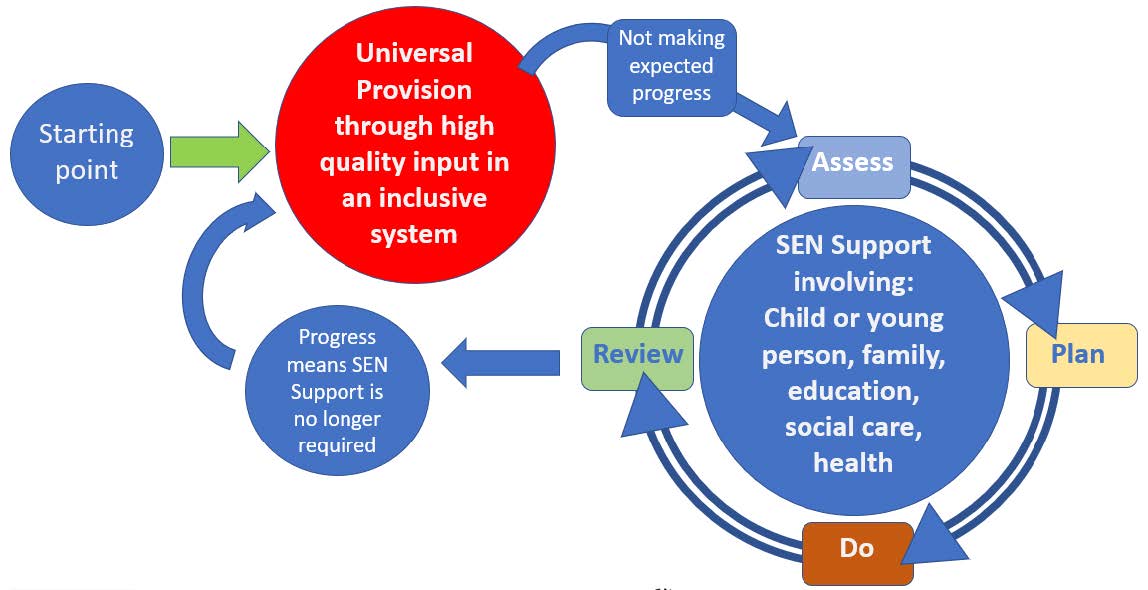
They should do this using the following four steps.
Teaching staff should work with the SENDCO to assess your child or young person’s needs, so that they give the right support. They should involve you in this and, where possible, seek your child or young person’s views. They should talk to you about this first and should take any concerns you may have brought to their attention seriously. Schools can and should involve specialists, such as educational psychology or speech and language therapy, to provide further advice and support if your child continues to make little progress or work at substantially lower levels than expected.
If the school decides that your child or young person needs SEND support it must tell you or your young person directly if they are over 16. The school should agree the outcomes that will be set, what help will be provided and a date for progress to be reviewed with you or your young person. The school should draw up a plan, involving you and your child, focusing on the outcomes your child needs and wants to achieve and detailing how the school will support them to achieve these. Schools should record details of the actions they are taking under SEND support.
Your child’ or young person’s class or subject teacher is usually responsible for the work that is done with your child or young person, and should work closely with any teaching assistants or specialist staff involved. The school should tell you or your young person who is responsible for the support your child or young person receives. The SENDCO will usually works with class and subject teachers to plan and deliver support, and keep a record of this. Everyone in school who works with your child or young person should be aware of their needs and the plan in place to address them.
The school should review your child’ or young person’s progress, and the difference that the help your child or young person has been given has made, on the date agreed in the plan. You and your child or young person should meet with school at least three times a year and be involved in the review and in planning the next step. If your child or young person has not responded to the help they were given, the review should decide what can be done next, which should be recorded in the records. This may include more or different help.
It is up to schools to decide how to keep their records but they should be able to provide clear and accessible information to you about your child’s support and progress. SEND support meetings should be in addition to scheduled parents’ evening meetings. The school must provide a report at least once a year on your child or young person’s progress.
To get a more in depth understanding of SEND support you may want to look at You may want to look at:
If, following a period of time at SEND Support stage, your child or young person is still not making the expected progress, you, your young person if over the age of 16 or the school can ask for an Education, Health and Care (EHC) needs assessment.
The Local Authority receive money from central government each year to fund schools. This is called the Dedicated Schools Grant (DSG). The DSG is split into three parts or 'blocks':

The Local Authority receive money from central government each year to fund schools. This is called the Dedicated Schools Grant (DSG). The DSG is split into three parts or ‘blocks’:
Following local area funding decisions in collaboration with the local schools forum, the Education and Skills Funding Agency and Local Authority provide this funding at the same level to all mainstream maintained schools, academies and free schools within thier local area.
This money comes from the Schools block of the Designated Schools Grant (DGS).

Schools, academies and Free schools all get money for each pupil, based on actual pupil numbers. This is called the Age Weighted Pupil Unit (AWPU) and it is part of schools’ delegated funding. This is the amount of money that is allocated to schools for every pupil on roll. This varies according to age, so primary schools get a different rate to secondary schools.
The national average AWPU funding per pupil is about £4,000, but Local Authorities (LAs) are permitted to choose different rates.
In Torbay the AWPU per pupil set for 2024-2025 is:
This funding goes directly to schools, academies and free schools and is used to run the school and to provide support for all pupils (including those with Special Educational Needs and/or Disabilities – SEND) so that they can achieve good quality learning outcomes through Quality First Teaching (QFT).
Some of this money is for general SEND provision for example the cost of providing the Special Educational Needs and Disability Coordinator (SENDCO) and some other resources.
This money comes from the Schools block of the Designated Schools Grant (DGS).
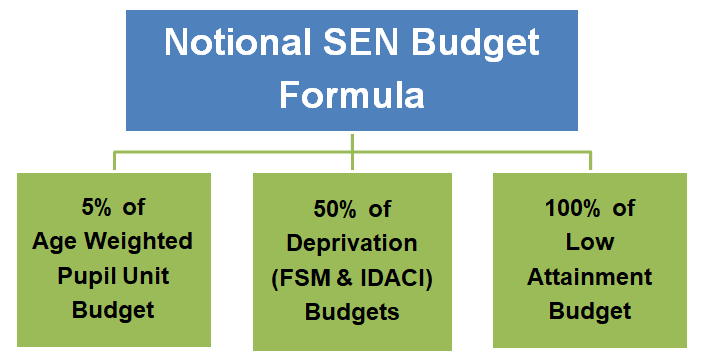
Schools, academies and free schools all have an amount identified within their overall budget, called the notional SEN budget. This is an additional amount of money to the element 1 (AWPU) which is used for SEND provision that is ‘additional to and different from’ the provision made for all pupils. This money is provided directly to schools and academies alongside their AWPU money. It is referred to as ‘notional’ because it is a suggested amount and is not ring-fenced.
The formula used in Torbay is 5% of the Age Weighted Pupil Unit (AWPU) + 50% of deprivation (Free School Meals (FSM) and Income Deprivation Affecting Children Index (IDACI)) budget +100% of the Low Attainment budget = Notional SEN Budget

Pupils with SEND have very varied needs therefore the amount of funding needed to meet these needs will be different for each pupil. The government has recommended schools use the notional SEN budget to pay for up to £6,000 worth of special educational provision to meet a child’s SEND, but the majority pupils at SEND support can have their needs met for much less than this.
Schools should use their SEND funding to pay for things like:
To find out how your child’s school use their SEND money, have a look at your child’s schools SEN Information report.
A school must use its ‘best endeavours’ [do all it possibly can] to meet the needs of pupils at SEND support using element 1 and 2 funding. School provision must be based on an ‘assess, plan, do, review’ cycle implemented in partnership with the pupil and their family. Sometimes the provision may target a pupil, but often shared provision is more preferable and meets the pupil’s needs best. For example, group work is very important when developing language and social skills.
More information about the provision that schools are expected to make for pupils at SEND support can be found in the SEND Code of Practice 0-25 p 99 – 107.
Some pupils with SEND will also be eligible for additional funding from:
This is provided from the high needs block element of the Designated Schools Grant (DGS), and is aimed mainly, though not exclusively, at pupils with Education, Health and Care plans (EHCPs).

The government expects schools, academies and free schools to have spent at least £10,000 out of their core and notional budget before this funding can be accessed.
Top-up funding is individual pupil related funding from the Local Authority from national funding called the ‘high needs block’ for children and young people with an Education Health and Care plan (EHCP) where the provision described is above the level of provision expected to be covered by Element 2 (Notional SEN Budget).
This funding is awarded on an individual basis and the amount depends on the pupil’s level and complexity of need in line with funding matrix descriptors.
An EHCP describes a pupil’s needs, agreed outcomes and required provision and the top-up funding is directly linked to these and reviewed alongside the Annual Review of the child’s EHCP.
The rest of the high needs block is used by us to fund other types of SEND support and provision. The total funding in the high needs block is spent on many different types of support. This includes:
The information below provides more information about what Carers Support Workers do and the contact list for Carers Support Workers and other support for Carers in Torbay.
Bay Benefits is a sevice offered by Carers Aid Torbay to unpaid carers and their families. Their entitlements advisor will work through the benefits process with unpaid carers.
The service aims to support unpaid carers to fill in benefits forms such as:

If applications for benefits are turned down, they can also help guide you through the appeal process.
Benefit line: 07530790354
(9.00am until 3.30pm, on Tuesdays and Thursday’s)
The service gets very busy so please contact them for an appointment in good time, as if you leave it to the last minute they may not be able to support you.
Carers Aid Torbay will support any unpaid Carer in Torbay. We offer them advice, help, information, practical and emotional support to alleviate some of the stress created by the responsibilities of caring.
Livewell Southwest is hosting the Children, Young People and Families (CYPFS) Neurodiversity Wellbeing Team for Torbay, Plymouth and Devon.
The CYPFS Neurodiversity Wellbeing Team will be supporting families who have a child/young person who experiences challenges with their neurodiversity. This wellbeing support can focus on areas such as sleep, diet, anxiety management, school difficulties, friendships and behaviour strategies for children and young people between the ages of 0-18 years.
The team can also provide advocacy support such as connecting families to local groups, organisations and professionals, in addition to assistance with completing forms, attending workshops/support groups and contacting local services.
They provide services to all families who are registered with a GP and are facing difficulties associated with neurodiversity, such as Autistic Spectrum Conditions (ASC) and/or Attention Deficit Hyperactivity Disorder (ADHD), regardless of whether the young person is pre-diagnosis or post-diagnosis.
They work with families on Neurodiversity waiting lists at both the Torbay Mood, Emotions and Relationships Service (MERS), previously known as CAMHS (Child and Adolescent Mental Health Service), and the Child Development Centre (CDC). Their aim is to support you / your young person even if they do not have a diagnosis.
View and / or download the Children, Young People and Families Neurodiversity Wellbeing Team leaflet here:

Devon in Sight offers a range of holistic services for anyone affected by sight loss across Devon. We can provide support to people who are blind or partially sighted, their families, friends and carers.
Our Sight Loss Services focus on four key areas, Information, Advice and Guidance, Independent Living, Health and Wellbeing, and Influencing Change (Making the world a better place for people with sight loss).
DFA provides support to adults on the autism spectrum who do not have a learning disability in Devon.
Email: trishdarke.dimensionsforautism@gmail.com
Facebook: Dimensions for Autism | Facebook
Online group chat using the Discord platform
Our Family Help Service is available to children and their families and is made up of two types of services that combine in different ways to form Torbay’s Early Help offer.
Here is the link to the assessment portal where you can register and complete an Early Help Assessment
These are universal services and targeted services.

Our Family Help Universal offer covers an umbrella of services which are available to all children and families. Please click here to open more information and how to contact that service.
The Family Intervention Team offer focused family support to families with complex needs through targeted support. We work flexibly and creatively with parents and their children in their homes and in groups, to increase the skills, confidence and abilities of all family members to live their daily lives in a positive and safe way. Key areas of work:

Early Help Assessment:
Support
Email: earlyhelp@torbay.gov.uk
Phone: 01803 208100
Healthwatch Torbay is the independent consumer champion for people using local health and social care services in Torbay, South Devon.
Our work covers all areas of health and adult social care. This includes GPs, hospitals, dentists, care homes, pharmacies, opticians and more.
We listen to what local residents say about the healthcare services they use and make sure they are heard by the people in charge who have the power to improve services for you. The more people share their ideas, experiences and concerns about their NHS and social care, the more services can understand what works, what doesn’t and what people want from care in the future.
Contact us:
Website: Home – Healthwatch Torbay
Email: info@healthwatchtorbay.org.uk
Healthwatch Torbay
Freepost-RTCG-TRXX-ZZKJ
Paignton Library & Information Centre
Great Western Road
Paignton
TQ4 5AG
Walk in centre:
Mon-Thurs 10am-3pm, Fri 9.30am-12pm.
(Upstairs in Paignton Library)
Telephone: (Freephone) 08000 520 029
Feedback/Concerns: 0800 520 0640
(Staffed 10am-4pm, Mon-Thurs)
Text Message: 07469 244112
Using this directory of online tools and resources you can filter information by type of audience and by topic.
SEND Family Voice Torbay is an independent Parent Carer Forum recognised by the Department of Education.

We are a small, independent, passionate group of volunteers, dedicated to listening and responding positively to the views of parents and carers of SEND children and young people. Our aim is to make life just that little bit easier by providing mutual support and exchanging information through to influencing policy and practice. We receive an annual grant from the Department for Education, to strengthen and sustain parent carer participation.
SEND Family Voice Torbay work with Torbay Council, the local NHS and other partners to help bring about improvements in SEND services and say hearing from local families vital.
We want to listen to and respond to the needs of parents for our SEND children and young people helping them access services and co-produce a positive change in the planning, commissioning, delivery and review of services. Championing the voice of parents and carers and ensure that the voice of lived experience is heard at every level. This means your voice!
We aim to use our collective voice for change by working co-productively with Torbay Council and other agencies to improve communication and remove barriers for the benefit of SEND families in Torbay. We are welcoming being part of the National Network of Parent Carer Forums, which brings together over 150 parent carer forums in England. Together, these local forums reach over 80,000 families.
Facebook: SEND Family Voice Torbay | Paignton | Facebook
Email: admin@familyvoicetorbay.onmicrosoft.com
Website: Family Voice Torbay
Office: Parkfield House, Paignton.
The Supporting Families Programme is a Government funded initiative that has been running since 2015.
When families experience a lot of challenges all at once these can be the most difficult times for them. The Supporting Families programme is aimed at working with families at these times by providing targeted interventions for families with complex problems. These problems might include the following:-
The four key principles of Supporting Families is helping you at the earliest possible time you experience a problem, working with your whole family, working with other agencies in partnership who can provide different types of support to you, and ensuring we make a real difference to you and your children.
The Supporting Families programme in Torbay is delivered via the Early Help Partnership. For more information click on the link, speak to a Family Hub worker or contact us by clicking here.
The Torbay Comunity Helpline is open to the people of Torbay to request help, volunteer their assistance or refer anyone they believe/know needs help.
Examples of what we provide support with include (but aren’t limited to) financial advice, mental health support, foodbank referrals and befriending, all provided by a number of community groups and statutory services around Torbay.
Activities and support for individuals with learning disabilities and their families.
Website: Torbay Mencap
Explore what financial support you can get through welfare benefits and grants based on your circumstances.
Turn2us is a national charity providing practical help to people who are struggling financially.
Lots of people care or support their relatives or friends. They may help with shopping or meals, attending appointments with them, or just making sure that they are alright. They may not see themselves as a carer or know about the support available to them.
Being a carer is really important and we want to help them, and the people they care for. Our commitment to this is in our carers policy, and in our action plan which will help us to achieve this.
Torbay Carers Service – Torbay and South Devon NHS FT
Contact us to see how we can support you in your caring role.
We offer:
For more details, ask your Carer Support Worker, call 01803 66 66 20, or email signposts@nhs.net
Ask us about a free Carer’s Passport
Torbay Carers Service
Torbay and South Devon NHS Foundation Trust
Paignton Library
Paignton
TQ4 5AG
Website: Torbay Carers Service – Torbay and South Devon NHS FT
Provides social support and access to information and guidance for parents and carers of young people who have a recognised disability, additional need or are awaiting diagnosis.
07796470009
https://tissuesandissues.org/
https://www.facebook.com/groups/1998466853749511/
tissuesandissues@outlook.com
We provide impartial information, advice and support to parents/carers & children/young people in relation to special educational needs and/or disability issues for children/young people aged 0-25.

Working across education, health and social care our officers provide confidential and impartial advice, as well as ensuring that parents and carers’ views are heard and understood and that they understand their rights, roles and responsibilities.
SENDIASS Torbay supports parents through a range of ways including phone or email contact and face to face meetings. We have recently started running coffee mornings for Parents to be able to share thier experience and learning with each other and gain new information from us and other professional invited speakers. (Please see the flyer, attached within the downloads section on the right hand side of this webpage, for more information including dates, times and venues)
We also provide a signposting service to direct parents and carers towards the organisations that is best suited to help them, ensuring that they are empowered to make informed decisions about their child’s future.
SENDIASS Torbay can support parents and carers and children or young people in any of the following areas:
We can provide advice on
Any service provided by SENDIASS ensures complete confidentiality for each individual case, we only take direct referrals from parents/carers & children/young people, or from a professional on thier behalf. We only make contact with a parent/carer or child/young person if it has been agreed that we can do so, and we have a dedicated confidential enquiry line. We can and will liase with other professionals on your behalf, with prior written consent. Contact us to find out more about how you can get involved.
Phone: 01803 207884 (inquiry line open 10am – 2pm Mon – Fri and 24 hour answerphone facility)
Email: sendiass@torbay.gov.uk
Sendiass Torbay | Torquay | Facebook
Website: Sendiass Torbay | Torbay
National Organisation that provides advice and information about how computers and other digital technologies that can help people with a range of conditions and impairments. There is a range of free downloadable factsheets on their website and they also provide a helpline.

Helpline: 0800 048 7642
(normal UK office hours)
National Organisation that specialises in the design and manufacture of clothes for wheelchair users, or for anyone who has problems in finding essential clothing that fits properly.

National Organisation that provide Assistive Technology and Augmentative and Alternative Communication services for people of all ages with complex needs.

Advice helpline: 0800 080 3115
(Office hours, 9am – 5pm, Monday – Friday)
Website: Ace Centre | Charity specialising in AAC & Assistive Technology
National Organisation with online information about Mayalgic Encephalomyelitis (ME)

Information and support for all ages: 0117 927 9551
Website: Action for ME
Facebook Group - Action for Sick Children’s mission is to ensure that healthcare in the UK meets the unique needs of all children and young people and their families.

Facebook Group – Action for Sick Children’s mission is to ensure that healthcare in the UK meets the unique needs of all children and young people and their families.
This National Organisations objective is to promote awareness to ADD, ADHD (Attention Deficit Hyperactivity Disorder) and to provide information and as much free practical help as theyt can to those affected by the condition, both adults and children and their families.

ADDISS is The National Attention Deficit Disorder Information and Support Service. including National ADHD and assocoiated conditions Information service, they can provide information, factsheets and recommend specialist books. The website has lots of helpful information and special sections for parents, children, teenagers and professionals.

Website: ADDISS
ADHD UK is by people with ADHD for people with ADHD.
ADHD is a condition that affects a significant number of people in the UK and, as every person is unique, it impacts individuals differently. We aim to help people navigate their life with ADHD, we want to reduce the stigma that some attach to those with ADHD, build awareness, and undertake or fund research that will have a meaningful positive impact on those with ADHD.
Website: ADHD UK – Homepage – ADHD UK
Afasic supports and provides information for families with children and young adults who have Speech Language and Communication Needs (SLCN) with a focus on Developmental Language Disorder (DLD).

Afasic Parents’ Helpline: 0300 666 9410
(Monday & Wednesday: 10.30am to 4.00pm)
Website: Home – Afasic
National Organisation that provides information and advice in relation to Allergies. Online information includes Allergy resources for schools.

Helpline: 01322 619898
Website: Allergy UK | National Charity
Anxiety UK is a national registered charity that provides information and support for anxiety, stress, anxiety-based depression or a phobia that’s affecting your daily life.

Helpline: 03444 775 774 | Text support: 07537 416 905
(Mon-Fri 09:30-17:30)
Website: National charity helping people with Anxiety – Anxiety UK
At Asthma + Lung UK, we believe that every breath matters – and that the right to breathe freely applies to everybody, regardless of income, age, ethnicity, gender, or background. For independent, confidential advice and support contact our Respiratory Nurses and Health Care Advisors.

Helpline: 0300 222 5800 | WhatsApp: 07378 606 728
(Monday to Friday, 9am to 5pm)
National Organisation that provides information, advice & support to sufferers, their families, carers & professionals. They also provide: Quarterly mag, info leaflets, videos & helpline.

Helpline: 0800 995 6037
(Monday to Thursday 10.30am until 2.30pm)
Website: Home – Ataxia UK
Autism Central is a peer education programme, commissioned by NHS England. It aims to build knowledge and understanding of autism and empower families and carers to advocate for autistic people they support. Local support helps families to get the right understanding and adjustments in place across the services they use.
Everything the programme does is informed by, or co-produced with autistic people, families and carers.
Website: Autism Central for Parents and Carers | Autism Central
National Organisation that provides loads of free online information and resources.

Website: Autism Education Trust
Be My Eyes is a free app that connects blind and low-vision people with sighted volunteers and company representatives for visual assistance through a live video call.
Download the Be My Eyes App: Be My Eyes – See the world together
Beat is the leading UK charity for people with eating disorders and their families.
Beat provides helplines, online support and a network of UK-wide self-help groups to help adults and young people in the UK beat their eating disorders.
Helpline: 0808 801 0677
(open 365 days a year from 1pm – 9pm during the week, and 5pm–9pm on weekends and bank holidays)
Website: The UK’s Eating Disorder Charity – Beat (beateatingdisorders.org.uk)
A national charity offering practical help to families caring for children with conditions like autism, aspergers, cerebral palsy, Down’s syndrome, developmental delay, brain injury, and specific learning difficulties like ADHD, dyslexia and dyspraxia.

We specialise in understanding the causes of challenging behaviour and can even offer support if your child has not been diagnosed with a condition.
Support and Advice Line (SAL): 07852803193
(Open Monday – Friday 9am – 5pm for calls or texts)
Website: bibic charity – assessments and developmental therapy for children
A national charity dedicated to supporting individuals with the much misunderstood and devastating condition of bipolar, their families and carers.
You may be worried about your mood swings and wonder if it’s something other than just growing up. You may already have a diagnosis, be waiting for one or disagree with your diagnosis. You may have a friend or family member with bipolar and you would like more information on how you can support them. Whatever the reason, we’re here to help.
Peer support is at the core of our work.
We offer:
Website: Bipolar UK National UK Charity
A resource for families, teachers and anyone who would like to know more about acquired brain injury in children.
Brain Injury Hub | The Children’s Trust (thechildrenstrust.org.uk)
A membership organisation working to achieve a dyslexia-friendly society for all.
Helpline: 0333 405 4567
(10am – 1pm Tuesdays & Wednesdays; 1pm – 5pm Thursdays)
A charity set up to help improve the lives of children with brain related conditions through research, education and directly supporting the children and their carers.
They offer a wide range of services and support helping the families of children with brain conditions including:
Website: Get Advice and Support – Cerebra
Child Autism UK helps children with autism achieve their potential. We provide services to enable children to overcome difficulties with communication, learning and life skills and give families the techniques and strategies to cope with autism through the use of evidence-based strategies.

Autism helpline: 01344 882248
Website: Support, advice and services for autistic children – Child Autism UK – releasing potential
Organisation that supports children, adults and families affected by rare growth conditions.

Telephone support line: 0208 995 0257
Website: Home – Child Growth Foundation
Free specialist legal advice and information on child, family and education law for parents, carers and young people in England from Coram Children’s Legal Centre.
This service is provided via this website packed with how to guides and information pages.
We cover legal issues that may arise following relationship breakdown as well as Local Authority intervention and child protection issues.
Our education advice ranges from admissions issues to exclusions as well as what to do if your child is being bullied to how to get help for your child if you suspect they have a Special Educational Need.
We also provide specialist advice and information on child, family and education law to parents, carers and young people in England via email and telephone.
Website: Home new – childlawadvice.org.uk
Facebook Groups - Our objectives are to increase knowledge and awareness about diabetes and its treatment in children and young people. We share experiences of living with diabetes.

Facebook Groups – Our objectives are to increase knowledge and awareness about diabetes and its treatment in children and young people. We share experiences of living with diabetes.
The Children with Diabetes UK (CWD UK) online groups and the Children with Diabetes UK Advocacy Group are patient-led support groups for families of children with diabetes living in the UK. It is run by families of children with diabetes.
Facebook Groups:
CWD UK Education – from nursery through to University
CWD UK Teens with Diabetes for kids aged 13-15 years old
CWD Young Adults with Diabetes 16-25 years old
Website: Help for UK Kids With Diabetes Children With Diabetes UK
Children’s Education Advisory Service (CEAS) is a tri-service organisation funded by the Ministry of Defence (MOD). It was established to provide information and support to Service families and eligible MOD civilians on all aspects of the education of their children in the UK and overseas.

When children move frequently from one school to another or between different educational systems obtaining appropriate provision can be complex.
CEAS provides information and advice as well as supporting parents at meetings with schools, local authorities, at tribunal etc. No question is too small or too large for us to deal with. If we don’t know the answer ourselves we usually know someone who does.
The Head of Service is Olivia Denson who is assisted by Jeremy Watt, Deputy Head of Service. Both have experience of working at a senior level in schools as well as working in local authorities. Susan Wright and Peter Flood are Parent Support Officers based in the Upavon office and Bernadette Lynch is a Parent Partnership Officer based in Germany. They all have extensive experience of working in education.
CEAS also has a Business Manager, 2 Executive Officers and 6 Helpline Operators. All of our staff have considerable experience of advising Service parents on a wide range of issues regarding Service children’s education.
Website: Children’s Education Advisory Service (CEAS) – GOV.UK (www.gov.uk)
A UK wide charity providing advice, information and support to the parents of all disabled children.
Helpline: 0808 808 3555
(Monday-Friday, 9.30am-5pm)
Website: Contact: the charity for families with disabled children
National Organisation responsible for research, education & support in all areas of cystic fibrosis.
Explore our information resources, including our consensus documents, factsheets and information packs, children’s books and our magazine CF Life.
Helpline: 0300 373 1000 or 020 3795 2184
(Monday–Friday 10am–4pm)
WhatsApp on 07361 582053
National Organisation that provides information, advice & practical help to parents to help their deaf child to listen & talk.
We are providing monthly online drop in events for parents/guardians/grandparents through Google Meet to be a part of the DELTA Community to ask questions, discuss and share experiences of raising their deaf child at home and at school using the language of the home and community.
Each month we will carry a theme and parents will be able to sign in from the comfort of their own home to be involved in sessions expected to last one hour to 90 minutes.
Website: DELTA: Deaf Education Through Listening and Talking – Deaf Education
We’re leading the fight against the UK’s biggest and growing health crisis. And it’s a fight that involves us all – sharing knowledge and taking on diabetes together.
Helpline: 0345 123 2399
(Monday to Friday, 9am to 6pm)
Website: Diabetes UK – Know diabetes. Fight diabetes. | Diabetes UK
DigiBete is a place to help young people and families to manage Type 1 Diabetes via a video platform and app, and one-stop-shop for young people’s diabetes management.

Website: Home – DigiBete
Find out about Dimensions’ autism friendly cinemas, libraries, museums and Belong by GAME Arenas.

Website: Dimensions autism friendly environments – Dimensions (dimensions-uk.org)
National Organisation that provides free e-learning resources about disabilities.
Website: Disability Matters Hub
A website for kids and teenagers to learn about Developmental Language Disorder (DLD) and to share how they've told others.

A website for kids and teenagers to learn about Developmental Language Disorder (DLD) and to share how they’ve told others.
Website: What is DLD? | DLD and Me
National Organisation that offers information, advice and support to people with Down's syndrome, their families and carers and the professionals who work with them. We have a general information and support helpline, and specialist benefits and education advisors.
National Organisation that offers information, advice and support to people with Down’s syndrome, their families and carers and the professionals who work with them. We have a general information and support helpline, and specialist benefits and education advisors.
Helpline: 0333 1212300
(10am-4pm)
Website: Home – Downs Syndrome Association (downs-syndrome.org.uk)
National Organisation that provides advice, information, support, professional & parental conferences and much more.
Helpline: 01462 454986
(9am -1pm, Tuesday –Friday)
Website: Dyspraxia Foundation
National charity dedicated to improving children’s bowel and bladder health.

Free helpline: 0808 169 9949
(Mon to Thur, 10am – 2pm)
Website: Home – ERIC
National Organisation that provides support, information, training, assessment, freephone helpline, publications & comprehensive website.
Helpline: 0808 800 5050
(Monday to Friday: 8.30am to 5pm and Saturday: 10am to 4pm)
Website: Home – Epilepsy Action
National Organisation that is committed to increasing the awareness and understanding of epilepsy both among people whose lives are directly affected by the condition, and the wider public.
Helpline: 01494 601 400
(Monday and Wednesday – 9am to 7.30pm, Tuesday, Thursday, and Friday – 9am to 4pm, Saturday – 9am to 12.30pm – not open on bank holidays)
Website: Epilepsy Society | Transforming lives through advocacy, research and care
FASD Awareness was established in 2018 to support the FASD community and raise awareness of Foetal Alcohol Spectrum Disorders (FASD). These two aims are met by providing support and friendship groups, activity days, education, training, and information to the FASD community and the wider population.
FASD Awareness is a family-focused organisation and is the essential bridge linking those with lived experience with clinicians and support services.
A charity that supports adults, children and their families diagnosed with Functional Neurological Disorder and adults, children and their families awaiting diagnosis.

They offer support, advice and pathways for treatment.
They run craft mornings and a drop-in centre in Newton Abbot.
You can message them on social media, where they will be happy to support you.
Website: FND FrieNDs |
The Fragile X Society aims to improve the lives of those affected by Fragile X and associated conditions by providing information and continued support to families and professionals they work with. Working together with those affected, the Society supports an inclusive community of people who understand the specific needs of Fragile X.
National Organisation that provides info & advice to sufferers and their families.

Helpline: 020 7939 0780
(9am to 5pm Mon – Friday)
Website: The Haemophilia Society – Together For Life | The Haemophilia Society
National Organisation, giving support and advice to families/carers and people with Huntington’s Disease, as well as health care professionals. Thier website also has lots of information about children, teens and young adults who have Juvenile Huntington’s Disease. Contact Head Office for details of local support groups.

Helpline: 0151 331 5444
(Monday to Friday, 9am to 5pm)
Website: Huntington’s Disease Association – Home (hda.org.uk)
National Organisation for people living with diabetes run by people living with diabetes.

Helpline: 01604 622837
(9.30am to 4.30pm, Monday to Fridays – does not offer medical advice or counselling)
SENDIAS services can support children, young people and their families on a range of issues including: school exclusions; EHC Needs Assessments; supporting conversations with a school or local authority; representation at SEND tribunals.

IPSEA is an independent national advice and support centre which offers free and independent legal advice and support in England and Wales. IPSEA deals with issues such as appeals to the SEN tribunal, disability discrimination in school and support for SEN pupils in school.
IPSEA has hundreds of free and downloadable website resources to help families get the right education for children and young people with all kinds of special educational needs and/or disability.
Book their Advice line or Tribunal helpline via the IPSEA website.
Call-in Helpline: 0300 222 5899
(Tuesday-Thursday 9.30-14.30)
Website: (IPSEA) Independent Provider of Special Education Advice
General enquiries and signposting, rather than specific advice, is also available via thier Main Office
IPSEA Office Phone number: 01799582030 (open Monday-Friday 10.00-15.00)
Learning for Life covers late primary, secondary, and beyond school, focusing on the Relationships and Sexual Education curriculum. The resources are created in line with what the Down's Syndrome community needs; teaching on personal health, emotions, relationships, and appropriate behaviour.

Learning for Life covers late primary, secondary, and beyond school, focusing on the Relationships and Sexual Education curriculum. The resources are created in line with what the Down’s Syndrome community needs; teaching on personal health, emotions, relationships, and appropriate behaviour.
Current resources explore Growing Up and Keeping Safe, Emotions, Puberty and Caring Friendships. These resources are created with specialist teachers and speech and language therapists, for young people with Down’s Syndrome and other SEN. To break down barriers in SEN education, all Learning for Life recourses are completely FREE and exclusively online.
Living Made Easy is a programme from DLF, part of Shaw Trust. We believe everyone has the right to live a decent and dignified life, we challenge inequality, and our work aims to break down barriers to enable social mobility
Website: Living Made Easy – Home
A UK charity for people with a learning disability and their families.

Learning Disability Helpline: 0808 808 1111
(10am to 3pm, Monday to Friday)
Website: Learning Disability – Down syndrome – Williams syndrome | Mencap
National Organisation that provides a range of services for those touched by the disease. The website includes information and support option available including an online community, peer support and much more.

Helpline: 0808 80 10 388
(9am-4pm Monday – Thursday and 9am – 1pm Friday)
Website: Meningitis Now | Meningitis charity | Research and awareness
National Organisation that provides practical and emotional support to sufferers & their carers.

Helpline: 0800 652 6352
A charitable membership organisation that exists to support and champion those working with, and for, children and young people with SEND and learning differences.

Membership is free.
A National Organisation that offers information, advice & support to people with Autism and Autistic Spectrum Conditions, their families, carers & professionals.
Complete an online enquiry form to get support from their:
Education Rights Helpline or School Exclusion Helpline
There are also other helplines for transition from school or further or higher education to adult life and tribunal support. Thee is also an online community is a place for autistic people and their families to meet like-minded people and share their thoughts and experiences.
We’re here for every deaf child who needs us, no matter what their level or type of deafness or how they communicate.

We provide free, independent support and information to parents, carers, deaf young people, extended family members and professionals.
We provide opportunities to safely connect with other families and professionals through events, online forums and local groups.
We also campaign for change on a local and national level, to create a world without barriers for all deaf children.
The following helplines are available Monday to Thursday 9am – 5pm and Friday 9am – 12:30pm:
National Organisation that aims to provide comprehensive information and advice service and a campaigning voice on behalf of people with eczema. They also provide information and advice specifically for teachers on eczema in schools.
Helpline: 0800 448 0818
(Monday to Friday between 10am and 4pm, not including Bank Holidays)
Website: Home – National Eczema Society
The National Organisation for FASD is dedicated to supporting people with Fetal Alcohol Spectrum Disorder (FASD), their families and communities. It promotes education for professionals and public awareness about the risks of alcohol consumption during pregnancy.
A charity that supports, advises and trains parents and carers about the education of children with Special Educational Needs and Disabilities.

Helpline: 0845 077 4055
Website: Network_81 (network81.org.uk)
UK charity supporting children and families living with the neuropsychiatric conditions PANS (Paediatric Acute-onset Neuropsychiatric Syndrome) and PANDAS (Paediatric Autoimmune Neuropsychiatric Disorders Associated with Streptococcal Infections).

Website: PANS PANDAS UK
We provide information, support and training about PDA for individuals, families and professionals.
To access support use their PDA Society Enquiry Line online form
A Charity supports families who have a child with a life-threatening or terminal illness.

Website: Supporting Children and Families | Rainbow Trust Children’s Charity
A national charity supporting more than 18 million people in the UK who are deaf, have hearing loss or tinnitus.

RSBC are here to support you and your family if you have a blind or partially sighted child aged 0-25. We offer a range of services including emotional support and practical advice for families, opportunities for children and young people to build confidence and skills through activities, and a specialist further education college - Dorton College.
RSBC are here to support you and your family if you have a blind or partially sighted child aged 0-25. We offer a range of services including emotional support and practical advice for families, opportunities for children and young people to build confidence and skills through activities, and a specialist further education college – Dorton College.
From the moment you receive a diagnosis that your child has sight loss, if there is a change in vision, if your child or family are going through some changes that are difficult to manage or any other time when life just seems a bit tough, get in touch and let one of our Family Practitioners be there to support you. We can support the whole family through our Families First service.
Our Support Advisor is on hand for any practical questions you may have, for example benefits information, blue badges or grant applications.
We also have a range of activities that you and your child can join to connect with others both in person and online. These include Family Fun Days, Audio book Club, Cooking sessions, Support with Assistive Technology, Sisterhood Group, Creative sessions, Sensory Stories and much more.
Our Families First service has Family Practitioners based regionally across England and Wales and our Support Advisor is available by phone or email. Activities are held both in London and online. We also work with local partners to offer activities across England and Wales. Our Connecting Families Facebook group is available to join RSBC Connecting Families Group | Facebook where you can chat in a safe space with other parents and carers.
At RSBC, we want every blind child and their family to have the skills and confidence to live their life without limits. All our services are free to join.
Email: connections@rsbc.org.uk or call 0203 198 0225
Our offices are open Monday to Friday 9-5pm, many of our activities also run on evenings and weekends.
Website – Welcome to the Royal Society for Blind Children (rsbc.org.uk)
Facebook – RSBC Connecting Families Group | Facebook
Royal Society for Blind Children (RSBC)
Life Without Limits Centre, 10 Lower Thames Street, London EC3R 6EN
Costs – all our services are free
Availability
Age Ranges – Blind and partially sighted children 0-25 and their families
Referral required – No
A disability equality charity that provides practical information and emotional support when it's most needed.
A disability equality charity that provides practical information and emotional support when it’s most needed.
Helpline: 0808 800 3333
(Monday to Friday, 9am to 6pm – Saturday and Sunday, 10am to 6pm – and most bank holidays)
Website: Home | Disability charity Scope UK
We believe that every family deserves access to the financial education and support they need to plan for their child's future. We're here to help you navigate the complex world of special educational needs & disabilities and create a plan that works for your unique situation.
We believe that every family deserves access to the financial education and support they need to plan for their child’s future. We’re here to help you navigate the complex world of special educational needs & disabilities and create a plan that works for your unique situation.
We offer workshops, support groups and one-on-one consultations to help you navigate the financial and care services available.
We direct you to a team of experts that can help you create a financial plan that meets your unique needs. From savings plans to Life Cover, Child ISA’s, Trusts, Protection, Wills and Pensions.
Our community is here to support families on their journey towards financial security.
We often collaborate with local and national organisations and host events in an inclusive environment that fosters communication, friendships and support.
Website: SEND Protect | Financial education for SEND Families | London, UK
Facebook Group - Our mission at SENsational Life is to support and empower neurodiverse families; giving parents of autistic children the tools, strategies and knowledge to provide and secure the support and services needed for an inclusive and happy life.

Facebook Group – Our mission at SENsational Life is to support and empower neurodiverse families; giving parents of autistic children the tools, strategies and knowledge to provide and secure the support and services needed for an inclusive and happy life.
Autism & Parent Support UK- Living a SENsational Life #SENsationalWarriors | Facebook
National Organisation supporting deafblind & sensory impaired children, adults, their families & carers.

Phone: 0300 330 9256
(9am to 5pm, Monday to Friday)
Request a British Sign Language interpreter or use Relay UK text service
Website: Sense | For disabled people
National Organisation that provides advice, practical support & information to people with spina bifida and or hydrocephalus, their families, carers and other professionals.
Website: Shine – Spina Bifida & Hydrocephalus (shinecharity.org.uk)
Sibs exists to support people who grow up with or have grown up with a disabled brother or sister. It is the only UK charity representing the needs of over half a million young siblings and over one and a half million adult siblings.
Please see our website www.sibs.org.uk for information and advice.
Or contact us at info@sibs.org.uk
We exist to create a world that makes space for stammering. Where a stammer is embraced as just a difference. Where no-one judges us on our stammer or the way we choose to deal with it.

Helpline: 0808 802 0002
(open weekdays 10am-noon & 6pm-8pm)
Website: STAMMA home page
SWAN UK (syndromes without a name) is the only dedicated support network available for families of children and young adults with undiagnosed genetic conditions in the UK. It is run by the charity Genetic Alliance UK.
Thier 3 main Aims are to:
They provide support by:
Website: SWAN UK (Syndromes Without A Name) – Genetic Alliance
Teach Me Too provides resources for early years and KS1. It covers Literacy, Maths, the Wider Curriculum, Exploring Language and Language through Play.

These resources are created with specialist speech and language therapists for children with Down’s Syndrome/SEN, to be used at home, in school or at support groups.
Teach Me Too is dedicated to utilising innovation and technology to break down barriers to education and learning for every person with Down’s Syndrome, regardless of wealth, background or postcode. As a result, all the recourses can be access completely FREE and are exclusively online.
National Organisation that aim to alleviate the distress and suffering that A-T causes by Funding Research, Supporting Families and Raising Awareness. From the shock of the initial diagnosis through to treatment and the challenges of everyday living, we can provide support, advice and advocacy for people with AT and their family, friends and carers.

Call us on 01582 760733
Website: Home – AT Society
Tourettes Action is run by a small team of dedicated staff and an experienced board of trustees who have worked with Tourette Syndrome and disability organisations.

Thier website provides:
Website: Tourettes Action
Mind provide advice and support to empower anyone experiencing a mental health problem. Their website contains useful information on a range of mental health problems, including postnatal and antenatal depression, perinatal mental health problems, postpartum psychosis, and postnatal depression and perinatal mental health problems experienced by dads and partners, as well as drugs, treatments and tips for everyday living. Mind also offer a range of online support services, as well as local groups. Bromley, Lewisham and Greenwich Mind have also published a downloadable leaflet, setting out advice on “Better mental health for new dads, partners and non-birthing parents”. For more information on the services offered at Devon Mind, please visit their website or Facebook page. Telephone: 01752 512280 Website: https://www.devonmind.com/ Facebook: @MindDevon Email: hello@devonmind.com Telephone: 0300 123 3393 (Mind Infoline – Mon-Fri, 9.00am-6.00pm, not including Bank Holidays) Website: https://www.mind.org.uk/ Facebook: @mindforbettermentalhealth Email: contact@mind.org.uk
Mind provide advice and support to empower anyone experiencing a mental health problem. Their website contains useful information on a range of mental health problems, including postnatal and antenatal depression, perinatal mental health problems, postpartum psychosis, and postnatal depression and perinatal mental health problems experienced by dads and partners, as well as drugs, treatments and tips for everyday living. Mind also offer a range of online support services, as well as local groups.
Bromley, Lewisham and Greenwich Mind have also published a downloadable leaflet, setting out advice on “Better mental health for new dads, partners and non-birthing parents”.
For more information on the services offered at Devon Mind, please visit their website or Facebook page.
Telephone: 01752 512280
Website: https://www.devonmind.com/
Facebook: @MindDevon
Email: hello@devonmind.com
Telephone: 0300 123 3393 (Mind Infoline – Mon-Fri, 9.00am-6.00pm, not including Bank Holidays)
Website: https://www.mind.org.uk/
Facebook: @mindforbettermentalhealth
Email: contact@mind.org.uk