


Highlight to listen
Also see Eye care | SeeAbility

Whatever you’re going through, a Samaritan will face it with you. We’re here 24 hours a day, 365 days a year.

Call: 116 123
Website: Contact Us | Samaritans
A C-Card allows anyone aged 13 to 24 living in Devon and Torbay to access FREE condoms.
Please visit the “Are you OK?” website to learn more about abuse and violence within relationships
Learning for Life covers late primary, secondary, and beyond school, focusing on the Relationships and Sexual Education curriculum. The resources are created in line with what the Down's Syndrome community needs; teaching on personal health, emotions, relationships, and appropriate behaviour.
Learning for Life covers late primary, secondary, and beyond school, focusing on the Relationships and Sexual Education curriculum. The resources are created in line with what the Down’s Syndrome community needs; teaching on personal health, emotions, relationships, and appropriate behaviour.

Current resources explore Growing Up and Keeping Safe, Emotions, Puberty and Caring Friendships. These resources are created with specialist teachers and speech and language therapists, for young people with Down’s Syndrome and other SEN. To break down barriers in SEN education, all Learning for Life recourses are completely FREE and exclusively online.
Sexting is a term often used to describe sharing this type of content but young people may refer to it as sending a ‘selfie or a ‘pic’. What you need to know from Think U Know


Find out about disabled parking in Torbay including how to get a Blue Badge or request a disabled parking bay.


Independent Travel Training is a free scheme which has been set up by Children’s Services at Torbay Council. Our Independent Travel Training programme provides targeted support for Children and Young People with special educational needs and/or disabilities (SEND). Our Trainer works with students from mainstream and special schools, education other than at school, and colleges of further education.

The scheme aims to support Children and Young People with SEND throughout Torbay, as they learn how to develop the skills required for safe and successful, independent travel between home and school. We use a Total Communication approach to support successful interaction, providing a range of communication aids throughout training, suited to the needs of the Trainee.
The Independent Travel Training programme will include road safety awareness, accurately telling the time, handling money, how to use a bus/train pass, appropriate social behaviour, stranger danger, location identification, strategies for solving problems and overcoming barriers, and any other issues that might arise.
If your Child or Young Person currently travels to school or college on assisted transport and would like to travel on their own, then our Independent Travel Trainer could help.
Benefits of our Independent Travel Training programme include:
We provide a person-centred approach, before any training commences our Independent Travel Trainer will liaise closely with the Trainee and their support circle including Parents/Carers, Tutors and Social Workers to gain an understanding of how to tailor the programme to best suit the needs of the Trainee.
If you would like your child to take part in this scheme, or for more information, please contact ITT@Torbay.gov.uk
An IMCA is an Independent Mental Capacity Advocate appointed by the local authority and/or NHS body to protect other people’s interests when they lack the capacity to make certain important decisions and, at the time such decisions need to be made, have no one else (other than paid staff) to support them or be consulted.

The Devon Advocacy Consortium provides an independent, professional advocacy service for people over the age of 16 in Devon. The service is free, flexible and confidential.
We take action to help people say what they want, secure their rights, represent their interests and to get the services they need. Advocates can visit you at home or a place of your choice and if an advocate can’t help they can find someone who will.
The Devon Advocacy service can help you if:
Where the above applies, an IMCA must be appointed when the decision involves:
An IMCA may also be involved:
If you feel that someone meets the criteria for an IMCA please call or email to request a referral form
Contact:
Telephone : 01392 822377
Email: devonadvocacy@livingoptions.org
Web address: https://devonadvocacy.org.uk/
Unit 3-4 Cranmere Court
Lustleigh Close,
Matford Business Park
Exeter
EX2 8PW
The Mental Capacity Act 2005 is a vitally important piece of legislation that applies within England and Wales and makes a real difference to the lives of people who may lack mental capacity. It empowers people to make decisions for themselves wherever possible, and protects people who lack capacity, by providing a flexible framework that places them at the very heart of the decision making process. It places a strong emphasis on supporting and enabling the individual to make his/her own decisions. If they are unable to do this it emphasises that they should be involved in the decision making process as far as possible.

The Mental Capacity Act 2005, covering England and Wales for people aged 16 years or over, provides a statutory framework for people who lack capacity to make decisions for themselves or have capacity and want to make preparations for a time when they may lack capacity in the future. The Act covers a wide range of decisions for example, supporting a person lacking capacity with their activities of daily living, supporting a person lacking capacity to manage their property and finances, supporting a person lacking capacity with serious medical treatment decisions.
You can find out more about the Mental Capacity Act 2005 via the following links:
This series of videos look at each of the Mental Capacity Act Principles in turn.

If you're aged 18 or older and have the mental ability to make financial, property and medical decisions for yourself, you can arrange for someone else to make these decisions for you in the future. This legal authority is called "Lasting Power of Attorney" (LPA).
If you’re aged 18 or older and have the mental ability to make financial, property and medical decisions for yourself, you can arrange for someone else to make these decisions for you in the future. This legal authority is called “Lasting Power of Attorney” (LPA).
You can choose what types of decisions you are happy for other nominated people to make for you.
Lasting power of attorney (LPA) includes:
Find out more about Lasting Powers of Attorney:
Deprivation of Liberty mean taking away a person’s freedom to do things that they want to do and to live where they want to live.
Deprivation of Liberty Safeguards (DoLS) were introduced by the Mental Capacity Act 2005, to protect people who lack mental capacity. However, as a result of the Mental Capacity (Amendment) Act 2019, DoLs is being replaced by new Liberty Protection Safeguards (LPS), they were due to come into effect on 1 April 2022, but have been delayed.
Both DoLS and LPS are designed to protect the interests of vulnerable people who may lack mental capacity and to:
The criteria for both DoLS and LPS is very similar and include the following requirements:
and
DoLS currently applies to anyone who:
However, LPS will increase this protection to anyone who:
Other differences between DoLS and LPS:
Please remember that:
The Devon Advocacy Service provides an independent advocacy service commissioned by Torbay for anyone who would experience substantial difficulty in participating in their assessment, preparation of their care and support plan and review (eg. due to difficulties with communication, including Deaf people with British Sign Language) and where there is no one available to support and represent their wishes.

NB. This service is available via referral only.
The Devon Advocacy Consortium also provides the following advocacy services for people in the Torbay area, available via referral only:
Four Seasons provide work, employment and life skills training for people with disabilities. Our base at Lupton House provides an ideal, safe and supportive learning environment. We develop people’s skills using outdoor practical tasks, horticulture and grounds maintenance. Positioned in the tranquil, therapeutic setting of Lupton House which is a grade 2 listed building nestling in beautiful parkland on the outskirts of Brixham.

Our Aim: “People of all abilities are inspired to develop work, employment and life skills fully within the community.” We are totally committed to equal opportunities to all, ensuring people are central to all that we do.
Contact us:
Four Seasons Torbay CIC, c/o Lupton House, Brixham Road, Brixham, TQ5 0LD
Telephone: 07810 757720
Email: fourseasonstorbay@gmail.com
The course covers the following nine topics to help you with independent living:
Turning Heads is a community interest company that is helping to build a community that values and empowers togetherness.

We work with people and organisations across Torbay. This includes families, children, people with learning disabilities, those who are furthest from employment and education and those who might be isolated or vulnerable.
Turning Heads runs day activities from Windsor House, Lime Avenue, Torquay TQ2 5JL, and both a Community Kitchen and Social Supermarket from Victoria Park Methodist Church in Plainmoor (Torquay).
Our curriculum will be based around providing a workbased employment model over a period of 12 weeks running in parallel with our programme that we offer through the DWP. It will begin with a period of induction which will typically be for up to 4 weeks and will involve the young person trying a variety of activities and opportunities before we decide which particular areas and skills to focus on for the period of time that they are with us.
Our programme will focus on developing confidence, work related skills and will aim to provide the young person with the starting tools to moving back into either education or training or employment. We will be looking at using a variety of NCFE adult qualification units that we can tailor to the individual.
Day services are all chargeable and clients pay through adult social care funding, direct payments or personal funds.
Phone: 07817 777739 or 07817 777739
Email: admin@turningheads.org.uk or alanrtilley@mail.com
Turning Heads, Windsor House, Lime Avenue, Torquay TQ2 5JL
We want you to live as independently as possible. You must decide what is right for you and consider where and who you want to live with.

Young people with learning disabilities should be able to choose:
Whether you want to continue to live with your family, or live with others independently or with support, there is much to consider. After finding somewhere to live, you and your family will need to consider the time scales for any move, financial issues and the level of support you need to live as independently as possible.
Living independently means having the right support to do things when and how you want. As you get older, you are able to make decisions about your life and how you live it. This includes deciding where you want to live.
If you are planning on moving into your own home it is important that you have the following:
The Government housing information webpages offers advice on all areas of moving house like benefits advice, mortgage advice, help with renting a private property and more.
The Torbay Council Housing advice service deal with enquiries from people who are in danger of becoming homeless to those who find themselves in the following situations:
The advice and support available depends on your circumstances and can be anything from one-off advice to being accommodated in emergency housing, while we help you find longer-term accommodation.
The earlier you contact us, the better the chance we have of helping you.
You may decide that you would like to continue living with your family. To continue living at home you may need some changes to be made to the home, or you may need some extra support.
You may decide that you would like to continue living with your family.
To continue living at home you may need some changes to be made to the home, or you may need some extra support.
To make changes to your home you can:
• apply for adaptions or equipment for your home
• apply to get a Disabled Facilities Grant
• find out more information on Shelter’s guide to help with adaptions to your home
To get support for daily living like:
you may need a support worker. You could be able to pay for the support you need from the benefits you recieve or you may be entitled to support via Adult Social Care and a personal Budget. Even if you qualify for support from Adult Social Care it is likely that you will have to pay a contribution towards the support provided.
About to move out for the first time? Whether you’re moving into student accommodation or your own place, living away from home can be an eye opening and daunting experience. Home Truths is here to teach you EVERYTHING you need to know about living on your own.
Visit: Your Place | Water Bills, TV Licencing & More | The Mix
This means renting from someone who owns a property. Some rents will be above the levels covered by housing benefit, so it is important to choose a property you can afford. Make sure you consider carefully how much you can pay when you are looking at properties. You should work out how much rent you can afford.
Private landlords advertise their properties in these places:
There are different ways in which you can rent:
There are a number of options which may suit you and your household:
If you are relying on Housing Benefit to help with your rent, you will need to know how many bedrooms you are entitled to and your Local Housing Allowance rate. Some landlords will not accept people on Housing benefit, so it is always best to check.
If you live on your own or with a friend in rented accomodation you will also need to budget for Coucil Tax. Coucil Tax may be reduced if you qualify for Council Tax benefi.
You will also need to budget for paying bills for things like water, electric, gass etc. unless any of them are included in your rent.
Before you move in you must be aware of:
After you have moved in you may need to consider:
You can find more information about finding a private rented home from Shelter and from How to rent – GOV.UK (www.gov.uk).
You can apply to join the waiting lists for a housing association property by registering with Devon Home Choice.

The number of properties available is limited and there is a long waiting list so most people will not be successful in getting a social housing property.
If you are successful it can typically take 18 – 24 months, so if you need to move quickly then you should not rely on a Devon home Choice application to find a home.
Full details on how Devon Home Choice works and how to apply can be found on our join the housing waiting list page.
Having your own home can help you feel secure and independent.

Home ownership
This is when you own the home you live in, either yourself or with a mortgage. A mortgage is when you borrow money to buy a house and pay the money back over many years. You can also use your savings. You could inherit a home which could be yours alone or it could be left to you and your family.
Shared ownership
This is when a Housing Association owns part of your home and you own the rest. You have to pay rent to the Housing Association for the part you do not own and pay the mortgage for the part you do own.
HOLD
There is a scheme in operation called HOLD that stands for Home Ownership for people with Long-term Disabilities.
This is a way that someone with a disability can own their own home. It is run by some Housing Associations, which are Registered Social Landlords.
The disabled person finds a property they would like to buy. The Housing Association buys the property, so the disabled person only deals with them.
The Housing Association sells part of the property to the disabled person. They might be able to buy more of it in the future.
They rent the other part from the Housing Association, who looks after things like repairs and making sure the property is in good condition.
If you have a disability, the HOLD scheme can help you buy on a shared ownership basis.
You can search on the house shop for properties that are accessible or have disabled access
Supported living can mean and be different things to different people.
For some, supported living can be living on their own with minimal support, living in an individual flat as independently as possible within the community with few hours of support a week. You will have your own tenancy and receive benefits which you will need to use toward daily living, bills and rent and paying towards the cost of any support needs you have.
For others, supported living can mean living with several other people with similar needs and sharing some support. It can mean having access to support 24 hours a day. You will have your own tenancy and receive benefits which you will need to use toward daily living, your share of bills and rent and paying towards the cost of any support needs you have. You may also have shared responsibilities with housemates towards daily chores like cooking and cleaning.
In a ‘shared lives scheme’ someone is matched with a host family and lives as part of that family. They share family life and live with, or near to, the host family. The host family gives support and care.
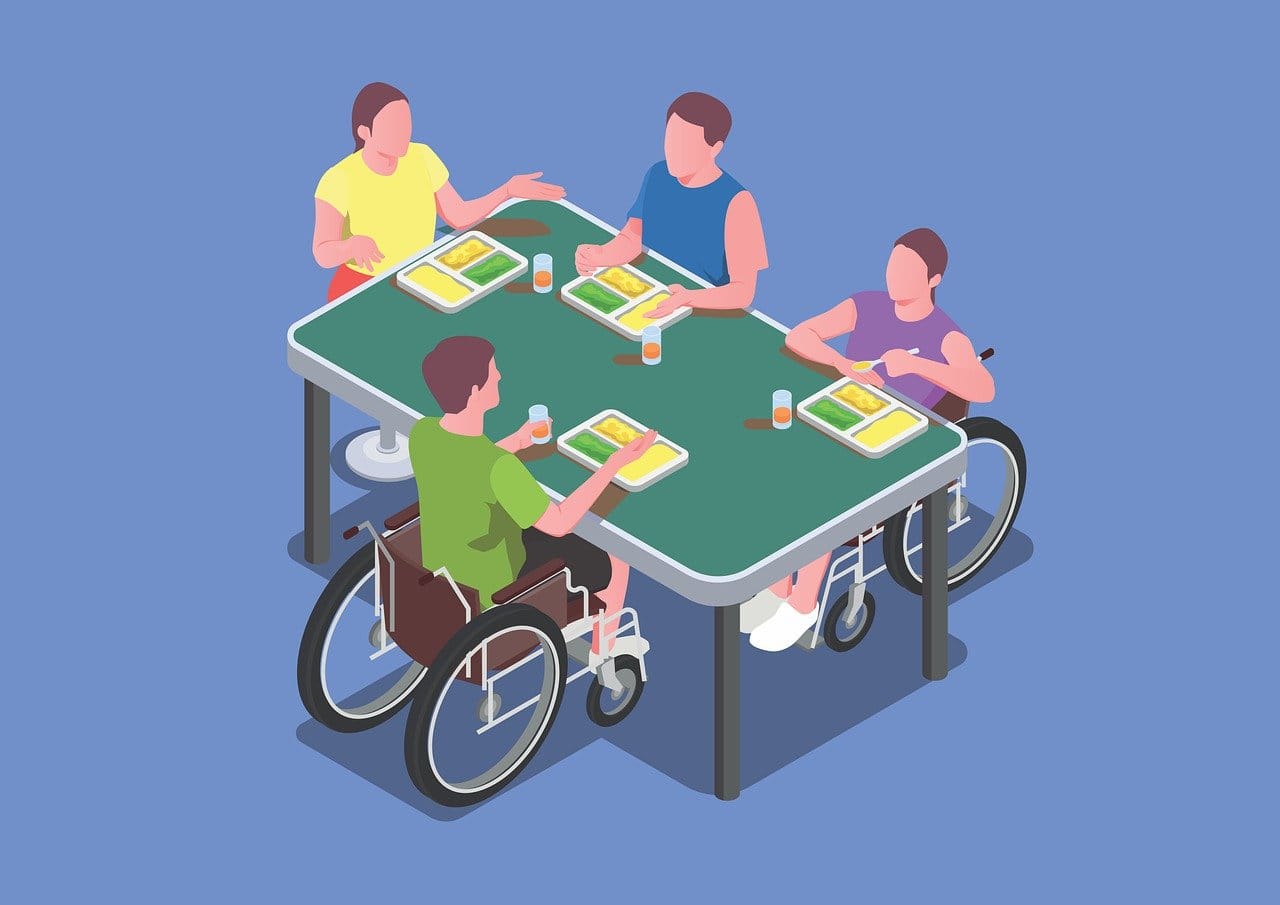
This can be for:
If you are eligable for the shared lives scheme your social worker will have to make a referal before you can be matched with appropriate support. Find out more about shared lives visit Carers who have space in their home to care | Shared Lives South West (sharedlivessw.org.uk)
For some people, residential care is more appropriate. This tends to be for young people with more complex needs, because of their physical need, health need or support with their challenging behaviour. Residential care means having a room in a building shared with a number of other people. Twenty four hour care will be provided on site as will meals. Specialist residential care homes may be considered after all other options for remaining at home have been explored and tried. Access to specialist residential care is based on an assessment of your needs by your Social Worker. Residential care means having a room in a building shared with a number of other people. Twenty four hour care will be provided on site as will meals. You will pay most of your benefits towards the cost of this care and be left with a small allowance. Residential homes are owned and managed by public, private sector or charitable bodies. Some specialise in particular forms of provision, for example for people on the autistic spectrum or those with sensory impairment in conjunction with a learning disability. NHS England has more information on care homes on their website.

For some people, residential care is more appropriate. This tends to be for young people with more complex needs, because of their physical need, health need or support with their challenging behaviour. Residential care means having a room in a building shared with a number of other people. Twenty four hour care will be provided on site as will meals.
Specialist residential care homes may be considered after all other options for remaining at home have been explored and tried. Access to specialist residential care is based on an assessment of your needs by your Social Worker. Residential care means having a room in a building shared with a number of other people. Twenty four hour care will be provided on site as will meals. You will pay most of your benefits towards the cost of this care and be left with a small allowance.
Residential homes are owned and managed by public, private sector or charitable bodies. Some specialise in particular forms of provision, for example for people on the autistic spectrum or those with sensory impairment in conjunction with a learning disability.
NHS England has more information on care homes on their website.
It's gotten more expensive for providers to buy energy, which has led to it costing more for us to power our homes. This is why, at GoCompare, we have developed an interactive energy cost calculator tool to find out how much something costs to run.

It’s gotten more expensive for providers to buy energy, which has led to it costing more for us to power our homes. This is why, at GoCompare, we have developed an interactive energy cost calculator tool to find out how much something costs to run.

Use the interactive calculator to pick the appliances you want to compare and select how long they’ll be in use for: https://www.gocompare.com/gas-and-electricity/guide/energy-calculator/
Illegal money lenders or loan sharks as they are more commonly known are criminals and they will lend money to almost anyone at extortionately high interest rates (100% a week is the norm) and will use a variety of tactics such as intimidation, harassment, threats and violence to ensure that the borrower continues to pay with no end date to the loan.
In the period 2016 – 2021, Devon was the nations “hotspot” for loan shark activity and Torbay in particular had numerous arrests made and several prosecutions.
Anyone who owes a loan shark money needs specialist help and support which only the Stop Loan Shark Team can provide and they can be contacted (anonymously if needs be) either by calling their 24/7/365 Helpline on 0300 555 2222 or via their Live Chat facility on their website www.stoploansharks.co.uk
And most importantly, anyone who has taken a loan from a loan shark has NOT committed any offence at all.
Explore what financial support you can get through welfare benefits and grants based on your circumstances.
Turn2us is a national charity providing practical help to people who are struggling financially.
Short reletively simple e-learning cources on:

People with learning disabilities often have poorer physical and mental health than other people. This doesn’t need to be the case.

The Annual Health Check scheme is for adults and young people aged 14 or above with learning disabilities who need more health support and who may otherwise have health conditions that go undetected.
It is important that everyone over the age of 14 who is on their doctor’s learning disability register has an annual health check.
An annual health check can help you stay well by talking to a doctor or nurse about your health and finding any problems early, so they can be sorted out.
You do not have to be ill to have a health check – in fact, most people have their annual health check when they are feeling well.
If you are worried about seeing a doctor, or there is anything they can do to make your appointment better, let the doctor or nurse know.
They can make changes to help you. These are called reasonable adjustments.
Learning disabilities – Annual health checks – NHS (www.nhs.uk)
High goals are important to success.
Setting the right goals will make sure that your young person will have a happy and fulfilling life.
This is the time to start thinking about:
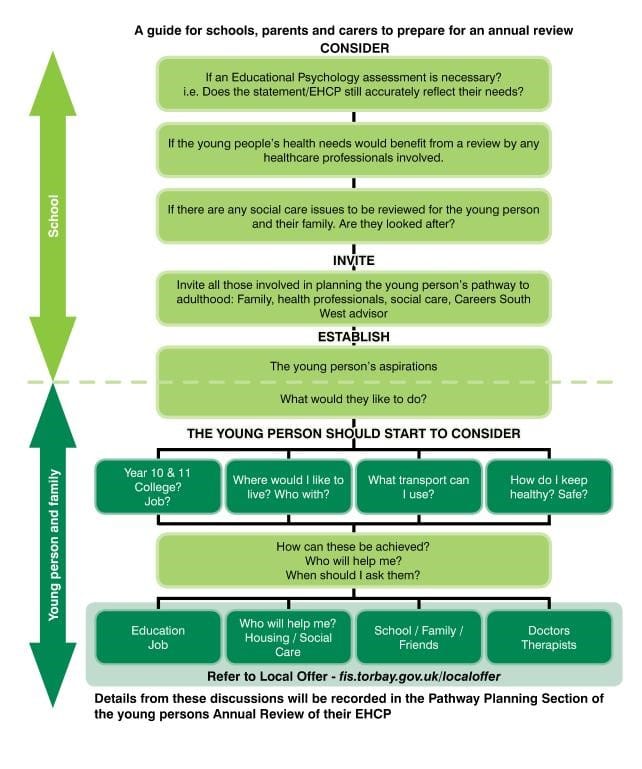
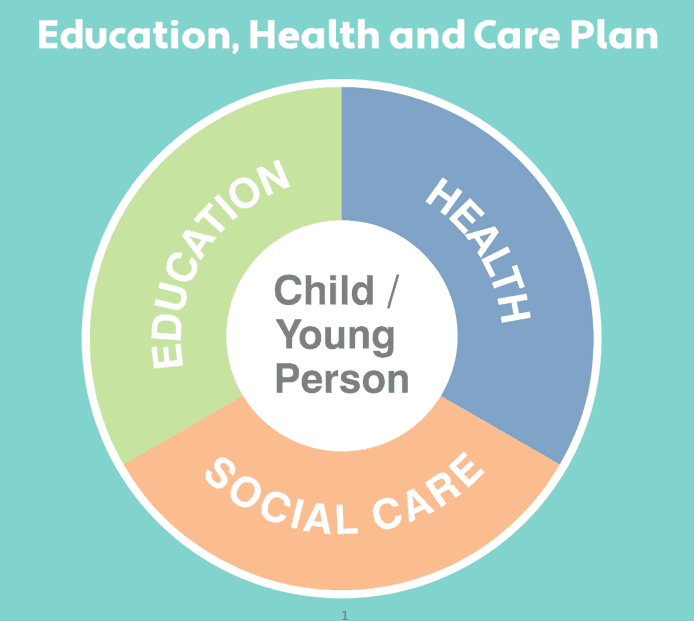
If your young person has an Education, Health and Care plan (EHCP), the Year 9 Annual Review of their EHCP is very important and begins the preparation for adulthood.
Starting this in Year 9 allows time to research options for:
This will ensure that the final years of school will focus on supporting your young person’s successful development in the future.
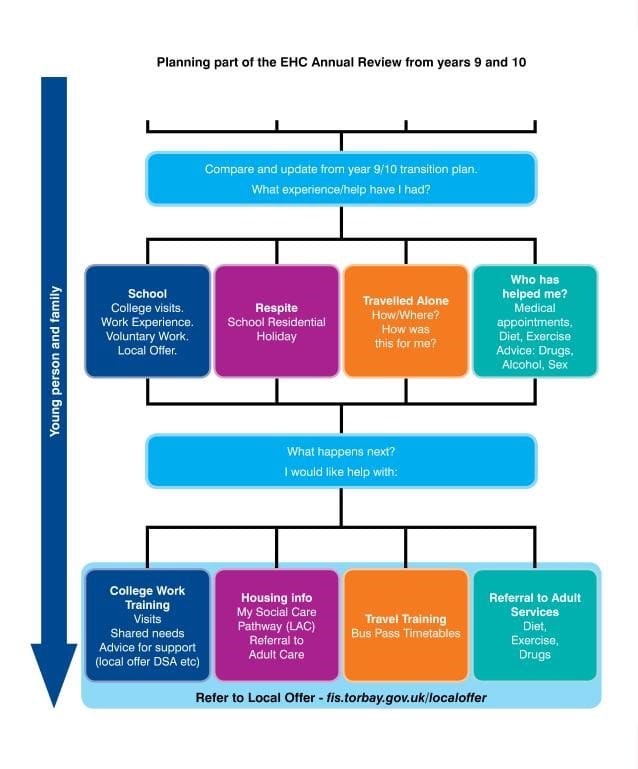
This flowchart will help you understand the moving towards adulthood pathway.

In Torbay, when young people move from childhood to adulthood, this is known as a ‘Transition’. We recognise this can be a daunting time for young people and their carers.
Our aims are:
The Year 9 annual review of your young person’s Education, Health and Care plan (EHCP) is very important and begins the preparation for adulthood. This is the time to start thinking about:
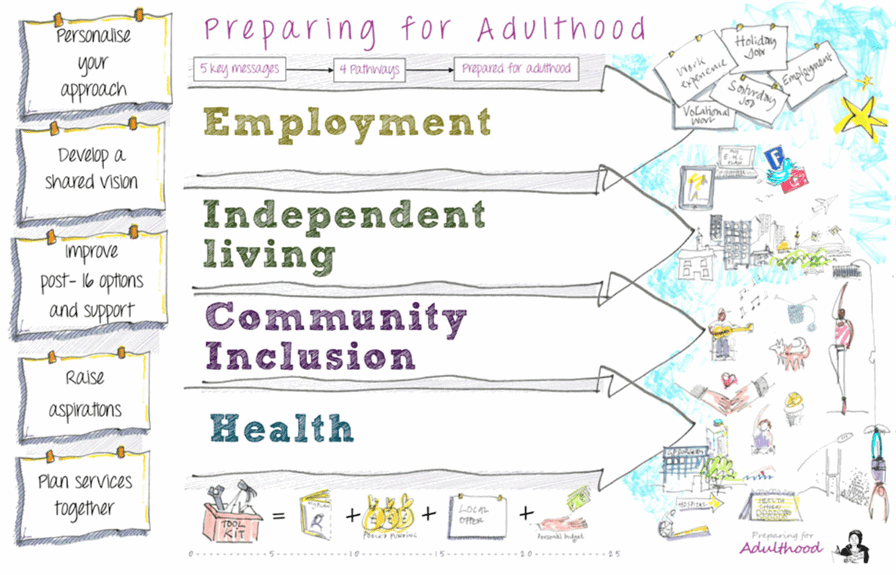
It will be important for the following people to be invited to and attend, or provide a report for, the Year 9 annual review:
These people will make sure that your young person remains involved in planning for their future.
Information, about children who are classed as having complex needs by the Children with Disabilities Service, will start to be shared with Adult Services to help with future planning.
Great reviews start with great preparation - to find out what is needed watch this animate for more information.
Great reviews start with great preparation – to find out what is needed watch this animate for more information.
CSW Group provides free information, advice, guidance and support to people of all ages to help them to enter work and learning.

The service for 13-19 year olds also provides support up to the age of 25 for young people who have learning difficulties or disabilities.
Also offer free information in learning and work to anyone aged 19 and over, helping improve career prospects by learning new skills, retraining or gaining new qualifications.
They also support vulnerable groups during this time of transition.
CSW Group offer a free transition advice and guidance to all Y11 students who have Education, Health and Care plans (EHCP) or are electively home educated (EHE)
The Transitions service aims to:
Website: https://www.devonservices.org.uk/service/careers-south-west/
Please see Post 16 Educational Opportunities which is a related topic on Moving towards Adulthood and can also be found at Post 16 Educational Opportunities.

Extra help or adjustments to exams are called 'Access Arrangements'.

Extra help or adjustments to exams are called ‘Access Arrangements’.
‘Access Arrangements’ allow students with special educational needs, disabilities or temporary injuries to access exams and show what they know and can do.
However, ‘Access Arrangements’ are not allowed to give the student an unfair advantage or compromise the integrity of the exam. This means that there will have to be evidence that any additional support provided in the tests is also the same as or similar to the additional support regularly provided to the student as part of normal classroom practice (except in the case of injuries). For example, a student would only be allowed to use a laptop in exams if they normally use one in class. Access arrangements must also be appropriate to the exam and the student. For example, a student with dyslexia may need extra time for a written exam, but not for a practical one.
There are a wide range of possible Access Arrangements that can be made, including:
Whilst some ‘Access Arrangements’ can be made by School without prior approval (delegated arrangements), many others will require advance application (before the February deadline) for approval or notification.
Every year the Joint Council for Qualifications (JCQ) produce Access Arrangements, Reasonable Adjustments and Special Consideration documents that contains the rules, regulations and guidance on what a student may, or may not receive when sitting formal examinations and lists the types of arrangements that may apply.
Most education providers and examining bodies will have made exam arrangements for individual students before, but they may not have come across all possible arrangements as support needs vary from person to person. If you think access arrangements may be required it is best to discuss this as early as possible, preferably at the start of the relevant course.
Schools may need to contact Educational Psychology & Specialist Teaching Service (TEPATS) who have a form specifically to address assess arrangements.
For young people with an EHCP, your young person’s Year 10 annual review will revisit the ideas first made in the Year 9 Preparing for Adulthood plan.
This is the time to start exploring the options open to your young person to help them reach their goals. This can be done by:
The school may also have open evenings with a focus on post 16 options. Be aware that courses can change and new courses may be introduced in the future.
Where required, the Post 16 provider can offer an extended transition to ensure the young person feels comfortable and helps lessen the anxiety of a change. There will be close liaison between the current school and the future provider, with the young person having a clear plan of what their transition will look like. This is then reviewed and adjusted when needed.
Having an Education, Health and Care plan (EHCP) does not mean having an indefinite Post 16 education. However, it may be possible for any pupil with special educational needs to stay on in education beyond their 19th birthday in certain circumstances if this is the most suitable plan. As with any other planning, this should be discussed through the annual review.
If it has been agreed that your young person’s further educational needs cannot be met at a local college, different providers may be considered. The local authority will review each application on a case by case basis.
This flowchart will help you understand the moving towards adulthood pathway.

In Torbay, when young people move from childhood to adulthood, this is known as a ‘Transition’. We recognise this can be a daunting time for young people and their carers.
Our aims are:
CSW Group provides free information, advice, guidance and support to people of all ages to help them to enter work and learning.
The service for 13-19 year olds also provides support up to the age of 25 for young people who have learning difficulties or disabilities.
Also offer free information in learning and work to anyone aged 19 and over, helping improve career prospects by learning new skills, retraining or gaining new qualifications.
They also support vulnerable groups during this time of transition.
CSW Group offer a free transition advice and guidance to all Y11 students who have Education, Health and Care plans (EHCP) or are electively home educated (EHE)
The Transitions service aims to:
Website: https://www.devonservices.org.uk/service/careers-south-west/
Please see Post 16 Educational Opportunities which is a related topic on Moving towards Adulthood and can also be found at Post 16 Educational Opportunities.
Extra help or adjustments to exams are called 'Access Arrangements'.
Extra help or adjustments to exams are called ‘Access Arrangements’.
‘Access Arrangements’ allow students with special educational needs, disabilities or temporary injuries to access exams and show what they know and can do.
However, ‘Access Arrangements’ are not allowed to give the student an unfair advantage or compromise the integrity of the exam. This means that there will have to be evidence that any additional support provided in the tests is also the same as or similar to the additional support regularly provided to the student as part of normal classroom practice (except in the case of injuries). For example, a student would only be allowed to use a laptop in exams if they normally use one in class. Access arrangements must also be appropriate to the exam and the student. For example, a student with dyslexia may need extra time for a written exam, but not for a practical one.
There are a wide range of possible Access Arrangements that can be made, including:
Whilst some ‘Access Arrangements’ can be made by School without prior approval (delegated arrangements), many others will require advance application (before the February deadline) for approval or notification.
Every year the Joint Council for Qualifications (JCQ) produce Access Arrangements, Reasonable Adjustments and Special Consideration documents that contains the rules, regulations and guidance on what a student may, or may not receive when sitting formal examinations and lists the types of arrangements that may apply.
Most education providers and examining bodies will have made exam arrangements for individual students before, but they may not have come across all possible arrangements as support needs vary from person to person. If you think access arrangements may be required it is best to discuss this as early as possible, preferably at the start of the relevant course.
Schools may need to contact Educational Psychology & Specialist Teaching Service (TEPATS) who have a form specifically to address assess arrangements.
This is a very important year for your young person. Decisions, building on the research started in Year 10, will need to be made. Your young person will now need to think about the type of course they want to do and how that links to their future career path.
The school may have a choice of prospectuses or brochures which list course information and open evenings for colleges and 6th Forms to help with this.
If the young person has a learning difficulty and/or disability and will be leaving school to enter college or a work based learning programme, the school’s careers advisor will complete a My Future, which records the young person’s goals for after 16 options. Your young person will need to consider giving permission to share some information with certain colleges or 6th Forms. If they decide not to give permission then the college or 6th form may not be in able to understand their needs and offer the right level of support.
The Annual Review for Year 11 will need to be held in the Autumn term before the young person leaves compulsory education. From the age of 16 your young person can start to make the decisions about their future as they become the main decision maker for themselves. Now is the time for your young person to give information about the difficulties they experience, which they may need help to overcome. Using the information in the young person’s Education, Health and Care Plans from Year 9 and Year 10, will help the young person move towards their goals.
This flowchart will help you understand the moving towards adulthood pathway.


Children and young people with special educational needs may get help with transport to school or college. Once a young person reaches 16 they may be asked to pay towards some of the cost of the transport. For further information please contact the Transport Team on 01803 207688 or email cstransport@torbay.gov.uk. Independent Travel training may be available from some colleges and 6th Forms.

Specialised transport is available including, wheelchair accessible minibuses and taxis as well as providing chaperones where required. Each child and young persons’ travel needs are assessed on an individual basis.
The Mental Capacity Act 2005 provides a legal framework for acting and making decisions on behalf of individuals who lack the mental capacity to make particular decisions for themselves. Everyone caring for, or working with, an adult who may lack capacity to make specific decisions must comply with the Act when making decisions or acting for that person, when the person lacks the capacity to make a particular decision for themselves. The same rules apply whether the decisions are life changing or everyday matters.
The Act’s starting point is to confirm in legislation that it should be assumed that an adult (aged 16 or over) has full legal capacity to make decisions for themselves (the right to autonomy) unless it can be proven that they lack capacity to make a specific decision at the time the decision needs to be made. This is known as the presumption of capacity.
The Act also states that people must be given all appropriate help and support to enable them to make their own decisions or to maximise their participation in any decision-making process.
The underlying philosophy of the Act is to ensure that any decision made or action taken on behalf of someone who lacks capacity to make the decision or act for themselves is made in their best interest. It is intended to assist and support people who may lack capacity and to discourage anyone who is involved in caring for someone who lacks capacity from being overly restrictive or controlling.
The Act also aims to balance an individual’s right to make decisions themselves with their right to be protected from harm if they lack capacity to make decisions to protect themselves. It sets out a legal framework of how to act and make decisions on behalf of people who lack capacity covering such areas as personal welfare, healthcare and financial matters.
You can find out more about the Mental Capacity Act 2005 via the following links:
CSW Group provides free information, advice, guidance and support to people of all ages to help them to enter work and learning.

The service for 13-19 year olds also provides support up to the age of 25 for young people who have learning difficulties or disabilities.
Also offer free information in learning and work to anyone aged 19 and over, helping improve career prospects by learning new skills, retraining or gaining new qualifications.
They also support vulnerable groups during this time of transition.
CSW Group offer a free transition advice and guidance to all Y11 students who have Education, Health and Care plans (EHCP) or are electively home educated (EHE)
The Transitions service aims to:
Website: https://www.devonservices.org.uk/service/careers-south-west/
As young people with special educational needs and/or a disability turn 16, 17, 18 or 19, they become entitled to benefits and support in their own right. What they are entitled to may or may not depend on whether they are still in education, are job seeking or claiming benefits.
Parents’ and carers’ benefits and tax credits can depend not only on the student or employment status of their young person with a disability and their other children, but also on what their children with a disability are claiming. Benefits and tax credits are complex.
You may find the following link useful Benefits at 16 | Contact
You may wish to take specialist advice about your own situation. You will also need to take further advice if the young person with a disability in the family is a parent themselves.
Please see Post 16 Educational Opportunities which is a related topic on Moving towards Adulthood and can also be found at Post 16 Educational Opportunities.
This video has been created by local Children and Young People.
This is one of a series of 3 videos to help children, young people and their families understand more about Education, Health and Care plans (EHCPs). The other 2 videos in this series are:
Since September 2015 all young people must participate in some form of education or training until they are 18. However, unlike the requirement to attend school up to the age of 16, it is the young person’s responsibility to arrange this and not the Local Authorities duty.

This could be participation in:
Study programmes are further education courses that can help you gain the skills you need to go on in to further education, get a job or become more independent.

A study programme is a full time programme, on average, 16 hours per week. This is usually 3 days per week and works out at approximately 540+ hours across the academic year. It will usually include the following:
This is learning that takes place in a work environment. It is a practical way of learning that offers real life work experience whilst working towards relevant qualifications in the industry.
E.g. Supported Internship, Traineeship, Apprenticeship
This is learning involving more practical activities and is commonly used to prepare a person for a particular trade or industry. These qualifications enable you to develop industry skills which can be applied to real life situations to prepare for employment. They also support the development of independence and like skills. Some courses may require learners to take exams as well as produce evidence of their new skills and knowledge throughout the year. These are qualifications recognised by employers.
E.g. BTEC, NVQ, Laser, ASDAN. As well as industry recognised qualifications.
This is a more formal style of learning that is usually based on theory rather than practical activities. These qualifications are recognised by employers and universities. They also support the development of independence and life skills. Assessments usually include an exam towards the end of the course and the learning style provides good foundations for progression to higher education.
E.g. GCSE, AS Level, A Level
There are lots of courses of different levels available. The aim of every course, no matter what level, should be about making progress in developing new skills. Every course is designed to help you get a qualification or reach an outcome at the end of it. There is a starting point for everyone. At the start of any course you should be aware of what the qualification or outcomes you hope to achieve by the end of the course. Achieving your qualification may be a combination of coursework, module assessment or end of year exam. Your tutor will be able to guide you through this process.

The different level of courses is explained below:
Students on these courses will often have high support needs. Most students on these courses will previously have been in special schools. The courses usually look at developing independence.
On these courses there is a high level of support and students are usually developing life skills and possibly with some vocational skills. Most students will have been working on P-Levels.
These courses are for young people who have developed functional skills and are looking to gain qualifications like GCSE’s, Level 1 NVQ’s and Level 1 Diplomas.
Young people on these courses will be ready to gain qualifications like BTEC Diplomas, more GCSE’s and intermediate level Apprenticeships.
On these courses young people will be working towards qualifications like A-levels and Apprenticeships.
After a level 3 course you might want to go on to a higher education course, which are University level courses or employment. Please note Education. Health and Care Plans do not continue if students progress into Higher Education. Support for students with Special Educational Needs and/or Disabilities in Higher Education is accessed through Higher Education (University Level) – Family Hub
Young people aged 16-19 may be able to claim money (a bursary) for you or your college/training provider to use to meet the cost of clothing, equipment or lunch on study days.
Young people who have additional needs should be able to get support to help them achieve and make progress. You should discuss your needs at your interview. Support provisions could include, study skills support, employability support, additional Maths and English support, as well as pastoral support.
Young people with an Education, Health and Care plan (EHCP) will have an individual support plan in place which will be reviewed annually. It is helpful for you to inform the provider that you have a plan when you attend interview.
If you think you will need an Education, Health and Care plan, please contact SENDIASS Torbay who will be able to offer you information advice and support.
There are several different types of work-based learning that give you the opportunity to train and get qualifications while working. For some young people going into a work environment suits them better than staying just in the classroom.

These courses allow you to develop your skills and gain qualifications (including English and Maths for those who need it) whilst benefiting from high quality work experience. They can help you prepare for a Supported Internship or an Apprenticeship. Usually, they last for 6 months and give you an opportunity to develop the skills you need to progress on to a Supported Internship (for those with an EHC plan), an Apprenticeship or paid employment. The work experience is not paid, but the costs of travel and meals might be supported by the training provider or employer. Traineeships are suitable for those working at around Level 1 and who might benefit from additional support to prepare them for work.
Supported internships are for disabled young people and those with significant special educational needs. To get a supported internship you will need an Education, Health and Care Plan (EHCP). As a supported intern, a young person will work for an employer for a fixed time, usually for up to 1 year. You do not usually get paid for your work, but some employers may cover travel and lunch expenses. As an intern you won’t gain qualifications, but you will get the opportunity to experience what working is like and gain the skills towards getting a job. If you are on a Supported Internship, you will get support from a job coach. A job coach will make sure a young person is prepared for and supported through their Supported Internship. They provide extra support that you would not normally get on an internship.
As an apprentice you can earn whilst studying for a nationally recognised qualification and getting ‘on the job’ training. It’s a way to gain experience, strengthen your CV and build your career, whilst studying Maths and English up to Level 2 Functional Skills or a Grade 4 GCSE, depending on the Apprenticeship requirement.
There is a wide range of apprenticeships available to suit every skill and passion and the training provider will offer support for your additional needs.
Although young people must be doing some form of recognised accredited education or training until their 18th birthday, this does not mean they have to attend college or school. For those that would rather work (whether paid or voluntary) this is still an option, as long as it involves at least 20 hours of work per week in addition to working towards a nationally recognised qualification. You can become self-employed and still count as participating, as long as you are doing part-time accredited education or training as well.
It is possible for parents/carers to claim child benefit for a young person after their 16th birthday if they continue in full-time approved education or training. This includes traineeships but not apprenticeships. The Child Benefit Office must be informed otherwise payments will stop on 31st August. For full details go to Claim Child Benefit - GOV.UK (www.gov.uk)
It is possible for parents/carers to claim child benefit for a young person after their 16th birthday if they continue in full-time approved education or training. This includes traineeships but not apprenticeships. The Child Benefit Office must be informed otherwise payments will stop on 31st August. For full details go to Claim Child Benefit – GOV.UK (www.gov.uk)
Post 16 Transport arrangements for students over Yr 11 are different from school transport arrangements for students under 16.
It becomes the young persons responsibility to attend education after Year 11. Parents/guardians will not be prosecuted if their young person does not participate in approved education or training after Year 11.
Young people with an Education, Health and Care plan (EHCP) will continue to have an annual review which will monitor progress towards their agreed outcomes.
If a young person has an Education, Health and Care plan (EHCP) and they progresses into Higher Education (University) their EHCP will be ceased and they will need to apply for a Disabled Student’s Allowance.
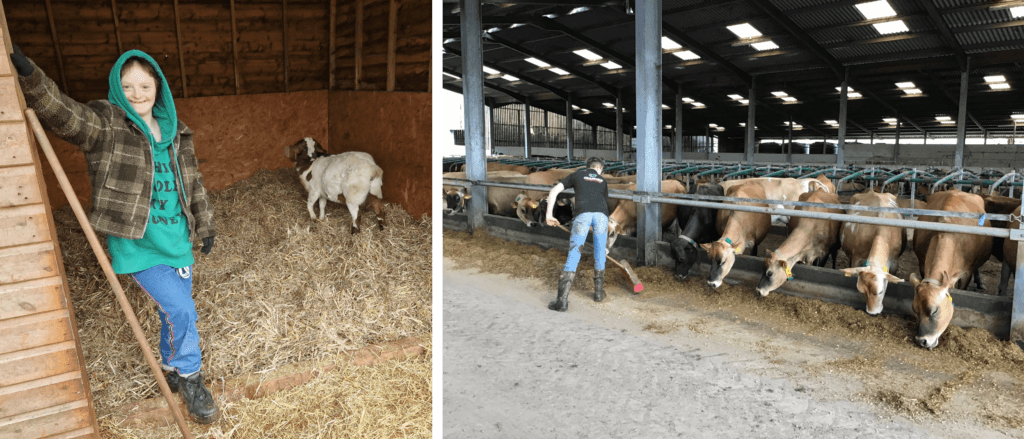
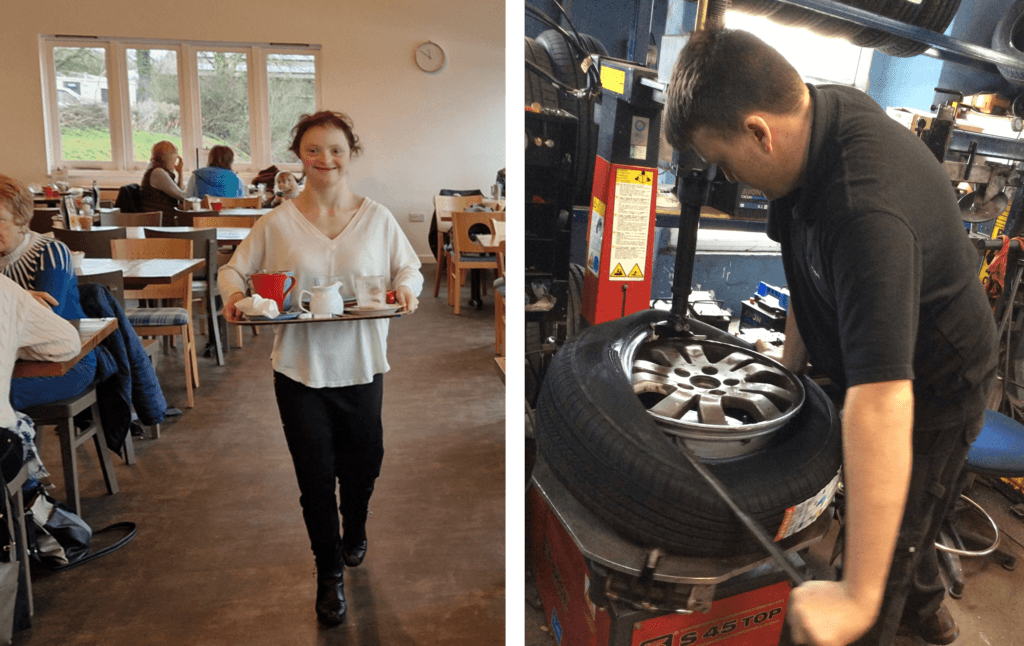
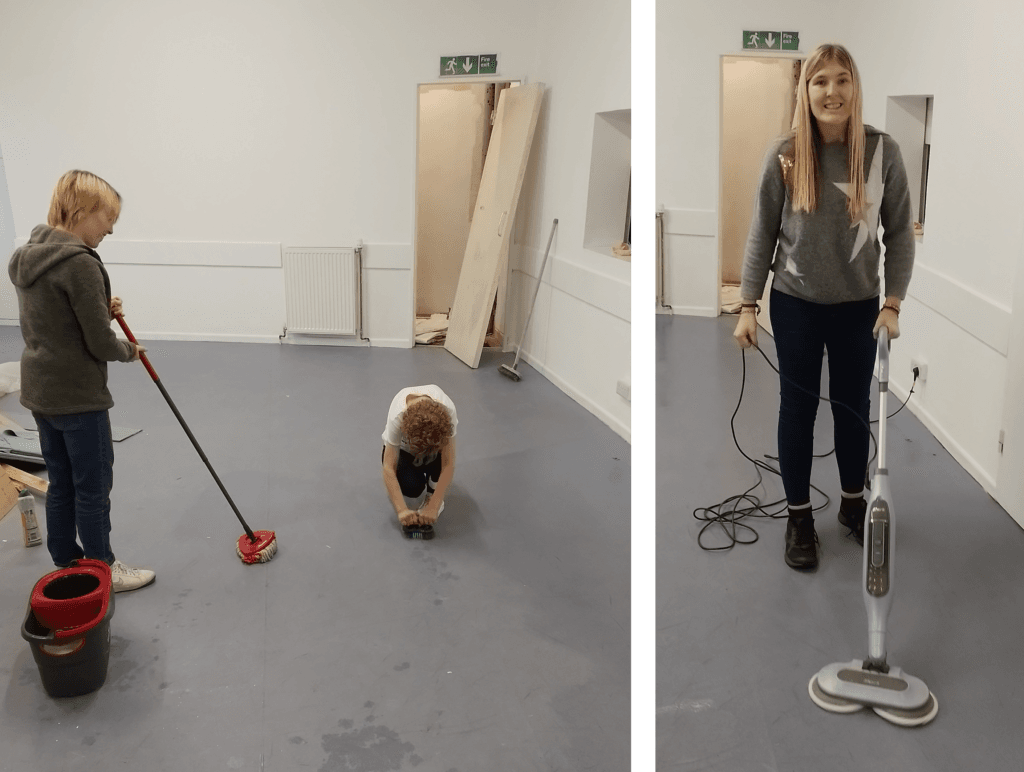
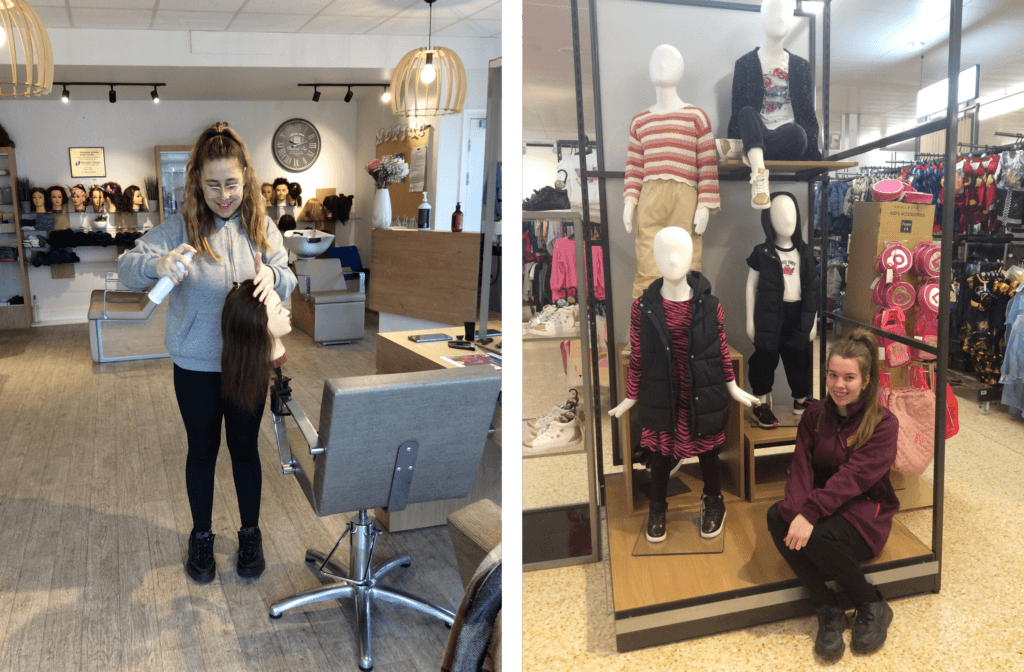
Local Supported Internships for young people aged between 17 and 20 have taken place in various employment settings and in various job roles - these have included working as a Sales Assistant, Hospital Porter, Ward Clerk, Cleaner, Ward Buddy, Tyre Mechanic, Waiter, Chef.
Local Supported Internships for young people aged between 17 and 20 have taken place in various employment settings and in various job roles – these have included working as a Sales Assistant, Hospital Porter, Ward Clerk, Cleaner, Ward Buddy, Tyre Mechanic, Waiter, Chef.
Sound Communities have produced the following two videos featuring our young people talking about Supported Internships, and the opportunities they have had.
The NTDI Supported Internships Grant Funding has enabled Torbay SEND Employment Forum to work with young people to promote Supported Internships.

Young people told us:
Many young people already have part-time paid jobs and feel this has helped them become more independent.

Young people involved in Supported Internships told us:

Young people involved when asked what could be better, told us:

Young people involved when why a bussiness should employ a young person who has Special Educational Needs and or Disabilities (SEND), told us:
This toolkit has been developed to acknowledge that at Post 16 education some tools are applied differently and the setting in which young people learn is also different.

Although we anticipate that many of the tools in the five main toolkits for Torbay will still be relevant for all children and young people this toolkit particularly describes the ordinarily available provision which all our young people should experience Post 16.
This toolkit has been combined into one easy-checklist guide for Post 16 parents and practitioners, with acknowledgement that they will still also use the main toolkits.
Torbay Young Carers Service are a friendly team based within Torbay Council’s Children’s Services. We provide a range of support and opportunities to young people who are in, or likely to take on a caring role.
What do we mean by Young Carer?
Torbay Young Carers Service works with young people aged up to 18, whose lives are affected by caring. The person being cared for may have a disability, a serious or long-term illness, mental ill-health or be affected by addiction issues.
The person being cared for is usually a parent, sibling or other family member.
The care tasks young carers may be involved in include:
Young carers may be the sole carer, or they may be supporting another family member in care tasks
What support do we Provide?
The support plan will vary depending on the individual needs of the young carer or their family, but examples include:
Contact Us:
Torbay Young Carers Consent Form 2026
Young Carers Teen Group Sign-Up Form 2026
A referral can be made to the appropriate health and social care team for all young people moving into Adult Services. Staff from Children’s and Adult Services will work together, sharing information about young people aged between 14 and 18 who are supported by Children’s Services.
From the age of 16, and subject to a Social Care needs assessments for Adults, Adult Services will work with the young person, their family and supporters to progress their transition.
Prior to the young person being allocated an Adult Care Worker, a transition coordinator will begin to work with the young person and their family to help them plan for the future. They will look at things like the young person’s current needs, the cost and possible support they may need as an adult. Children’s and Adult Services work in different way and the level and type of support the young person receives may change. Adult Services need to understand what young people want in the way of work and social opportunities so that they can help prepare the young person for adulthood.
A referral needs to go through a single point of contact for Torbay adult services. Once a referral has been received a letter confirming its delivery will be sent to the young person and their representative with a copy to the referrer, by the transitions co-ordinator.
The referral will go through a ‘triage’ process by Adult Health & Social Care professionals to determine if the Young Persons Care & Support Needs meet the threshold of the National Eligibility Criteria as set out in in the Care & Support (Eligibility Criteria) regulations 2015. During this process Adult Health & Social Care professionals will identify the most appropriate action plan depending on the young persons care & support needs.
Transition Coordinators will keep in touch with the young person, families, carers & the referrer to provide up-dates or gather more information as required.
Should the outcome of the ‘triage’ be that the young person does not meet the eligibility criteria for Adult Social Care Funding, the Transition Coordinators or Health & Social Care Coordinators will support with providing information, advice and guidance in line with the needs of the young person who has been referred.
Contact:
Phone: 01803 219700
CSW Group provides free information, advice, guidance and support to people of all ages to help them to enter work and learning.

The service for 13-19 year olds also provides support up to the age of 25 for young people who have learning difficulties or disabilities.
Also offer free information in learning and work to anyone aged 19 and over, helping improve career prospects by learning new skills, retraining or gaining new qualifications.
They also support vulnerable groups during this time of transition.
CSW Group offer a free transition advice and guidance to all Y11 students who have Education, Health and Care plans (EHCP) or are electively home educated (EHE)
The Transitions service aims to:
Website: https://www.devonservices.org.uk/service/careers-south-west/
The service is provided to adults who have a wide range of communication disorders, as follows:
Adult’s Speech and Language Therapy – Torbay and South Devon NHS Foundation Trust
Self Help Techniques and Advice for Managing Anxiety YOUNG DEVON
The course covers the following nine topics to help you with independent living:

If you are a new or expectant parent who is feeling overwhelmed, stressed or struggling with anxiety, help is available. TALKWORKS is a free, NHS talking therapies service, here to help you get back to feeling like yourself again. The service is open to adults, aged 18+, living in Torbay and across the whole of Devon (outside Plymouth, which is covered by Plymouth options). TALKWORKS offers a priority service to new and expectant parents, so that they can access support as quickly as possible.
Treatment and support includes:
You don’t need to a GP referral in order to access TALKWORKS. Self-refer online: https://www.talkworks.dpt.nhs.uk/support-for-parents or by calling the team on 0300 555 3344.
Makaton is a unique language programme that uses symbols, signs and speech to enable people to communicate. It supports the development of essential communication skills such as attention and listening, comprehension, memory, recall and organisation of language and expression. Find out more about Makaton here.
https://www.bbc.co.uk/cbeebies/joinin/something-special-what-is-makaton
Local Supported Internships for young people aged between 17 and 20 have taken place in various employment settings and in various job roles - these have included working as a Sales Assistant, Hospital Porter, Ward Clerk, Cleaner, Ward Buddy, Tyre Mechanic, Waiter, Chef.
Local Supported Internships for young people aged between 17 and 20 have taken place in various employment settings and in various job roles – these have included working as a Sales Assistant, Hospital Porter, Ward Clerk, Cleaner, Ward Buddy, Tyre Mechanic, Waiter, Chef.
Sound Communities have produced the following two videos featuring our young people talking about Supported Internships, and the opportunities they have had.
The NTDI Supported Internships Grant Funding has enabled Torbay SEND Employment Forum to work with young people to promote Supported Internships.

Young people told us:
Many young people already have part-time paid jobs and feel this has helped them become more independent.

Young people involved in Supported Internships told us:

Young people involved when asked what could be better, told us:

Young people involved when why a bussiness should employ a young person who has Special Educational Needs and or Disabilities (SEND), told us:
This toolkit has been developed to acknowledge that at Post 16 education some tools are applied differently and the setting in which young people learn is also different.
Although we anticipate that many of the tools in the five main toolkits for Torbay will still be relevant for all children and young people this toolkit particularly describes the ordinarily available provision which all our young people should experience Post 16.
This toolkit has been combined into one easy-checklist guide for Post 16 parents and practitioners, with acknowledgement that they will still also use the main toolkits.
Extra help or adjustments to exams are called 'Access Arrangements'.
Extra help or adjustments to exams are called ‘Access Arrangements’.
‘Access Arrangements’ allow students with special educational needs, disabilities or temporary injuries to access exams and show what they know and can do.
However, ‘Access Arrangements’ are not allowed to give the student an unfair advantage or compromise the integrity of the exam. This means that there will have to be evidence that any additional support provided in the tests is also the same as or similar to the additional support regularly provided to the student as part of normal classroom practice (except in the case of injuries). For example, a student would only be allowed to use a laptop in exams if they normally use one in class. Access arrangements must also be appropriate to the exam and the student. For example, a student with dyslexia may need extra time for a written exam, but not for a practical one.
There are a wide range of possible Access Arrangements that can be made, including:
Whilst some ‘Access Arrangements’ can be made by School without prior approval (delegated arrangements), many others will require advance application (before the February deadline) for approval or notification.
Every year the Joint Council for Qualifications (JCQ) produce Access Arrangements, Reasonable Adjustments and Special Consideration documents that contains the rules, regulations and guidance on what a student may, or may not receive when sitting formal examinations and lists the types of arrangements that may apply.
Most education providers and examining bodies will have made exam arrangements for individual students before, but they may not have come across all possible arrangements as support needs vary from person to person. If you think access arrangements may be required it is best to discuss this as early as possible, preferably at the start of the relevant course.
Schools may need to contact Educational Psychology & Specialist Teaching Service (TEPATS) who have a form specifically to address assess arrangements.
The service is provided to adults who have a wide range of communication disorders, as follows:
Adult’s Speech and Language Therapy – Torbay and South Devon NHS Foundation Trust
Self Help Techniques and Advice for Managing Anxiety YOUNG DEVON
For young people with an EHCP, your young person’s Year 10 annual review will revisit the ideas first made in the Year 9 Preparing for Adulthood plan.
This is the time to start exploring the options open to your young person to help them reach their goals. This can be done by:
The school may also have open evenings with a focus on post 16 options. Be aware that courses can change and new courses may be introduced in the future.
Where required, the Post 16 provider can offer an extended transition to ensure the young person feels comfortable and helps lessen the anxiety of a change. There will be close liaison between the current school and the future provider, with the young person having a clear plan of what their transition will look like. This is then reviewed and adjusted when needed.
Having an Education, Health and Care plan (EHCP) does not mean having an indefinite Post 16 education. However, it may be possible for any pupil with special educational needs to stay on in education beyond their 19th birthday in certain circumstances if this is the most suitable plan. As with any other planning, this should be discussed through the annual review.
If it has been agreed that your young person’s further educational needs cannot be met at a local college, different providers may be considered. The local authority will review each application on a case by case basis.
This is a very important year for your young person. Decisions, building on the research started in Year 10, will need to be made. Your young person will now need to think about the type of course they want to do and how that links to their future career path.
The school may have a choice of prospectuses or brochures which list course information and open evenings for colleges and 6th Forms to help with this.
If the young person has a learning difficulty and/or disability and will be leaving school to enter college or a work based learning programme, the school’s careers advisor will complete a My Future, which records the young person’s goals for after 16 options. Your young person will need to consider giving permission to share some information with certain colleges or 6th Forms. If they decide not to give permission then the college or 6th form may not be in able to understand their needs and offer the right level of support.
The Annual Review for Year 11 will need to be held in the Autumn term before the young person leaves compulsory education. From the age of 16 your young person can start to make the decisions about their future as they become the main decision maker for themselves. Now is the time for your young person to give information about the difficulties they experience, which they may need help to overcome. Using the information in the young person’s Education, Health and Care Plans from Year 9 and Year 10, will help the young person move towards their goals.
Since September 2015 all young people must participate in some form of education or training until they are 18. However, unlike the requirement to attend school up to the age of 16, it is the young person’s responsibility to arrange this and not the Local Authorities duty.
This could be participation in:
The course covers the following nine topics to help you with independent living:

The transition into adulthood from 14 to 18 years of age is an important time in the lives of young people.
It is important to consider the following throughout the transitions process (and beyond):
A strength-based approach will protect the individual’s independence and ability to make choices. This will be the ‘golden thread’ that runs through the interactions between the health and social care teams and the people that they support.
If you are a new or expectant parent who is feeling overwhelmed, stressed or struggling with anxiety, help is available. TALKWORKS is a free, NHS talking therapies service, here to help you get back to feeling like yourself again. The service is open to adults, aged 18+, living in Torbay and across the whole of Devon (outside Plymouth, which is covered by Plymouth options). TALKWORKS offers a priority service to new and expectant parents, so that they can access support as quickly as possible.
Treatment and support includes:
You don’t need to a GP referral in order to access TALKWORKS. Self-refer online: https://www.talkworks.dpt.nhs.uk/support-for-parents or by calling the team on 0300 555 3344.
Torbay Young Carers Service are a friendly team based within Torbay Council’s Children’s Services. We provide a range of support and opportunities to young people who are in, or likely to take on a caring role.
What do we mean by Young Carer?
Torbay Young Carers Service works with young people aged up to 18, whose lives are affected by caring. The person being cared for may have a disability, a serious or long-term illness, mental ill-health or be affected by addiction issues.
The person being cared for is usually a parent, sibling or other family member.
The care tasks young carers may be involved in include:
Young carers may be the sole carer, or they may be supporting another family member in care tasks
What support do we Provide?
The support plan will vary depending on the individual needs of the young carer or their family, but examples include:
Contact Us:
Torbay Young Carers Consent Form 2026
Young Carers Teen Group Sign-Up Form 2026
A referral can be made to the appropriate health and social care team for all young people moving into Adult Services. Staff from Children’s and Adult Services will work together, sharing information about young people aged between 14 and 18 who are supported by Children’s Services.
From the age of 16, and subject to a Social Care needs assessments for Adults, Adult Services will work with the young person, their family and supporters to progress their transition.
Prior to the young person being allocated an Adult Care Worker, a transition coordinator will begin to work with the young person and their family to help them plan for the future. They will look at things like the young person’s current needs, the cost and possible support they may need as an adult. Children’s and Adult Services work in different way and the level and type of support the young person receives may change. Adult Services need to understand what young people want in the way of work and social opportunities so that they can help prepare the young person for adulthood.
A referral needs to go through a single point of contact for Torbay adult services. Once a referral has been received a letter confirming its delivery will be sent to the young person and their representative with a copy to the referrer, by the transitions co-ordinator.
The referral will go through a ‘triage’ process by Adult Health & Social Care professionals to determine if the Young Persons Care & Support Needs meet the threshold of the National Eligibility Criteria as set out in in the Care & Support (Eligibility Criteria) regulations 2015. During this process Adult Health & Social Care professionals will identify the most appropriate action plan depending on the young persons care & support needs.
Transition Coordinators will keep in touch with the young person, families, carers & the referrer to provide up-dates or gather more information as required.
Should the outcome of the ‘triage’ be that the young person does not meet the eligibility criteria for Adult Social Care Funding, the Transition Coordinators or Health & Social Care Coordinators will support with providing information, advice and guidance in line with the needs of the young person who has been referred.
Contact:
Phone: 01803 219700
Makaton is a unique language programme that uses symbols, signs and speech to enable people to communicate. It supports the development of essential communication skills such as attention and listening, comprehension, memory, recall and organisation of language and expression. Find out more about Makaton here.
https://www.bbc.co.uk/cbeebies/joinin/something-special-what-is-makaton
High goals are important to success.
Setting the right goals will make sure that your young person will have a happy and fulfilling life.
This is the time to start thinking about:
If your young person has an Education, Health and Care plan (EHCP), the Year 9 Annual Review of their EHCP is very important and begins the preparation for adulthood.
Starting this in Year 9 allows time to research options for:
This will ensure that the final years of school will focus on supporting your young person’s successful development in the future.
This flowchart will help you understand the moving towards adulthood pathway.


In Torbay, when young people move from childhood to adulthood, this is known as a ‘Transition’. We recognise this can be a daunting time for young people and their carers.
Our aims are:
Study programmes are further education courses that can help you gain the skills you need to go on in to further education, get a job or become more independent.
A study programme is a full time programme, on average, 16 hours per week. This is usually 3 days per week and works out at approximately 540+ hours across the academic year. It will usually include the following:
This is learning that takes place in a work environment. It is a practical way of learning that offers real life work experience whilst working towards relevant qualifications in the industry.
E.g. Supported Internship, Traineeship, Apprenticeship
This is learning involving more practical activities and is commonly used to prepare a person for a particular trade or industry. These qualifications enable you to develop industry skills which can be applied to real life situations to prepare for employment. They also support the development of independence and like skills. Some courses may require learners to take exams as well as produce evidence of their new skills and knowledge throughout the year. These are qualifications recognised by employers.
E.g. BTEC, NVQ, Laser, ASDAN. As well as industry recognised qualifications.
This is a more formal style of learning that is usually based on theory rather than practical activities. These qualifications are recognised by employers and universities. They also support the development of independence and life skills. Assessments usually include an exam towards the end of the course and the learning style provides good foundations for progression to higher education.
E.g. GCSE, AS Level, A Level
This flowchart will help you understand the moving towards adulthood pathway.

There are lots of courses of different levels available. The aim of every course, no matter what level, should be about making progress in developing new skills. Every course is designed to help you get a qualification or reach an outcome at the end of it. There is a starting point for everyone. At the start of any course you should be aware of what the qualification or outcomes you hope to achieve by the end of the course. Achieving your qualification may be a combination of coursework, module assessment or end of year exam. Your tutor will be able to guide you through this process.

The different level of courses is explained below:
Students on these courses will often have high support needs. Most students on these courses will previously have been in special schools. The courses usually look at developing independence.
On these courses there is a high level of support and students are usually developing life skills and possibly with some vocational skills. Most students will have been working on P-Levels.
These courses are for young people who have developed functional skills and are looking to gain qualifications like GCSE’s, Level 1 NVQ’s and Level 1 Diplomas.
Young people on these courses will be ready to gain qualifications like BTEC Diplomas, more GCSE’s and intermediate level Apprenticeships.
On these courses young people will be working towards qualifications like A-levels and Apprenticeships.
After a level 3 course you might want to go on to a higher education course, which are University level courses or employment. Please note Education. Health and Care Plans do not continue if students progress into Higher Education. Support for students with Special Educational Needs and/or Disabilities in Higher Education is accessed through Higher Education (University Level) – Family Hub
The Year 9 annual review of your young person’s Education, Health and Care plan (EHCP) is very important and begins the preparation for adulthood. This is the time to start thinking about:
It will be important for the following people to be invited to and attend, or provide a report for, the Year 9 annual review:
These people will make sure that your young person remains involved in planning for their future.
Information, about children who are classed as having complex needs by the Children with Disabilities Service, will start to be shared with Adult Services to help with future planning.
Children and young people with special educational needs may get help with transport to school or college. Once a young person reaches 16 they may be asked to pay towards some of the cost of the transport. For further information please contact the Transport Team on 01803 207688 or email cstransport@torbay.gov.uk. Independent Travel training may be available from some colleges and 6th Forms.
Specialised transport is available including, wheelchair accessible minibuses and taxis as well as providing chaperones where required. Each child and young persons’ travel needs are assessed on an individual basis.
Great reviews start with great preparation - to find out what is needed watch this animate for more information.
Great reviews start with great preparation – to find out what is needed watch this animate for more information.
The Mental Capacity Act 2005 provides a legal framework for acting and making decisions on behalf of individuals who lack the mental capacity to make particular decisions for themselves. Everyone caring for, or working with, an adult who may lack capacity to make specific decisions must comply with the Act when making decisions or acting for that person, when the person lacks the capacity to make a particular decision for themselves. The same rules apply whether the decisions are life changing or everyday matters.
The Act’s starting point is to confirm in legislation that it should be assumed that an adult (aged 16 or over) has full legal capacity to make decisions for themselves (the right to autonomy) unless it can be proven that they lack capacity to make a specific decision at the time the decision needs to be made. This is known as the presumption of capacity.
The Act also states that people must be given all appropriate help and support to enable them to make their own decisions or to maximise their participation in any decision-making process.
The underlying philosophy of the Act is to ensure that any decision made or action taken on behalf of someone who lacks capacity to make the decision or act for themselves is made in their best interest. It is intended to assist and support people who may lack capacity and to discourage anyone who is involved in caring for someone who lacks capacity from being overly restrictive or controlling.
The Act also aims to balance an individual’s right to make decisions themselves with their right to be protected from harm if they lack capacity to make decisions to protect themselves. It sets out a legal framework of how to act and make decisions on behalf of people who lack capacity covering such areas as personal welfare, healthcare and financial matters.
You can find out more about the Mental Capacity Act 2005 via the following links:
CSW Group provides free information, advice, guidance and support to people of all ages to help them to enter work and learning.

The service for 13-19 year olds also provides support up to the age of 25 for young people who have learning difficulties or disabilities.
Also offer free information in learning and work to anyone aged 19 and over, helping improve career prospects by learning new skills, retraining or gaining new qualifications.
They also support vulnerable groups during this time of transition.
CSW Group offer a free transition advice and guidance to all Y11 students who have Education, Health and Care plans (EHCP) or are electively home educated (EHE)
The Transitions service aims to:
Website: https://www.devonservices.org.uk/service/careers-south-west/
Young people aged 16-19 may be able to claim money (a bursary) for you or your college/training provider to use to meet the cost of clothing, equipment or lunch on study days.
Young people who have additional needs should be able to get support to help them achieve and make progress. You should discuss your needs at your interview. Support provisions could include, study skills support, employability support, additional Maths and English support, as well as pastoral support.
Young people with an Education, Health and Care plan (EHCP) will have an individual support plan in place which will be reviewed annually. It is helpful for you to inform the provider that you have a plan when you attend interview.
If you think you will need an Education, Health and Care plan, please contact SENDIASS Torbay who will be able to offer you information advice and support.
As young people with special educational needs and/or a disability turn 16, 17, 18 or 19, they become entitled to benefits and support in their own right. What they are entitled to may or may not depend on whether they are still in education, are job seeking or claiming benefits.
Parents’ and carers’ benefits and tax credits can depend not only on the student or employment status of their young person with a disability and their other children, but also on what their children with a disability are claiming. Benefits and tax credits are complex.
You may find the following link useful Benefits at 16 | Contact
You may wish to take specialist advice about your own situation. You will also need to take further advice if the young person with a disability in the family is a parent themselves.
There are several different types of work-based learning that give you the opportunity to train and get qualifications while working. For some young people going into a work environment suits them better than staying just in the classroom.
These courses allow you to develop your skills and gain qualifications (including English and Maths for those who need it) whilst benefiting from high quality work experience. They can help you prepare for a Supported Internship or an Apprenticeship. Usually, they last for 6 months and give you an opportunity to develop the skills you need to progress on to a Supported Internship (for those with an EHC plan), an Apprenticeship or paid employment. The work experience is not paid, but the costs of travel and meals might be supported by the training provider or employer. Traineeships are suitable for those working at around Level 1 and who might benefit from additional support to prepare them for work.
Supported internships are for disabled young people and those with significant special educational needs. To get a supported internship you will need an Education, Health and Care Plan (EHCP). As a supported intern, a young person will work for an employer for a fixed time, usually for up to 1 year. You do not usually get paid for your work, but some employers may cover travel and lunch expenses. As an intern you won’t gain qualifications, but you will get the opportunity to experience what working is like and gain the skills towards getting a job. If you are on a Supported Internship, you will get support from a job coach. A job coach will make sure a young person is prepared for and supported through their Supported Internship. They provide extra support that you would not normally get on an internship.
As an apprentice you can earn whilst studying for a nationally recognised qualification and getting ‘on the job’ training. It’s a way to gain experience, strengthen your CV and build your career, whilst studying Maths and English up to Level 2 Functional Skills or a Grade 4 GCSE, depending on the Apprenticeship requirement.
There is a wide range of apprenticeships available to suit every skill and passion and the training provider will offer support for your additional needs.
Although young people must be doing some form of recognised accredited education or training until their 18th birthday, this does not mean they have to attend college or school. For those that would rather work (whether paid or voluntary) this is still an option, as long as it involves at least 20 hours of work per week in addition to working towards a nationally recognised qualification. You can become self-employed and still count as participating, as long as you are doing part-time accredited education or training as well.
Please see Post 16 Educational Opportunities which is a related topic on Moving towards Adulthood and can also be found at Post 16 Educational Opportunities.
It is possible for parents/carers to claim child benefit for a young person after their 16th birthday if they continue in full-time approved education or training. This includes traineeships but not apprenticeships. The Child Benefit Office must be informed otherwise payments will stop on 31st August. For full details go to Claim Child Benefit - GOV.UK (www.gov.uk)
It is possible for parents/carers to claim child benefit for a young person after their 16th birthday if they continue in full-time approved education or training. This includes traineeships but not apprenticeships. The Child Benefit Office must be informed otherwise payments will stop on 31st August. For full details go to Claim Child Benefit – GOV.UK (www.gov.uk)
Post 16 Transport arrangements for students over Yr 11 are different from school transport arrangements for students under 16.
It becomes the young persons responsibility to attend education after Year 11. Parents/guardians will not be prosecuted if their young person does not participate in approved education or training after Year 11.
Young people with an Education, Health and Care plan (EHCP) will continue to have an annual review which will monitor progress towards their agreed outcomes.
If a young person has an Education, Health and Care plan (EHCP) and they progresses into Higher Education (University) their EHCP will be ceased and they will need to apply for a Disabled Student’s Allowance.
Local Supported Internships for young people aged between 17 and 20 have taken place in various employment settings and in various job roles - these have included working as a Sales Assistant, Hospital Porter, Ward Clerk, Cleaner, Ward Buddy, Tyre Mechanic, Waiter, Chef.
Local Supported Internships for young people aged between 17 and 20 have taken place in various employment settings and in various job roles – these have included working as a Sales Assistant, Hospital Porter, Ward Clerk, Cleaner, Ward Buddy, Tyre Mechanic, Waiter, Chef.
Sound Communities have produced the following two videos featuring our young people talking about Supported Internships, and the opportunities they have had.
The NTDI Supported Internships Grant Funding has enabled Torbay SEND Employment Forum to work with young people to promote Supported Internships.

Young people told us:
Many young people already have part-time paid jobs and feel this has helped them become more independent.

Young people involved in Supported Internships told us:

Young people involved when asked what could be better, told us:

Young people involved when why a bussiness should employ a young person who has Special Educational Needs and or Disabilities (SEND), told us:
This video has been created by local Children and Young People.
This is one of a series of 3 videos to help children, young people and their families understand more about Education, Health and Care plans (EHCPs). The other 2 videos in this series are:
Independent Travel Training is a free scheme which has been set up by Children’s Services at Torbay Council. Our Independent Travel Training programme provides targeted support for Children and Young People with special educational needs and/or disabilities (SEND). Our Trainer works with students from mainstream and special schools, education other than at school, and colleges of further education.
The scheme aims to support Children and Young People with SEND throughout Torbay, as they learn how to develop the skills required for safe and successful, independent travel between home and school. We use a Total Communication approach to support successful interaction, providing a range of communication aids throughout training, suited to the needs of the Trainee.
The Independent Travel Training programme will include road safety awareness, accurately telling the time, handling money, how to use a bus/train pass, appropriate social behaviour, stranger danger, location identification, strategies for solving problems and overcoming barriers, and any other issues that might arise.
If your Child or Young Person currently travels to school or college on assisted transport and would like to travel on their own, then our Independent Travel Trainer could help.
Benefits of our Independent Travel Training programme include:
We provide a person-centred approach, before any training commences our Independent Travel Trainer will liaise closely with the Trainee and their support circle including Parents/Carers, Tutors and Social Workers to gain an understanding of how to tailor the programme to best suit the needs of the Trainee.
If you would like your child to take part in this scheme, or for more information, please contact ITT@Torbay.gov.uk
The service is provided to adults who have a wide range of communication disorders, as follows:
Adult’s Speech and Language Therapy – Torbay and South Devon NHS Foundation Trust
Self Help Techniques and Advice for Managing Anxiety YOUNG DEVON
If you are a new or expectant parent who is feeling overwhelmed, stressed or struggling with anxiety, help is available. TALKWORKS is a free, NHS talking therapies service, here to help you get back to feeling like yourself again. The service is open to adults, aged 18+, living in Torbay and across the whole of Devon (outside Plymouth, which is covered by Plymouth options). TALKWORKS offers a priority service to new and expectant parents, so that they can access support as quickly as possible.
Treatment and support includes:
You don’t need to a GP referral in order to access TALKWORKS. Self-refer online: https://www.talkworks.dpt.nhs.uk/support-for-parents or by calling the team on 0300 555 3344.
Makaton is a unique language programme that uses symbols, signs and speech to enable people to communicate. It supports the development of essential communication skills such as attention and listening, comprehension, memory, recall and organisation of language and expression. Find out more about Makaton here.
https://www.bbc.co.uk/cbeebies/joinin/something-special-what-is-makaton
Four Seasons provide work, employment and life skills training for people with disabilities. Our base at Lupton House provides an ideal, safe and supportive learning environment. We develop people’s skills using outdoor practical tasks, horticulture and grounds maintenance. Positioned in the tranquil, therapeutic setting of Lupton House which is a grade 2 listed building nestling in beautiful parkland on the outskirts of Brixham.
Our Aim: “People of all abilities are inspired to develop work, employment and life skills fully within the community.” We are totally committed to equal opportunities to all, ensuring people are central to all that we do.
Contact us:
Four Seasons Torbay CIC, c/o Lupton House, Brixham Road, Brixham, TQ5 0LD
Telephone: 07810 757720
Email: fourseasonstorbay@gmail.com
CSW Group provides free information, advice, guidance and support to people of all ages to help them to enter work and learning.
The service for 13-19 year olds also provides support up to the age of 25 for young people who have learning difficulties or disabilities.
Also offer free information in learning and work to anyone aged 19 and over, helping improve career prospects by learning new skills, retraining or gaining new qualifications.
They also support vulnerable groups during this time of transition.
CSW Group offer a free transition advice and guidance to all Y11 students who have Education, Health and Care plans (EHCP) or are electively home educated (EHE)
The Transitions service aims to:
Website: https://www.devonservices.org.uk/service/careers-south-west/
Courses in English and Maths, up to GCSE level are usually free. Other further education courses are free until the age of 19, up to level 3. However, if your child has an Education, Health and Care plan (EHCP), their course may be fully funded until they are 25 years old, if the course meets the targets outlined in their plan and the course is below level 4.

16-19 Bursary Fund is available to students in receipt of disability benefits to help with the associated costs of education, such as lunch, books and travel.
Further education courses and funding outlines a range of funding accessible to young people studying a further education course, without an EHCP.
Discretionary funds can sometimes be offered to students whose education will be impacted by financial deprivation, SEND (with no EHCP) or some kind of hardship. Colleges will need to be contacted directly as each will have their own eligibility criteria and level of grant available.
Many young people with Special Educational Needs and/or Disabilities (SEND) progress to higher education, however it is not possible to have an Education, Health and Care plan (EHCP) at University. Those who require additional support and may incur extra costs as a result of their disability, may be eligible for a Disabled Student Allowance (DSA). The financial support offered is based on individual need not household income and does not have to be repaid.

If a young person with an EHC Plan has a confirmed Higher Education place, with their permission, the Local Authority will pass a copy of the EHC Plan to the relevant institution and to the assessor for Disabled Students Allowance.
For more information about the Disabled Students Allowance and how to apply visit www.gov.uk/disabled-students-allowances-dsas/overview.
UCAS has information and advice for students with disabilities, including access arrangements and financial options.
Note: Higher Education is funded through the Higher Education Funding Council for England and the Special Educational Needs Code of Practice does not apply to students in Higher Education.
Supported Internships are work-based learning placements within mainstream employment settings. The aim is to secure a job at the end of the placement. Placements should last over 6 months and normally would be at least 20 hours per week.
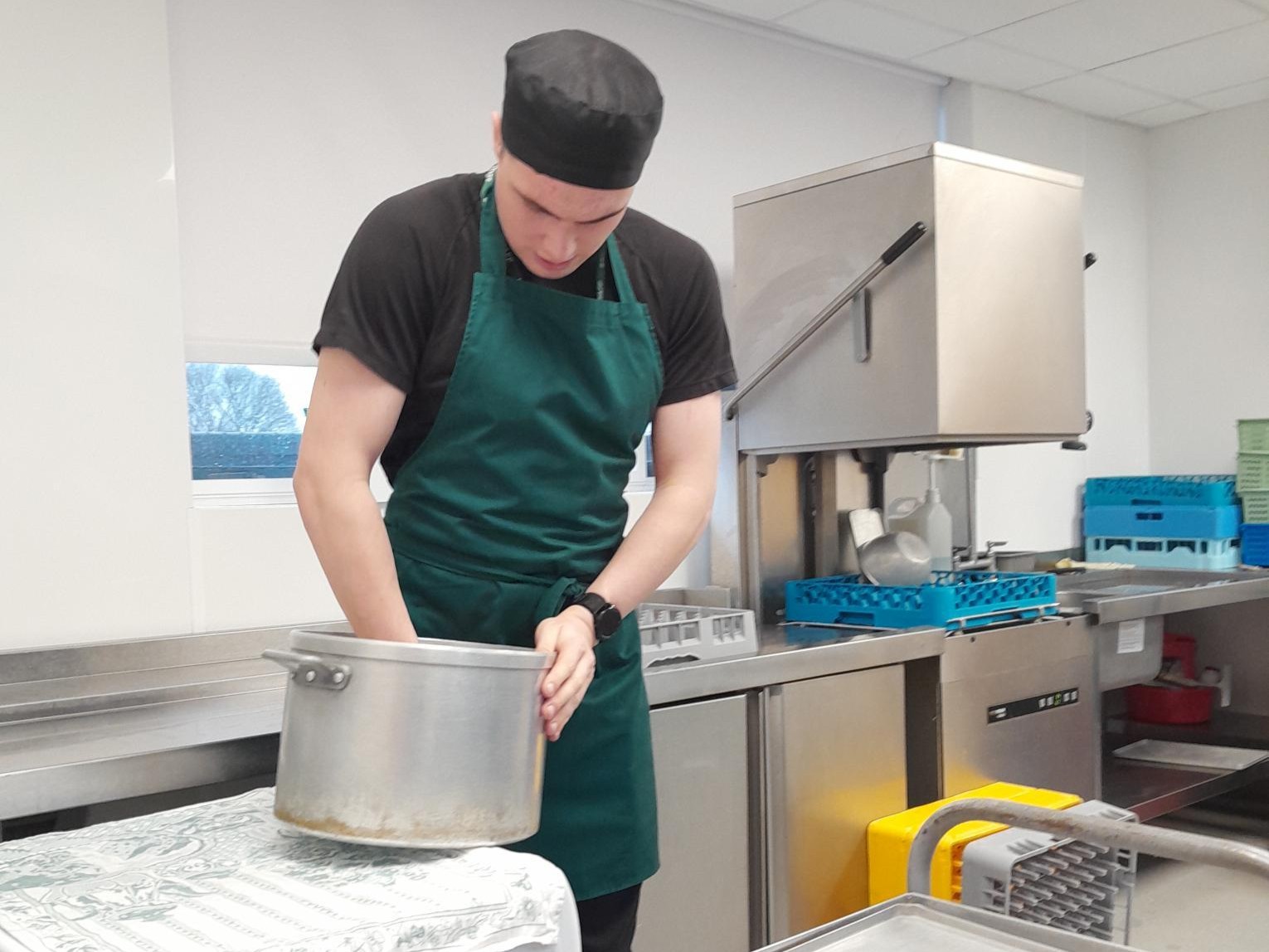
The National Development Team for Inclusion have produced an Easy Read guide about Supported Internships for young people
If you are an education provider, gov.uk has a guide explaining what you need to know to set up a Supported Internship programme.
Torbay Council launched its Supported Internship programme in Autumn 2025, in partnership with South Devon College, Brunel School and Coombe Pafford.
The programme offers 16 -24-year-olds with a diagnosed learning disability and an Education, Health and Care Plan (EHCP) a chance to gain real workplace experience. It supports them to build confidence and develop essential employment skills in a supportive environment.
Find out more about Supported Internships at Torbay Council
See what interns have said about working at Torbay Council

I am enjoying my work experience in the IT department at Torbay Council. I enjoy every day there and always look forward to it. The staff there are friendly and supportive and are good people to work with. I thank Simon, Rob and Gareth for their help.
The work is giving me more skills and knowledge that will help me in the future to get a job. I have learnt a variety of ways of installing updates to computers, particularly Window 11. I have also enjoyed learning how to connect a television, speakers, microphone and other periphery items to a computer.

I have been there for 5 months now. It’s good, and I feel I have learnt a lot about how a professional kitchen works.
The staff have been nice, understanding, and supportive.
I would like to get involved a bit more with preparing the food.
The staff induction was good, and I understood everything. I feel like I am a member of the team.
The placement gets a bit loud with the children sometimes, but I have learnt to take 5 minutes out or use headphones.
Into Apprenticeships is a guide for disabled people, parents and key advisers about applying for apprenticeships in England. It deals with common questions such as how to find an apprenticeship, whether the training will be accessible and what support is available in the workplace.
Read the gov.uk guide and find out how apprenticeships work, what you'll get and how to apply
Read the gov.uk guide and find out how apprenticeships work, what you’ll get and how to apply
Find out how to become an apprentice
You can also search the site for apprenticeship opportunities
Local Supported Internships for young people aged between 17 and 20 have taken place in various employment settings and in various job roles - these have included working as a Sales Assistant, Hospital Porter, Ward Clerk, Cleaner, Ward Buddy, Tyre Mechanic, Waiter, Chef.
Local Supported Internships for young people aged between 17 and 20 have taken place in various employment settings and in various job roles – these have included working as a Sales Assistant, Hospital Porter, Ward Clerk, Cleaner, Ward Buddy, Tyre Mechanic, Waiter, Chef.

Sound Communities have produced the following two videos featuring our young people talking about Supported Internships, and the opportunities they have had.
The NTDI Supported Internships Grant Funding has enabled Torbay SEND Employment Forum to work with young people to promote Supported Internships.

Young people told us:
Many young people already have part-time paid jobs and feel this has helped them become more independent.

Young people involved in Supported Internships told us:

Young people involved when asked what could be better, told us:

Young people involved when why a bussiness should employ a young person who has Special Educational Needs and or Disabilities (SEND), told us: