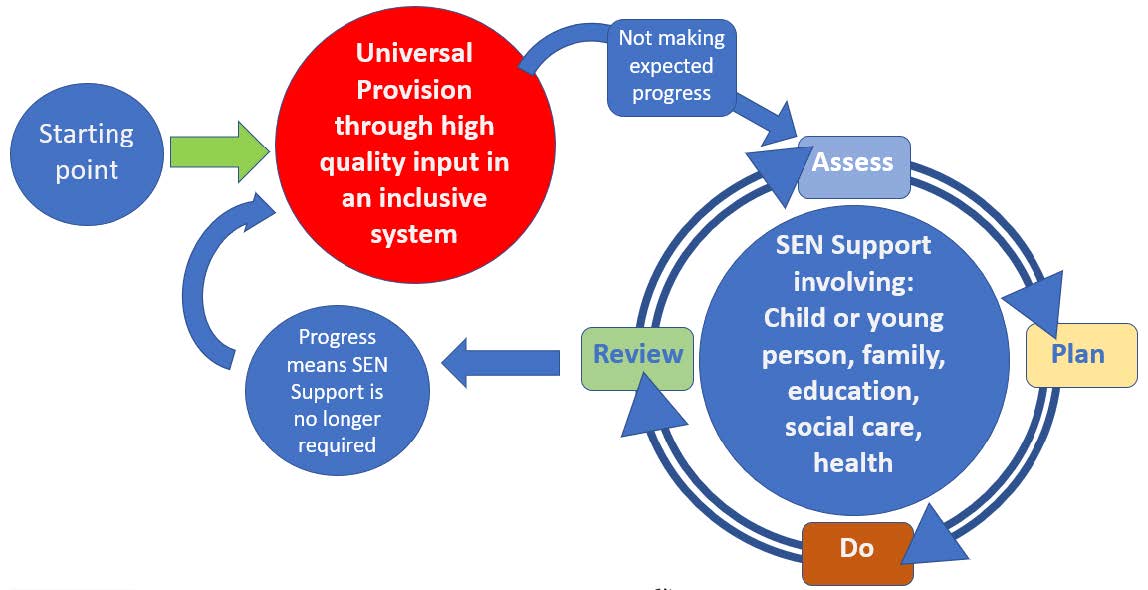
What is SEND Support? SEND Local Offer
SEND Support is the term used for extra and different support to meet the needs of children and young people with identified Special Educational Needs and/or Disability (SEND).

Highlight to listen
SEND Support is the term used for extra and different support to meet the needs of children and young people with identified Special Educational Needs and/or Disability (SEND).


All educational setting (Nurseries, Schools and Colleges) have a legal responsibility to:
This is described in detail within the SEND Code of Practice.
The purpose of SEND support is to help children and young people meet their learning objectives so that they can achieve their desired outcomes.
SEND support is tailored to each child or young person’s individual needs and can include:
Most children and young people with SEND have their needs met in mainstream education (Nurseries, Schools and Colleges). This works through high-quality teaching differentiated for individual pupils or under SEND Support.
The SEND Code of Practice says:
All children and young people are entitled to an education that enables them to make progress so that they: achieve their best become confident individuals living fulfilling lives, and make a successful transition into adulthood, whether into employment, further or higher education or training
(SEND Code of Practice section 6.1)
If your child is receiving SEND Support you should be informed and involved.
The SEND Code of Practice says mainstream schools must:

(SEND Code of Practice section 6.2)
- use their best endeavours to make sure that a child with SEN gets the support they need – this means doing everything they can to meet children and young people’s SEN
- ensure that children and young people with SEN engage in the activities of the school alongside pupils who do not have SEN
- designate a teacher to be responsible for co-ordinating SEN provision – the SEN co-ordinator, or SENCO.
- inform parents when they are making special educational provision for a child
- publish an SEN information report and their arrangements for the admission of disabled children, the steps being taken to prevent disabled children from being treated less favourably than others, the facilities provided to enable access to the school for disabled children and their accessibility plan showing how they plan to improve access progressively over time
Each school should publish the following documents and links on thier own school’s website:
The majority of children with special educational needs will have their needs met in mainstream school at SEND support within the SEND Support and Provision – Graduated Response without the need for an EHCP.

The Local Authority (LA) will also always seek to place SEND pupils who have an EHCP in mainstream schools providing that:
The Council has a Strategic Policy for Inclusion which works to promote inclusion, reduce disadvantage and support potential learners into learning experiences. Torbay’s key principles of inclusion includes reducing the number of pupils with SEND in special schools and ensuring that the number in mainstream school rises.
For further information:
Every school must publish an SEN information report about the SEND provision the school makes. You should be able to find your child or young person’s schools SEN information report on the schools website. You can also ask your child or young person’s teacher or the school’s Special Educational Needs and Disability Coordinator (SENDCO) for information on the SEND provision made by the school.

The information published should be set out in clear, straightforward language, updated annually and any changes to the information occurring during the year must be updated as soon as possible.
The information required is set out in Schedule 1 of the Special Educational Needs and Disability Regulations 2014 and must include:
(SEND Code of Practice section 6.79)
- the kind of SEN the school provides for.
- policies for identifying children and young people with SEN and assessing their needs, including the name and contact details of the SENCO (Special Educational Needs Coordinator).
- arrangements for consulting parents of children with SEN and involving them in their child’s education.
- arrangements for consulting young people with SEN and involving them in their education. This should include the opportunities available to work with parents and young people as part of this assessment and review
- arrangements for supporting children and young people moving between phases of education and in preparing for adulthood…
- the approach to teaching children and young people with SEN
- how adaptations are made to the to the curriculum and the learning environment of children and young people with SEN
- the expertise and training of school staff and how specialist expertise will be available.
- evaluating the effectiveness of the provision made for children and young people with SEN
- how children and young people with SEN are enabled to engage in activities available with children and young people in the school who do not have SEN
- support for improving emotional and social development, including listening to the views of children with SEN and measures to prevent bullying.
- how the school involves other bodies, including health and social care bodies, local authority support services and voluntary sector organisations, in meeting children and young people’s SEN and supporting their families.
- arrangements for handling complaints from parents of children with SEN about the provision made at the school
The SEND Code of Practice says:
Class and subject teachers, supported by the senior leadership team, should make regular assessments of progress for all pupils. These should seek to identify pupils making less than expected progress given their age and individual circumstances.
(SEND Code of Practice section 6.17)
The school should then decide if your child or young person needs SEND support. The school should talk to you and your child about this. If a young person is 16 or older the school should involve them directly.
Sometimes you may be the first to notice that your child or young person has or may have Special Educational Needs and/or Disabilities (SEND). If you think your child or young person may need SEND support you should talk to your child’s teacher or to the Special Educational Needs and Disability Co-Ordinator (SENDCO).
If you are not happy about the support your child has you can ask to talk to the SENDCO or headteacher.
The SEND Code of Practice says:
Where a pupil is identified as having SEN, schools should take action to remove barriers to learning and put effective special educational provision in place.
(SEND Code of Practice section 6.44)
When your child or young person is identified has having Special Educational Needs and/or Disabilities (SEND), the school should be able to:
They should do this using the following four steps.
Teaching staff should work with the SENDCO to assess your child or young person’s needs, so that they give the right support. They should involve you in this and, where possible, seek your child or young person’s views. They should talk to you about this first and should take any concerns you may have brought to their attention seriously. Schools can and should involve specialists, such as educational psychology or speech and language therapy, to provide further advice and support if your child continues to make little progress or work at substantially lower levels than expected.
If the school decides that your child or young person needs SEND support it must tell you or your young person directly if they are over 16. The school should agree the outcomes that will be set, what help will be provided and a date for progress to be reviewed with you or your young person. The school should draw up a plan, involving you and your child, focusing on the outcomes your child needs and wants to achieve and detailing how the school will support them to achieve these. Schools should record details of the actions they are taking under SEND support.
Your child’ or young person’s class or subject teacher is usually responsible for the work that is done with your child or young person, and should work closely with any teaching assistants or specialist staff involved. The school should tell you or your young person who is responsible for the support your child or young person receives. The SENDCO will usually works with class and subject teachers to plan and deliver support, and keep a record of this. Everyone in school who works with your child or young person should be aware of their needs and the plan in place to address them.
The school should review your child’ or young person’s progress, and the difference that the help your child or young person has been given has made, on the date agreed in the plan. You and your child or young person should meet with school at least three times a year and be involved in the review and in planning the next step. If your child or young person has not responded to the help they were given, the review should decide what can be done next, which should be recorded in the records. This may include more or different help.
It is up to schools to decide how to keep their records but they should be able to provide clear and accessible information to you about your child’s support and progress. SEND support meetings should be in addition to scheduled parents’ evening meetings. The school must provide a report at least once a year on your child or young person’s progress.
To get a more in depth understanding of SEND support you may want to look at You may want to look at:
If, following a period of time at SEND Support stage, your child or young person is still not making the expected progress, you, your young person if over the age of 16 or the school can ask for an Education, Health and Care (EHC) needs assessment.
Visiting a school is the best way to determine whether that school is right for your child. It is an opportunity to get a sense of the school environment and get your questions answered. Below are some suggestions to help you get the most out of your visit.
Discuss your thoughts and feelings about the school with someone else:
A child will reach compulsory school age on a prescribed day (31 December, 31 March or 31 August) on or after their 5th birthday. All children are entitled to a full time school place from the September following their 4th birthday.
So, although your child does not legally have to start school until the term following her/his 5th birthday, most children start in Reception in the September of the school year in which they are 5.
| Child’s date of birth | When to apply | Allocation day | Start date |
| 1 Sept 2020 to 31 Aug 2021 | 1 Nov 2024 to 15 Jan 2025 | 16 April 2025 | Sept 2025 |
Summer born children
You may find it useful to read more about:
Parents who are considering delaying their summer born child’s admission to school should seek advice from the schools they might like their child to attend, and from any professionals involved in the care of their child, so that they are able to make an informed decision.
You can apply for a school place and then delay your child’s start until later in the reception year without jeopardising the offer of a place. Pupils born between 1 September and 31 December would be expected to take up their place no later than the start of the spring term.
| Child born | Normal date of admission | Deferred admission |
| 1 September to 31 December | Autumn Term | Spring term |
| 1 January to 31 March | Autumn Term | Spring or Summer Term |
| 1 April to 31 August | Autumn Term | Spring or Summer Term |
The deferred admission arrangements do not allow summer born children to keep a place until the Autumn Term in Year 1. Parents with summer born children who do not want their child to start school until the autumn term following their fifth birthday will need to apply through the in year admissions process for them to be admitted into year 1 and should be aware that many schools will have no places available. If parents of these children want them to start in Reception the term after their fifth birthday, they will need agreement from the school concerned and will need to apply in the following main admission round and compete for places with other children in that cohort.
The deadline for amending an Education, Health and Care plan (EHCP) including the name of Primary School/provision is February 15th in the year they are due to transfer to the new school.
All children:
All children:
Some parents, of children who are 4, will want their child to start school on a part-time basis until they become 5. This is usually half day sessions (either mornings or afternoons – 15 hrs per week). You need to talk to your child’s school to discuss this option further.
Remember that once your child starts attending school part-time, they will be on the school roll. This means that if you are considering part-time attendance at school combined with other early years provision, you will no longer be able claim any extra early years funded hours.
Some parents, of children who are 4, will want their child to start school later in the academic year or at the start of the following academic year. This is called deferred entry. This is in 2.17, School Admissions Code.
You must still apply for a school place by January of the previous academic year. You need to do this to secure your child’s school place even if you want them to start school later.
You have an automatic right to defer your child starting school, but your child must start school by the beginning of the term after their 5th birthday. Children who defer entry to reception will be able to go to nursery or pre-school until they start school. If eligible, free early years funded hours are able be used up until they start school.
If your child was born between:
Your child may:
Arranging a part-time start in September might be a better option to reduce these risks.
Most children with SEND will be able to go to their local mainstream school. They will be taught with children of their own age. They will receive extra help from their class teacher or some other special help provided by the school.
Find a primary school – Torbay Council provides a list and map view of schools in Torbay.
You may find it useful to:
Since Torbay is a small area within Devon, some parents may wish to widen thier search for thier prefered school for their child or young person.
Primary Archives – Schools Information – Education and Families (devon.gov.uk)
Admissions to secondary schools in Devon are managed by the Torbay Local Authority in consultation with Devon County Council.
Some parents want their child to be held back a year and to start school a year behind their chronological age group. This is called delayed entry. This is covered in 2.18 – 2.20, School Admissions Code.
Parents of children born prematurely who would have been born in the following academic year if born on their due date may be more likely to consider requesting their child has a delayed entry.
Children who are born between 1st April and 31st August are described as summer born children. If you decide your summer born child will start school aged 5, and you want your child to start school in reception (not year 1), you need to make a request for delayed entry to the school’s admission authority.
The admission authority decides whether children who start school at compulsory school age should be admitted to reception or year 1. They must make this decision on the basis of the circumstances of each case and in the best interests of the child concerned.
This will include taking account of:
Parents have a statutory right to appeal against the refusal of a place at a school for which they have applied. This right does not apply if they are offered a place at the school, but it is not in their preferred age group.
If you apply for a school place for the September following your child’s fourth birthday you can:
You might want also to consider part-time or deferred entry.
Staying on in early years settings
Moving back to the normal age group
Changing schools
Leaving school
School transport
Most children with Special Educational Needs and/or Disabilities (SEND) can be taught in mainstream schools.
The Torbay Local Authority will always seek to place SEND pupils in a mainstream school providing that:
If your child has more severe or complex needs, their needs might be best met by attending an enhanced provision within a mainstream school or a special school.
In addition to looking at our tips for Choosing a School for a child with SEND, you may also want to consider the following enhanced provisions within mainstream schools and special schools. It is important to take advice from professionals and remember that the majority of specialist places are allocated following Specialist Education Provision allocation panel meetings held during the Spring term for places in the following September.
It is important to be aware that home to school transport is not included within an EHCP and is only awarded in line with the Home to School Transport Policy.
Enhanced provision within mainstream schools:
Special schools:
Since Torbay is a small area within Devon, some parents may wish to widen thier search for thier prefered school to be named on their child or young person’s EHCP.
Primary Archives – Schools Information – Education and Families (devon.gov.uk)
Admissions to secondary schools in Devon are managed by the Torbay Local Authority SEND Team in consultation with Devon County Council.
Children born between 1 September 2020 and 31 August 2021 will start primary school in September 2025.
Apply online from 1 November 2024 for September 2025 admissions. You must apply by 15 January 2025. If you apply after 15 January your application will be considered as late and may be at a disadvantage.
Important things to remember about securing a place in Primary School:
You should complete the Admissions form and put down at least two but preferably three schools. Places are allocated according to the distance from your home to the school. If there are more requests than places, the Local Authority will use the Oversubscription Criteria. Further information about the application process can be found at Apply for a school place – Torbay Council
If your child is not allocated a place at your preferred school you may be able to appeal.
The Torbay Local Authority will always seek to place SEND pupils in a mainstream school providing that:
Usually your preferred mainstream school will be able to cater for your child’s needs. You should apply in the same way as all other parents, either online or using a paper form.
Apply for a school place – Torbay Council
Admissions for pupils with Education. Health and Care Plans (EHCP’s) will be managed by our Special Educational Needs and/or Disabilities (SEND) section who will follow the SEND code of practice and consult formally with the governing body of your first preference school to establish whether the school can meet your child’s needs. We will also consider whether this is a good use of the council’s resources. A school cannot refuse a place simply because your child has special needs.
If your child has a new Education, Health and Care Plan (EHCP) you will be asked to name your preferred school during the draft stage prior to the EHCP being finalised. If your child is currently undergoing an EHC needs assessment it is important not to presume an EHC plan will be the result.
If your child already has an EHCP in place at pre-school it will be amended following an Annual Review. This is also a good opportunity to update the outcomes and needs of your child within the EHCP. You will be asked to name your preferred school during the draft stage prior to the amended EHCP being finalised. It is therefore helpful if you and your child start visiting possible primary schools in advance of the Annual Review of your child’s EHCP.
The SEND code of practice suggests that EHCP’s should be reviewed and amended in sufficient time so that planning and commissioning of support can take place before children move between key phases of their education.
The deadline for amending an EHCP including the name of Primary School/provision is February 15th in the year they are due to transfer to the new school.
If you would like to discuss the school, college or provision that is named in the EHCP then you can contact the SEND Team. If you disagree with the setting or provision we have named you can appeal to the SEND Tribunal.
Children with special educational needs and disabilities (SEND) often find change difficult. As part of transition, schools, educational settings and families must work together to create a plan for your child. The plan should be in place to help with any specific needs, strengths, interests and potential anxieties and learning styles.
The move should be part of a process, rather than a one off event, allowing your child to feel confident and happy when the time comes.
When your child is moving up to primary school into reception class, arrange to visit and talk to staff about your child’s needs and how you help them at home. This would also be part of the planning meeting as school would be invited to attend
Arrange for your child to visit their primary school as often as they need before they start. (Additional visits are often agreed and supported where possible by the education setting staff)
Try to spend time in key areas of the school when they are empty for your child to get used to the classroom. Ask if your child could meet their new teacher, teaching assistant and any other support staff on their own. (Take photos for a book or ask if school would provide one)
If you have any concerns about your child’s progress when they have started school, arrange to meet their teacher or the school Special Educational Needs Co-Ordinator (SENDCo).
Transitioning children with SEND from their Early Years (EY) setting to school will almost certainly be more complex than the support needed for most other children. Children with SEND face challenges of adjustment and adaptation, and will need time and planning by the adults to ensure a smooth transition. They may need individual care plans or risk assessments, and school staff may need to be trained in the use of medical equipment, adaptive aids and emergency medication.
Torbay LA provide Early Years settings with Enhanced Transition planning tools including a Torbay Enhanced Transition Planner to support them taking timely action, towards effective transitioning, by providing month by month guidance. The enhanced transition tools are downloadable from Enhanced transition planning (Early Years to Primary School) – Family Hub
Every child or young person with special educational needs and/or disabilities (SEND) should have SEND support. This means help that is additional to or different from the support generally given to other children of the same age. Schools must identify pupils who have SEND and need extra help through SEND support. Schools should involve parents in this process. For further information please see:
SEND Support in Mainstream Schools
More detailed descriptions of the special educational provision the Local Authority (LA) expects to be available for children and young people in its area who have SEND or disabilities, and how SEND funding works can be found in:
This video has been created by local Children and Young People.
This is one of a series of 3 videos to help children, young people and their families understand more about Education, Health and Care plans (EHCPs). The other 2 videos in this series are:
Visiting a school is the best way to determine whether that school is right for your child. It is an opportunity to get a sense of the school environment and get your questions answered. Below are some suggestions to help you get the most out of your visit.
Discuss your thoughts and feelings about the school with someone else:
The move from primary to secondary education can be stressful for any child and can be especially a child with Special Educational Needs and/or Disabilities (SEND).
It is vital to start planning for the move well in advance, whilst your child is in Yr 5.
| Child’s date of birth | When to apply | Allocation day | Start date |
| 1 Sept 2013 to 31 Aug 2014 | 1 Sept to 31 Oct 2024 | 3 March 2025 | Sept 2025 |
The deadline for amending an EHCP with the details of secondary school/provision is 15th February in the year they are due to transfer.
The embedded video below was recorded from a virtual event facilitated between Torbay SEND and SENDIASS Torbay, supported by Torbay SEND Family Voice that took place on 08/11/2022
Most children with SEND will be able to go to their local mainstream school. They will be taught with children of their own age. They will receive extra help from their class teacher or some other special help provided by the school.
Find a secondary schools – Torbay Council provides a list and map view of schools in Torbay.
Since Torbay is a small area within Devon, some parents may wish to widen their search for their preferred school for their child or young person.
Secondary Archives – Schools Information – Education and Families (devon.gov.uk)
Admissions to secondary schools in Devon are managed by the Torbay Local Authority in consultation with Devon County Council.
You may find it useful to:
It is good to start choosing your preferred secondary school in advance of the Yr 5 Annual Review.
Most children and young people with special educational needs can be taught in mainstream schools.
The Torbay Local Authority will always seek to place SEND pupils in mainstream schools providing that:
If your child has more severe or complex needs, their needs might be best met by attending an enhanced provision within a mainstream school or a special school.
In addition to looking at our tips for Choosing a School for a child with SEND you may also want to consider the following enhanced provisions within mainstream schools and special schools. However, it is important to take advice from professionals and remember that the majority of specialist places are allocated following Specialist Education Provision allocation panel meetings held during the Spring term for places in the following September. Therefore, any possibility of a specialist education provision being considered should have been discussed within the Yr 5 Annual Review meeting and appropriate referral made in relation to the Specialist Education Provision allocation panel.
It is important to be aware that home to school transport is not included within an EHCP and is only awarded in line with the Home to School Transport Policy.
Enhanced provision within mainstream schools:
Special Schools:
Since Torbay is a small area within Devon, some parents may wish to widen thier search for thier prefered school for their child or young person.
Secondary Archives – Schools Information – Education and Families (devon.gov.uk)
Admissions to secondary schools in Devon are managed by the Torbay Local Authority SEND Team in consultation with Devon County Council.
Children born between 1 September 2013 and 31 August 2014 will start Secondary School in September 2025.
Apply online from 1 September 2024 for September 2025 admissions. You must apply by 31 October 2024. If you apply after 31 October your application will be considered late and may be at a disadvantage.
Important things to remember about securing a place in Secondary School:
You should complete the Admissions form and put down at least two but preferably three schools. Places are allocated according to the distance from your home to the school. If there are more requests than places, the local authority will use the Oversubscription Criteria. Further information about the application process can be found at Apply for a school place – Torbay Council
If your child is not allocated a place at your preferred school you may be able to appeal.
The transition from primary school to secondary school starts early, from Yr 5, for children with an education, health and care plan (EHCP).
The Torbay Local Authority will always seek to place SEND pupils in mainstream schools providing that:
Usually your preferred mainstream school will be able to cater for your child’s needs. You should apply in the same way as all other parents, either online or using a paper form.
Apply for a school place – Torbay Council
For pupils with an EHC plan, you must apply for mainstream secondary placement via the Admissions portal. However, if you are requesting a specialist/ERP setting for the next phase of Education, please liaise with your school’s SENDCo and complete a Special Education Placement (SEP) online form.
Admissions for pupils with EHCP’s will be managed by our EHC Team who will follow the SEND Code of Practice – SEND_Code_of_Practice_January_2015.pdf and consult formally with the governing body of your first preference school to establish whether the school can meet your child’s needs. We will also consider whether this is a good use of the council’s resources. A school cannot refuse a place simply because your child has special needs.
If your child has a new Education, Health and Care Plan (EHCP) you will be asked to name your preferred school during the draft stage prior to the EHCP being finalised. If your child is currently undergoing an EHC needs assessment it is important not to presume an EHCP will be the result.
If your child already has an EHCP in place at primary school, it will be amended following an Annual Review. At the Yr 5 Annual Review secondary placement should be discussed and appropriate referrals submitted if a move to a special school for secondary transfer is being suggested. This is also a good opportunity to update the outcomes and needs of your child within the EHCP. You will be asked to name your preferred school during the draft stage prior to the amended EHCP being finalised. It is therefore helpful if you and your child start visiting possible secondary schools in advance of the Annual Review.
The SEND code of practice suggests that Education, Health and Care Plans should be reviewed and amended in sufficient time so that planning and commissioning of support can take place before children move between key phases of their education.
The deadline for amending an EHCP with the details of secondary school/provision is 15th February in the year they are due to transfer.
If you would like to discuss the school, college or provision that is named in the EHCP then you can contact the Torbay SEND team.
If you disagree with the setting or provision we have named you can appeal to the SEND Tribunal.
Every child or young person with special educational needs and/or disabilities (SEND) should have SEND support. This means help that is additional to or different from the support generally given to other children of the same age. Schools must identify pupils who have SEND and need extra help through SEND support. Schools should involve parents in this process. For further information please see:
SEND Support in Mainstream Schools
More detailed descriptions of the special educational provision the Local Authority (LA) expects to be available for children and young people in its area who have SEND or disabilities, and how SEND funding works can be found in:
Children with special educational needs and disabilities (SEND) often find change difficult. As part of transition, schools, educational settings and families must work together to create a plan for your child. The plan should be in place to help with any specific needs, strengths, interests and potential anxieties and learning styles.
The move should be part of a process, rather than a one off event, allowing your child to feel confident and happy when the time comes.
When your child starts a new school, it is important that current school staff discuss their needs with both you and their new school and with the involvement of your child. If your child has an Education, Health and Care Plan (EHCP) this may be done as part of an annual review.
Arrange for your child to visit their new school as often as they need before they start. It is likely that additional visits will automatically be arranged as part of the transition planning.
If you have any concerns about your child’s progress when they have started school, you should arrange to meet their teacher, Head of Year or the school Special Educational Needs Co-Ordinator (SENDCo).
You may also want to look at How Parents Can Help With Secondary School Transition | YoungMinds and this Ten Ways for parents to help children cope with change poster from Young Minds
This video has been created by local Children and Young People.
This is one of a series of 3 videos to help children, young people and their families understand more about Education, Health and Care plans (EHCPs). The other 2 videos in this series are:
Visiting a school is the best way to determine whether that school is right for your child. It is an opportunity to get a sense of the school environment and get your questions answered. Below are some suggestions to help you get the most out of your visit.
Discuss your thoughts and feelings about the school with someone else:
There may be several reasons why you may be considering changing your childs' school outside of normal transition points:
There may be several reasons why you may be considering changing your childs’ school outside of normal transition points:
If you are unhappy with how your child’s school is providing for your child’s SEND, you might like to:
Most children with SEND will be able to go to their local mainstream school. They will be taught with children of their own age. They will receive extra help from their class teacher or some other special help provided by the school.
Find a primary school – Torbay Council provides a list and map view of schools in Torbay.
Find a secondary schools – Torbay Council provides a list and map view of schools in Torbay.
Since Torbay is a small area within Devon, some parents may wish to widen their search for their preferred school for their child or young person.
Primary Archives – Schools Information – Education and Families (devon.gov.uk)
Secondary Archives – Schools Information – Education and Families (devon.gov.uk)
Admissions to secondary schools in Devon are managed by the Torbay Local Authority in consultation with Devon County Council.
You may find it useful to:
Most children and young people with special educational needs can be taught in mainstream schools.
The Torbay Local Authority will always seek to place SEND pupils in mainstream schools providing that:
If your child has more severe or complex needs, their needs might be best met by attending an enhanced provision within a mainstream school or a special school.
In addition to looking at our tips for Choosing a School for a child with SEND you may also want to consider the following enhanced provisions within mainstream schools and special schools. However, it is important to take advice from professionals and remember that the majority of specialist places are allocated following Specialist Education Provision allocation panel meetings held during the Spring term for places in the following September.
It is important to be aware that home to school transport is not included within an EHCP and is only awarded in line with the Home to School Transport Policy.
Enhanced provision within mainstream primary schools:
Enhanced provision within mainstream secondary schools:
Special schools:
Since Torbay is a small area within Devon, some parents may wish to widen thier search for thier prefered school to be named on their child or young person’s EHCP.
Schools Archive – Schools Information – Education and Families (devon.gov.uk)
Admissions to secondary schools in Devon are managed by the Torbay Local Authority SEND Team in consultation with Devon County Council.
Every child or young person with special educational needs and/or disabilities (SEND) should have SEND support. This means help that is additional to or different from the support generally given to other children of the same age. Schools must identify pupils who have SEND and need extra help through SEND support. Schools should involve parents in this process. For further information please see:
SEND Support in Mainstream Schools
More detailed descriptions of the special educational provision the Local Authority (LA) expects to be available for children and young people in its area who have SEND or disabilities, and how SEND funding works can be found in:
It is a good idea consider chosen areas of interest, types of courses you might be interested and the different types of post 16 education providers.
It is important to be aware that transport is not included within an EHCP and transport assistance is only awarded in line with the Post 16 transport – Torbay Council.
Options include (but are not limited to):
Since Torbay is a small area within Devon, some parents may wish to widen thier search for thier prefered school for their young person. This may include sith form at schools or colleges in Devon.
All young people must remain in education, employment or training until the age of 18. Learning can be academic, vocational or work based.
The Post 16 Educational Opportunities explains the range of options open to young people and the types of qualifications and skills that can be gained through each pathway.
There is also lots of additional information within our Moving towards Adulthood section to help guide you.
Colleges have similar responsibilities to schools to provide reasonable support to young people with special educational needs (SEND), including when they do not have an Education, Health and Care plan (EHCP). This could include access to a teaching assistant, specialist vocational teachers, tailored study support, independence skills and adaptations to resources or technology to make them more accessible.
If a young person arrives at college and is assessed to need more support than the college could usually provide, the college can request an Education, Health and Care (EHC) needs assessment, up until the young person achieves their learning objectives, leaves education or training or turns 25 years old (whichever happens first).
SEND: 19-25 year olds entitlement to EHC plans is guidance provided by the government about the support which must be available to young adults with SEND.
If the young person has an EHCP, this will be with them until they achieve their identified learning objectives, leave education or training permanently or turn 25 years old (whichever happens first). The support outlined in their plan must be fulfilled by their education provider, such as a further education college. Annual reviews will continue to take place to ensure the support is appropriate, effective and outcomes are being achieved.
Preparing for Adulthood Outcomes – Family Hub outlines how children with an EHCP should be practically supported to develop skills for adulthood, right from when they are in the early years.
Adults with Special Educational Needs and/or Disabilities (SEND) may want to continue going on courses to learn new skills and gain knowledge about subjects they are interested in.
Functional Skills Courses in English and Maths, up to GCSE level, and basic ICT skills are usually free. Other further education courses are free until the age of 19, up to level 3. If a young person has an EHCP and needs longer time to complete their education, the course may be fully funded until they are 25 years old, if the course meets the targets outlined in their plan and the course is below level 4. This position does not mean that there is an automatic entitlement to continued support at age 19 or an expectation that those with an EHC plan should all remain in education until age 25. A Local Authority may cease a plan for a 19- to 25-year-old if it decides that it is no longer necessary for the EHC plan to be maintained.
It is a priority to ensure that young people have good skills in English, Maths and basic ICT, as these are often essential for employment.
If a young person has not achieved a GCSE in English and Maths at the end of Year 11, they will continue to study these subjects alongside their post 16 course, until they achieve a Grade 4 or or turn 19 years old, whichever one comes first. Achieving a qualification in English and Maths is often a requirement to move onto other courses.
Courses in English and Maths, up to GCSE level, and basic ICT skills are usually free.
We are committed to reducing the number of young people who are not in any form of education, employment or training (NEET). These young people may face multiple barriers to their participation and need a different type of support.

They may already receive support from local services, but need a package of help aimed specifically at returning to work or learning.
We are required to keep in regular contact with young people, until they are 19-years-old, to offer support to help them get into education, training or work. This means that from time to time we will contact you, just to check things are going well.
If you are a young person who is aged 16 to 18 and are not currently in any form of education, employment or training or you have recently dropped out of school, college or another training programme you can get free independent careers guidance and support from CSW Group.
If you are aged 19 or over and are not currently in education, employment or training, you can get free independent careers guidance and support from the National Careers Service.
There are lots of places you can go to for information and advice about getting into education, employment and training.
They can give you information and advice on a wide range of subjects including education and training options, careers, finance, transport, accommodation, childcare and additional support.
At your local Jobcentre you can find out about jobs in your area or get help and support applying for work. Find your local Jobcentre.
If you have a disability, you can also get help at the Jobcentre from a disability employment adviser.
Courses in English and Maths, up to GCSE level are usually free. Other further education courses are free until the age of 19, up to level 3. However, if your child has an Education, Health and Care plan (EHCP), their course may be fully funded until they are 25 years old, if the course meets the targets outlined in their plan and the course is below level 4.

16-19 Bursary Fund is available to students in receipt of disability benefits to help with the associated costs of education, such as lunch, books and travel.
Further education courses and funding outlines a range of funding accessible to young people studying a further education course, without an EHCP.
Discretionary funds can sometimes be offered to students whose education will be impacted by financial deprivation, SEND (with no EHCP) or some kind of hardship. Colleges will need to be contacted directly as each will have their own eligibility criteria and level of grant available.
Many young people with Special Educational Needs and/or Disabilities (SEND) progress to higher education, however it is not possible to have an Education, Health and Care plan (EHCP) at University. Those who require additional support and may incur extra costs as a result of their disability, may be eligible for a Disabled Student Allowance (DSA). The financial support offered is based on individual need not household income and does not have to be repaid.
If a young person with an EHC Plan has a confirmed Higher Education place, with their permission, the Local Authority will pass a copy of the EHC Plan to the relevant institution and to the assessor for Disabled Students Allowance.
For more information about the Disabled Students Allowance and how to apply visit www.gov.uk/disabled-students-allowances-dsas/overview.
UCAS has information and advice for students with disabilities, including access arrangements and financial options.
Note: Higher Education is funded through the Higher Education Funding Council for England and the Special Educational Needs Code of Practice does not apply to students in Higher Education.
This video has been created by local Children and Young People.
This is one of a series of 3 videos to help children, young people and their families understand more about Education, Health and Care plans (EHCPs). The other 2 videos in this series are:
We recommend you to collect as much information as possible about your child or young person's needs and the SEND Support level provision that is working well for your them. This is so you can share that information with your child or young person's new school.

We recommend you to collect as much information as possible about your child or young person’s needs and the SEND Support level provision that is working well for your them. This is so you can share that information with your child or young person’s new school.
If either of the following is relevant to your child or young person:
Preferably with at least 15 days notice, you must let your current Local Authority, including their SEND team, know:
This is because your current Local Authority must transfer the EHC needs assessment advice, and the Educational, Health and Care plan (EHCP) to the new Local Authority. If you have not given notice, the 15 days starts from the day you inform them of the move.
If your child or young person doesn't have an EHCP but has a statutory assessment in progress, your current LA must transfer all the information / advice received to Torbay Special Educational Needs and Disability (SEND) Team.
If your child or young person doesn’t have an EHCP but has a statutory assessment in progress, your current LA must transfer all the information / advice received to Torbay Special Educational Needs and Disability (SEND) Team.
Your current LA must transfer the EHCP and any opinion they have reached under the Disabled Persons Act 1986, that the child or young person is disabled to Torbay Special Educational Needs and Disability (SEND) Team.
Your new Local Authority SEND team have to decide whether they need to carry out an EHC needs assessment themselves using the information provided by the previous authority. When making their decision, they will take account of the information the previous authority used when deciding to carry out an EHC needs assessment. If they agree to carry out an EHC needs assessment, they will also use information already gathered by the previous authority as part of the EHC needs assessment. They will keep you informed of their decisions and procedures.
Your new local authority SEND team will become responsible for maintaining the EHCP and for the special educational provisions specified. Your child or young person can continue to attend the school named in their EHCP if it is close enough to your new home address. Where attendance would be impractical, for reasons such as it now being too far away, they must place your child or young person temporarily at an appropriate educational setting until the EHCP is formally amended.
Within 6 weeks of the date of transfer, your new Local Authority SEND team must inform you when they will be reviewing the plan or whether they propose to re assess.
The new Local Authority may:
The new local authority must:
The Integrated Care Board (ICB) is the group that commissions all the health services for the area where you live.
A move may mean that your child or young person not only changes Local Authority, but also ICB. The old ICB must notify the new ICB on the day of the move or, where it has not become aware of the move, at least 15 working days prior to that move, within 15 working days beginning on the day on which it did become aware.
Where it is not practicable for the new ICB to secure the health provision specified in the EHC plan, the new ICB must, within 15 working days of becoming aware of the change of ICB, request your new Local Authority SEND team make an EHC needs assessment or review the EHC plan. The new Local Authority SEND team must comply with any request.
When you move from one Local Authority area to a different Local Authority area the support you receive from social care may change. This is because each Local Authority may apply different eligibility criteria.
When you move to Torbay a referral will be made, with your consent, to the Torbay Multi-Agency Safeguarding Hub (MASH). Your child or young persons needs will then be considered against the eligibility criteria for the Torbay Children with Disabilities Team.
If your child or young person meets the Torbay Children with Disability criteria a referral will be made, with your consent, to the Torbay Children with Disabilities Team. The Torbay Children with Disability Team will then carry out a single assessment of need. This new assessment of needs will consider the Short Breaks plan previously in place for your child or young person.
If your child or young person does not meet the Torbay Children with Disability criteria a referral may be made, with your consent, to the social care Single Assessment Team. The social care Single Assessment Team will then make a decision on whether or not they carry out a single assessment of need. If the social care Single Assessment Team decide to carry out an assessment of needs, this will also consider the Short Breaks plan previously in place for your child or young person.
In either case, we will work with you to make sure adequate, appropriate and timely arrangements are made. This is so that we can make sure that appropriate provision is in place for your child or young person, in line with their identified needs. We will work with you to consider any Short Break provision which meets the needs of your child.
If your child is aged over 18 (a young person) there should be continuity of care in accordance with the Care Act 2014. For further information on adults moving to a different area please see the Department of Health and Social Care Factsheet 9: Continuity of care when moving between areas
The requirements for special educational needs in these countries are all slightly different from arrangements in England. Torbay will apply the same principles to ensure your child or young person's Special Education Needs and/or Disabilities (SEND) continue to be met. If your child or young person is moving with a Statement of SEN from Wales or Northern Ireland or with a Co-ordinated Support Plan from Scotland we will either:
The requirements for special educational needs in these countries are all slightly different from arrangements in England. Torbay will apply the same principles to ensure your child or young person’s Special Education Needs and/or Disabilities (SEND) continue to be met. If your child or young person is moving with a Statement of SEN from Wales or Northern Ireland or with a Co-ordinated Support Plan from Scotland we will either:
Service personnel/families may relocate more than the rest of the population sometimes, at short notice. These transitions should be well managed to avoid Service children or young people with Special Educational Needs and/or Disabilities (SEND) experiencing delays in having their needs assessed and met.
If you are a Service family moving into the area with a child or young person who has an Education, Health and Care plan (EHCP), a Co-ordinated Support Plan or a Statement of Special Educational Needs, you will need to contact your current or home local authority as set in Moving to or from Torbay with a child or young person with SEND and the Children’s Education Advisory Service (CEAS)
On our Home to School Transport page, you will find further information on the following topics.

Specialised transport is available including, wheelchair accessible minibuses and taxis as well as providing chaperones where required. Each child and young persons’ travel needs are assessed on an individual basis.
Find out if your child is eligible for help with the cost of home to school transport.
Independent Travel Training is a free scheme which has been set up by Children’s Services at Torbay Council. Our Independent Travel Training programme provides targeted support for Children and Young People with special educational needs and/or disabilities (SEND). Our Trainer works with students from mainstream and special schools, education other than at school, and colleges of further education.

The scheme aims to support Children and Young People with SEND throughout Torbay, as they learn how to develop the skills required for safe and successful, independent travel between home and school. We use a Total Communication approach to support successful interaction, providing a range of communication aids throughout training, suited to the needs of the Trainee.
The Independent Travel Training programme will include road safety awareness, accurately telling the time, handling money, how to use a bus/train pass, appropriate social behaviour, stranger danger, location identification, strategies for solving problems and overcoming barriers, and any other issues that might arise.
If your Child or Young Person currently travels to school or college on assisted transport and would like to travel on their own, then our Independent Travel Trainer could help.
Benefits of our Independent Travel Training programme include:
We provide a person-centred approach, before any training commences our Independent Travel Trainer will liaise closely with the Trainee and their support circle including Parents/Carers, Tutors and Social Workers to gain an understanding of how to tailor the programme to best suit the needs of the Trainee.
If you would like your child to take part in this scheme, or for more information, please contact ITT@Torbay.gov.uk
Find out if your child is eligible for free transport to sixth form or college and how to apply.

Visit Post 16 transport – Torbay Council
For Torbay Council’s Post 16 Transport Policy, please visit Post 16 Transport Policy 2024/25 – Torbay Council
The Local Authority receive money from central government each year to fund schools. This is called the Dedicated Schools Grant (DSG). The DSG is split into three parts or 'blocks':

The Local Authority receive money from central government each year to fund schools. This is called the Dedicated Schools Grant (DSG). The DSG is split into three parts or ‘blocks’:
Following local area funding decisions in collaboration with the local schools forum, the Education and Skills Funding Agency and Local Authority provide this funding at the same level to all mainstream maintained schools, academies and free schools within thier local area.
This money comes from the Schools block of the Designated Schools Grant (DGS).

Schools, academies and Free schools all get money for each pupil, based on actual pupil numbers. This is called the Age Weighted Pupil Unit (AWPU) and it is part of schools’ delegated funding. This is the amount of money that is allocated to schools for every pupil on roll. This varies according to age, so primary schools get a different rate to secondary schools.
The national average AWPU funding per pupil is about £4,000, but Local Authorities (LAs) are permitted to choose different rates.
In Torbay the AWPU per pupil set for 2024-2025 is:
This funding goes directly to schools, academies and free schools and is used to run the school and to provide support for all pupils (including those with Special Educational Needs and/or Disabilities – SEND) so that they can achieve good quality learning outcomes through Quality First Teaching (QFT).
Some of this money is for general SEND provision for example the cost of providing the Special Educational Needs and Disability Coordinator (SENDCO) and some other resources.
This money comes from the Schools block of the Designated Schools Grant (DGS).
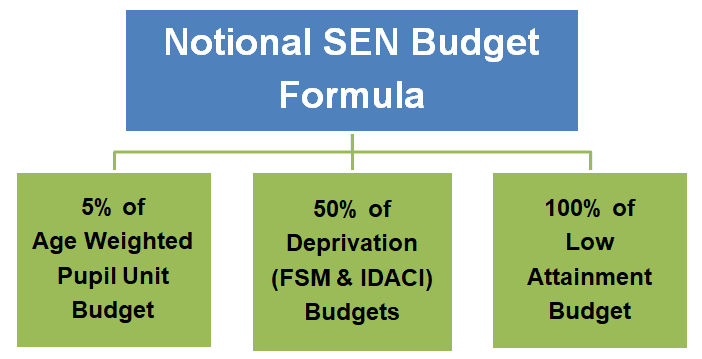
Schools, academies and free schools all have an amount identified within their overall budget, called the notional SEN budget. This is an additional amount of money to the element 1 (AWPU) which is used for SEND provision that is ‘additional to and different from’ the provision made for all pupils. This money is provided directly to schools and academies alongside their AWPU money. It is referred to as ‘notional’ because it is a suggested amount and is not ring-fenced.
The formula used in Torbay is 5% of the Age Weighted Pupil Unit (AWPU) + 50% of deprivation (Free School Meals (FSM) and Income Deprivation Affecting Children Index (IDACI)) budget +100% of the Low Attainment budget = Notional SEN Budget

Pupils with SEND have very varied needs therefore the amount of funding needed to meet these needs will be different for each pupil. The government has recommended schools use the notional SEN budget to pay for up to £6,000 worth of special educational provision to meet a child’s SEND, but the majority pupils at SEND support can have their needs met for much less than this.
Schools should use their SEND funding to pay for things like:
To find out how your child’s school use their SEND money, have a look at your child’s schools SEN Information report.
A school must use its ‘best endeavours’ [do all it possibly can] to meet the needs of pupils at SEND support using element 1 and 2 funding. School provision must be based on an ‘assess, plan, do, review’ cycle implemented in partnership with the pupil and their family. Sometimes the provision may target a pupil, but often shared provision is more preferable and meets the pupil’s needs best. For example, group work is very important when developing language and social skills.
More information about the provision that schools are expected to make for pupils at SEND support can be found in the SEND Code of Practice 0-25 p 99 – 107.
Some pupils with SEND will also be eligible for additional funding from:
This is provided from the high needs block element of the Designated Schools Grant (DGS), and is aimed mainly, though not exclusively, at pupils with Education, Health and Care plans (EHCPs).
The government expects schools, academies and free schools to have spent at least £10,000 out of their core and notional budget before this funding can be accessed.
Top-up funding is individual pupil related funding from the Local Authority from national funding called the ‘high needs block’ for children and young people with an Education Health and Care plan (EHCP) where the provision described is above the level of provision expected to be covered by Element 2 (Notional SEN Budget).
This funding is awarded on an individual basis and the amount depends on the pupil’s level and complexity of need in line with funding matrix descriptors.
An EHCP describes a pupil’s needs, agreed outcomes and required provision and the top-up funding is directly linked to these and reviewed alongside the Annual Review of the child’s EHCP.
The rest of the high needs block is used by us to fund other types of SEND support and provision. The total funding in the high needs block is spent on many different types of support. This includes:
Find out if your child is eligible for funded childcare and how to apply.
The home learning environment and early years team provide support and advice in all aspects of early years education and childcare.
We are committed to supporting professionals, parents and carers and we want to ensure that all children under five can access the ‘Best Start in Life’. To help do this we provide support, advice and training.
We are also responsible for the facilitation and administration of the early years funded childcare and you can find everything you need to know by clicking on this link to Torbay Councils Home learning environment and early years webpage.
All children are automatically entitled to the equivalent of 570 hours per year once they meet the age criteria - from the term following their 3rd birthday. This can be accessed as 15 hours per week during term time or on a more flexible basis for families who require childcare all year round e.g. 11 hours per week over 51 weeks of the year.
All children are automatically entitled to the equivalent of 570 hours per year once they meet the age criteria – from the term following their 3rd birthday. This can be accessed as 15 hours per week during term time or on a more flexible basis for families who require childcare all year round e.g. 11 hours per week over 51 weeks of the year.
Find out if your child is eligible for funded childcare and how to apply.
Working parents of three and four year olds are potentially eligible for an additional 15 hours a week childcare on top of the universal 15 hours funded childcare for three and four year olds.
Find out more about funded childcare for your child and see if your family is eligible.
Find out where you can get help and advice with your childcare costs.
Childcare Choices is a dedicated site for childcare and the options available for the free entitlements and any help or support with paying for childcare.
You can get help paying for childcare if it’s provided by a:
This is known as ‘approved childcare’.
The GOV.UK website has a useful tool to identify potential help you can access. Click here to find out more.
Information for families Electively Home Educating in Torbay
The law requires every child of statutory school age to be educated, either by regular attendance at school or, if parents choose, at home, providing the child receives an efficient full-time education suitable –
(1) to their age, ability and aptitude, and
(2) to any special educational needs they may have.
If you choose to make your own arrangements to educate your child at home you will be fully responsible. The Local Authority does not provide any assistance with examination costs, curriculum materials or additional resources. The decision to educate your child at home is a big step; it will take a considerable amount of your time, energy and money. Please read through the guidelines booklet below if you are considering elective home education.
If you decide to electively home educate and your child currently attends a school, it is important to inform the school by writing to the Headteacher.
If you are electively home educating in Torbay, please complete the voluntary registration form and return this to ehe@torbay.gov.uk. This can be downloaded by clinking on the tab below.
Download the home education voluntary registration form
Once the local authority is aware that a child is electively home educated, the EHE Team will contact parents to request information on the education at home.
Please also be aware that if you chose to electively home educate a child who already has an Education, Health and Care plan (EHCP) this will continue to be monitored and reviewed via Annual Review meetings. The health and/or social care support for a child with an EHCP should not be affected by you choosing to electively home educate your child.
Email: ehe@torbay.gov.uk
Tel No: 01803 206473 Business Support, Elective Home Education Team
Postal address: Elective Home Education Team, Torbay Education, 2nd Floor, Electric House, Castle Circus, Torquay, TQ1 3DR
EHE Lead Professional: David Bevan
Senior Head of Vulnerable Students Team: Dan Hamer
A copy of the Elective Home Education Policy and Procedures document can be requested by contacting the Elective Home Education Team.
See Home education useful websites
Torbay Council work hard to provide our customers with the best possible service. Many people wish to compliment us on what we do for example where a member of staff has been particularly helpful or polite or where a service has exceeded expectation or where a policy has resulted in great customer satisfaction. Sometimes, however, we are unable to meet our customers’ expectations, and as with compliments, when we have done something well, we use any complaints as learning points to try and improve our services. Any complaint about the Elective Home Education Team, should be through the central councils complaints procedure, which can be found at https://www.torbay.gov.uk/feedback/
We are You Can Sit With Us - a friendly space where home-educated children aged 8-14 can come together, work independently, and feel part of something special.
We are You Can Sit With Us – a friendly space where home-educated children aged 8-14 can come together, work independently, and feel part of something special.
It’s not a school, it’s not childcare – it’s something new.
We provide supervised, 3 hour sessions where children bring their individual learning materials and enjoy working alongside others in a calm, welcoming environment. Think of it like a co-working space – but for young people.
Each 3-hour session costs £15 per child. Some specialist sessions (like themed clubs or workshops) may be slightly more – these will be clearly marked in advance. There’s no minimum booking and no commitment – just book the sessions that suit your family. Sessions run in either the morning or afternoon, depending on the day and venue. Children can attend multiple sessions per week, but no child may attend more than 18 hours per week, in line with national guidance for unregistered educational settings.
Find the website here.
At South Devon College we run a very successful and popular Elective Home Education programme, which is designed to meet the needs of the home educating community in South Devon.
If your child is registered with your Local Authority as home educated and will be in school year 10 or 11 in September, you can apply for a place on our course.
Home Learning is for everyone, whatever your age or your stage. Whether you are at school or are Electively Home Educated, we hope the following information is helpful.
For further information about Elective Home Education please see Elective Home Education (EHE) – Family Hub (torbayfamilyhub.org.uk) and/or Elective Home Education – Torbay Council
Please see the sections below for resource weblinks you may find useful. All of the links for each section will be revealed if you click on the arrow.
We are aware that there are also a wide range of online forums that we have not included links to, but, that you may wish to explore yourself.
If you decide to enter your child into private examinations, you will hopefully find the following guidance helpful.
Setting up a pathway for examinations when electively home educating (EHE) is the biggest challenge for our families in Torbay, however, over the past 5 years (excluding the two COVID years!) a small number of parents have been successful in entering their children for GCSE’s.
The most important thing to arrange, in the first instance, is where a child can ‘sit’ their final examinations. A child can only ‘sit’ an examination at a registered ‘centre of examination’. Schools are registered ‘centres of Examinations’, however, very few schools offer this provision to ‘private candidates’ and your son or daughter, as an EHE child is known as a ‘private candidate’. If you wish your child to complete examinations, they will be expected to sit examinations at an accredited examination centre, in the normal way. So it is important to investigate appropriate examination centres at the earliest opportunity.
There are other centres located in Devon, these can be found on Examination Board websites. You will then need to check with the centre if they offer the course or subject you require. A list of examination boards can be found at GCSE Exam Boards (projectgcse.co.uk) You can then google each examination board to check out the examination information. For example, AQA page is found at AQA | Student and parent support | Private candidates
Transport and planning ahead are essential to ensure a successful examination takes place. I recommend discussing your requirements early with your chosen ‘examination centre’ so that late examination fees are avoided. There is no funding made available, therefore, all arrangements and costs are organised and funded by parents privately.
You will want to align the examination subject chosen, the examination board, course code and syllabus, to match any tutoring your son or daughter receives. A good quality teacher, tutor or online provision, should be able to teach to the course requirements if this is initially known in advance. Check that online schools support examinations. Most online schools, still expect parents to arrange and pay for any examinations.
Some GCSE courses are unavailable to private candidates, just because they cannot practically be achieved, such as, some GCSE Science courses which require completion of coursework and practical examinations, therefore, it is important to investigate the most popular courses that EHE children access and complete. Many families choose IGCSE courses for this reason.
It is important to discuss any arrangements with the chosen examination centre at the earliest opportunity to avoid disappointment.
These links may be useful:
It is also worth posting a request for information from the local social media EHE support groups. Often there are similar families who have already made the arrangements and are willing to assist.
When considering the use of external centres for examinations, you may find it useful to look at this list that includes centres for examinations that EHE families have used.
It is important to be aware of the following legislation when it comes to your child being involved in any employment, work placed learning or vocational experiences that may take place in work environments:
Electively Home Educated children can do work experience, but it must only be for a short period only, or it may be considered to be employment and require a work permit. Where young people are ‘Elective Home Educated’, and as part of their learning programme are involved in work experience or work environments, we recommend that you check all legislation is in place regarding health and safety, insurance and safeguarding. This is so young people of ‘Statutory School Age’, which includes all children until the last Friday in June of their final year 11 educational school year, can safely and legally take part in these learning experiences.
The Elective Home Education Team do not want to discourage wider learning activities from taking place, however, where children are involved in work related activities, as part of their wider education, ‘Child Employment Guidelines’ must be followed. These guidelines outline the activities children can participate in, and the hours that can be worked. No child is permitted to be involved in any work activities during the school day, even when they are Electively Home Educated, unless they have commenced their Year 10 academic school year. Ongoing work experience, for Electively Home Educated children is only permitted in the school day once a child has entered into Year 10 and Year 11. Where this is the case, these opportunities should complement and not hinder the overall quality of the home educational programme, so that other essential areas of learning are maintained and not pushed out.
If a child is involved in any permitted work experience or work employment, who is Electively Home Educated, the employer must obtain a ‘Child Work Permit’. This is for any child involved in these work related activities, even if this is outside of their education programme at home. An Elective Home Education Officer will be able to sign and authorise a Child Employment Permit on the agreement that the child, the employer and the parents are following the guidelines in place.
You can find out further guidance at Apply for a work permit certificate – Torbay Council where the employer can download the application, and also scroll down and click on the appropriate age, to see the activities young people are permitted to take part in.
Please remember that it is illegal for young people under 13 to work, other than in television, theatre, or modelling. Children working in these areas will need a performance licence which is issued by the local authority. Young people must also not work before 7.00am, after 7.00pm, or for more than two hours on a school day or a Sunday. They cannot do any job that may affect their health and safety or interfere with their education. Young people may also not work in any business, including the family business, without the employer notifying the local authority and obtaining a work permit.
If you would like to speak to the Local Authority Officer who oversees the Child Work Employment and Licensing in Torbay, please contact,
Email: licensing&permits@torbay.gov.uk or telephone: 01803 207588