

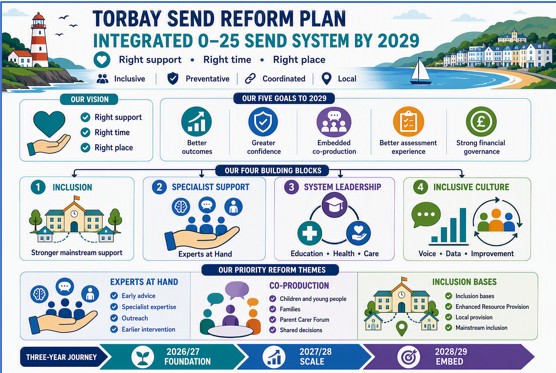
Torbay SEND Reform Plan: Integrated 0–25 SEND system by 2029
Inclusive, preventative, coordinated and local.
Our vision
Our five goals to 2029
Our four building blocks
Our priority reform themes
Experts at hand
Co-production
Inclusion bases
Three-year journey
Torbay is moving towards a fully integrated 0–25 SEND system, shifting from a reactive and fragmented model to one that is inclusive, preventative and coordinated. This reflects high levels of need linked to deprivation, health inequalities and complex family circumstances, alongside rising demand, delays in support and inconsistent family experiences.
Currently, only 35.8% of pupils with EHCPs attend mainstream settings, alongside high levels of absence and exclusions. Inconsistent delivery of the universal offer and graduated response continues to drive uneven inclusion and escalating need. Over the next three years, Torbay will strengthen Ordinarily Available Inclusive Provision (OAIP) and an effective graduated response, embed locality-based delivery and expand early intervention through the Experts at Hand offer (EaHO). These actions aim to increase mainstream inclusion, reduce reliance on out-of-area placements and ensure needs are met earlier and more effectively.
Partnership working has significantly improved following inspection and implementation of the Priority Impact Plan, with clearer governance and more aligned leadership through the SEND Board. However, historical challenges in joint working, commissioning and communication have contributed to fragmentation and delays. The ambition is a fully integrated system where parent carers, education, health and care partners operate through shared pathways, joint commissioning and locality-based delivery. This will be supported by Family Hubs, Families First and sub-regional collaboration to improve consistency and efficiency.
Workforce capacity remains a significant challenge, particularly in Educational Psychology, Speech and language therapy and wider health services. Recruitment and retention difficulties impact timeliness, quality and system resilience, while variability in practitioner confidence contributes to inconsistent early identification and reliance on referrals.
Over the next three years, Torbay will build a more confident and skilled workforce across all sectors. Priorities include strengthening SEN Co-ordinator (SENDCo)capacity, expanding multi-agency training and embedding specialist outreach through the Experts at Hand offer. This will support earlier intervention, reduce dependency on Education, Health and Care Plans (EHCPs) and enable more needs to be met within mainstream provision.
Inspection findings highlighted delays, inconsistent experiences and weak communication, contributing to low parental confidence. Although governance, data use and engagement are improving, these changes are not yet consistently experienced by families.
The next phase will focus on delivering visible improvements in key pressure areas, including EHCP timeliness, health waiting times and exclusions, alongside strengthening communication and co-production. The aim is to create a more responsive and transparent system, with clear pathways, timely support and meaningful family involvement in decision-making.
Since joining the Safety Valve Programme in 2023, Torbay has strengthened oversight of the SEND budget, placing it in a strong position for SEND reform. It has been successful in containing placements at Independent and Non-Maintained Special Schools through a targeted programme of enhancing special school enhanced provision, now the focus will be turned to strengthening mainstream provision. Financial pressures do still remain due to historically high EHCP demand and reliance on specialist provision, particularly in ASC (Autistic Spectrum Condition), SEMH (Social, Emotional, and Mental Health) and alternative provision.
Over the next three years, resources will be aligned more effectively through strategic commissioning, data-led planning and a co-produced sufficiency strategy. Investment in early intervention, inclusive mainstream practice and integrated delivery will reduce reliance on high-cost provision while improving outcomes.
Overall, financial sustainability is closely linked to system reform: a more inclusive, preventative and coordinated approach will deliver better outcomes, improved experiences and long-term value for money.
